
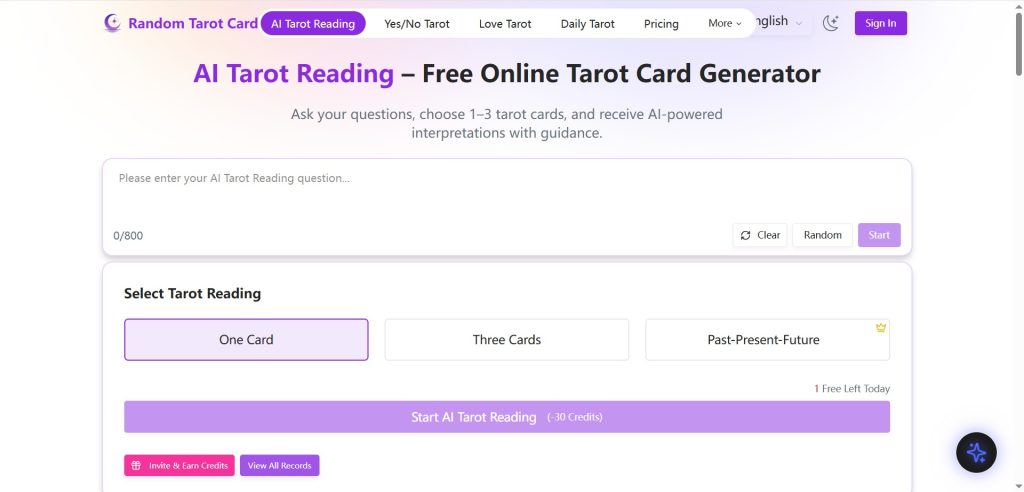
RandomTarotCard.org is an AI Tarot reading website that brings ancient wisdom into the modern age.
It combines the symbolism of traditional Tarot with the clarity of artificial intelligence to help you explore your thoughts, emotions, and life questions.Whether you’re searching for guidance, inspiration, or just a little magic in your day, our AI Tarot reader is here to help you connect with yourself on a deeper level.
✨ What you can do:
● Draw a Random Tarot Card and uncover its message.
● Ask our AI Tarot Reading for personalized insights.
● Try the Yes or No Tarot for quick, clear answers.
● Explore Love Tarot to understand your relationships.
● Discover your Daily Tarot for motivation and reflection.
● Chat with our Healing Chat AI for comfort and emotional support.
Related Posts
- How to Build a Simple “No-Code” AI Chatbot for Your Website.
- WhatsApp’s Next Big Thing: AI Lets You Design Dream Chat Wallpapers—And It’s Almost Here!
- I Tested Humbot AI to See If It Can Beat GPTZero. Here Are the Real Results
- Imagetocaption Ai
- Gaming’s AI Revolution: How Artificial Intelligence is Leveling Up the $27 Billion Gaming Industry
● Try the One Card Tarot to receive a simple, focused message that guides your next step.
Each experience is unique — just like every card.
Let intuition and technology guide you together.
💫👉 Try it now at www.randomtarotcard.org
Key Points :
What Exactly is Random Tarot Card?
If you visit randomtarotcard.org, you’ll notice something rare: simplicity.
Unlike other esoteric sites that bombard you with pop-ups about “moon phases” or “premium psychics,” this tool is a clean, straightforward generator. It uses a digital Random Number Generator (RNG) to pull from the standard 78-card Rider-Waite Smith deck.
It’s essentially a digital shuffle. But does it work?
The Setup: How to Use It (The Right Way)
Most people use these tools wrong. They click the button repeatedly like a slot machine until they get a card they like. Don’t do that.
Here is the exact method I used to get meaningful results:
- Clear the Mental Clutter: I took a deep breath.
- Frame the Question: Instead of asking “Will I get rich?”, I asked, “What should I focus on to improve my finances today?”
- Select the Spread: The tool usually offers a single card (great for focus) or a 3-card spread (Past/Present/Future).
- The Click: I clicked once. Whatever came up, I committed to analyzing it.
The “Daily Pull” Test
For seven mornings, I used the tool for a “Card of the Day.” Here is where the tool shines.
On Tuesday, I was dreading a difficult conversation with a client. I pulled the Five of Wands.
In a traditional reading, this card means conflict, competition, and hassle.
- The Tool’s Definition: It gave a concise keyword list: “Conflict, Disagreement, Struggle.”
- My Takeaway: Instead of panicking, I realized the conflict was inevitable. The card validated my anxiety. It helped me shift my mindset from “avoiding the fight” to “managing the chaos.”
This is the power of the tool. It didn’t predict the future; it gave me a lens to view my present.
The “Yes or No” Feature: A Reality Check
I also tested the tool for binary decisions. Should I skip the gym? Should I buy that expensive keyboard?
This is where you need to be careful. The tool will often give you a card and label it “Yes,” “No,” or “Maybe.”
My experience:
I asked, “Should I take on this extra project?”
- Result: The Hermit (labeled as “Maybe” or “Introspection”).
- The Insight: A simple “Yes” or “No” would have been bad advice here. The Hermit told me I needed to go inward and think about why I wanted the project. Was it for money? Or ego?
Pro Tip: Use the “Yes/No” feature not for the answer, but to check your gut reaction. If it says “No” and you feel disappointed, you actually wanted to do it.
Where the Tool Struggles (And How to Fix It)
No AI tool is perfect. Here is where a digital deck falls short compared to a physical one:
- No “Jumper” Cards: In real life, sometimes a card falls out of the deck while shuffling. That feels like fate. You don’t get that tactile accident here.
- Generic Descriptions: The text provided is standard. It won’t know you’re asking about a breakup versus a job offer.
- The Fix: Use the tool for the image, then trust your intuition for the meaning. If you pull the Two of Cups (usually romance) regarding a job, read it as “partnership” or “good contracts.”
Common Mistakes to Avoid
I browsed Reddit and Twitter to see how others use digital Tarot, and I saw the same errors over and over.
- The “Spam Clicker”: Clicking until you get a “good” card. This destroys the psychological benefit of the reading.
- The “Literalist”: Taking the description as gospel. If the card says “Death,” it almost never means physical death. It means change. The tool might not emphasize that enough, so you need to know it.
My Final Verdict
So, what’s the bottom line?
Random Tarot Card is an excellent tool for anyone who wants to bypass the ritual and get straight to the reflection. It is perfect for:
- Beginners learning the card meanings without buying a deck.
- Busy professionals needing a morning mindfulness prompt.
- Writers using it for character prompts or plot ideas.
It won’t replace my vintage cardstock deck for deep, hour-long sessions, but for a daily “vibe check”? It’s bookmarked on my browser bar.
What about you?
Have you ever felt a digital reading was weirdly accurate, or do you think it’s just random noise? Try pulling one card right now and let me know what you got in the comments below!
 Login with Google