
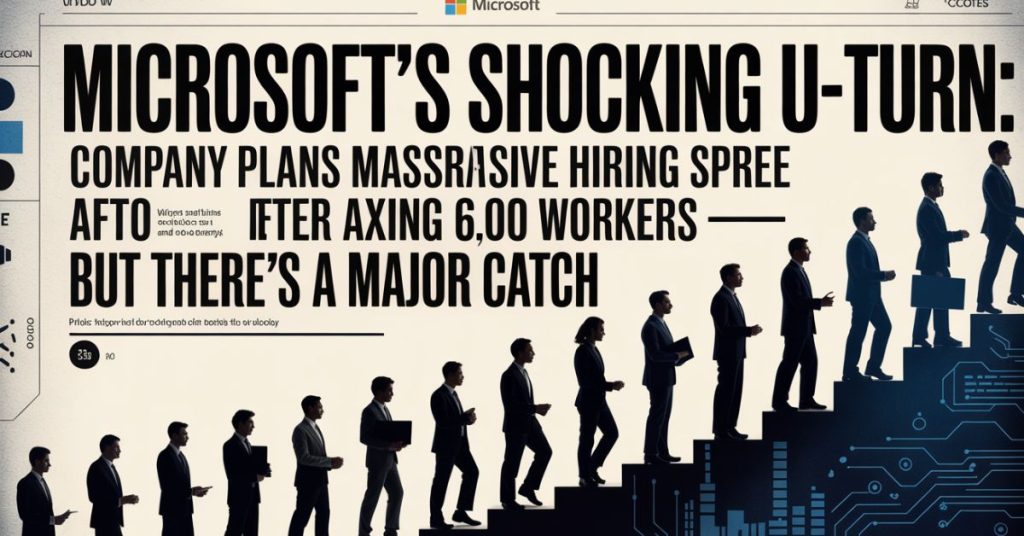
REDMOND, Washington — Just months after wielding the axe on roughly 6,000 employees, Microsoft’s CEO Satya Nadella has dropped a bombshell that’s leaving industry watchers scratching their heads: the company is ready to hire again. But here’s the twist that nobody saw coming — if you’re not an AI expert, don’t bother updating your resume.
In what some are calling either visionary leadership or a cold corporate calculation (depending on who you ask), Nadella revealed Microsoft’s controversial new playbook during a candid conversation on investor Brad Gerstner’s B2G podcast. The message was crystal clear, and frankly, a bit unsettling: Microsoft wants bodies back in the building, but only those who can dance with artificial intelligence.
The Brutal Numbers Nobody Wants to Talk About
Let’s not sugarcoat this — we’re talking about real people here. Nearly 4,000 software engineers found pink slips in their inboxes, part of a broader bloodbath that affected approximately 6,000 professionals across Microsoft’s global operations. These weren’t just numbers on a spreadsheet; these were families, mortgages, kids’ college funds, and suddenly derailed career paths.
Washington state, Microsoft’s longtime home base, bore the brunt of the devastation with over 30% of the cuts concentrated there. Imagine entire neighborhoods in the Seattle area where multiple households simultaneously lost their primary income source. Local coffee shops that relied on Microsoft badge-holders probably felt the pinch too.
When Nadella addressed shell-shocked employees back in May, he tried to soften the blow, explaining that roughly 3% of Microsoft’s total workforce was being let go. Three percent might sound manageable on paper, but tell that to the 6,000 people who had to explain to their spouses why they were coming home early on a Wednesday.
“It’s Not You, It’s AI” — The New Corporate Breakup Line
Here’s where things get interesting, and perhaps a bit more humane than typical corporate speak. Nadella was surprisingly upfront with affected workers: this wasn’t about performance. Nobody was getting fired for missing deadlines or writing buggy code. Instead, Microsoft was essentially admitting it had hired for yesterday’s problems, not tomorrow’s opportunities.
“Look, you’re great at what you do,” the subtext seemed to say, “but what you do isn’t what we need anymore.”
It’s the corporate equivalent of “it’s not you, it’s me” — except in this case, it really might be true. The company claims it’s restructuring to align with what Nadella keeps calling “evolving business priorities,” which is fancy executive talk for “AI is eating our lunch, and we need to either adapt or die.”
One former Microsoft engineer, speaking on condition of anonymity, put it bluntly to colleagues: “They’re not firing us because we’re bad. They’re firing us because we’re obsolete.”
Related Posts
Ouch.
The “Leverage” Game: Doing More With… More?
Now here’s where Nadella’s vision gets both fascinating and terrifying, depending on your perspective. During that B2G podcast appearance, he dropped a phrase that should make every tech worker pay attention: “leverage.”
“We will grow our headcount,” Nadella explained, sounding almost excited, “but that headcount will grow with a lot more leverage than what we had pre-AI.”
Translation? Microsoft plans to hire people, sure, but each new employee is expected to accomplish what might have taken an entire team before. It’s like hiring Superman when you previously employed Clark Kent — same person on paper, massively different output.
Think about that for a second. If one AI-savvy developer can do the work of five traditional programmers (thanks to AI coding assistants, automated testing, and machine learning-powered debugging), Microsoft can build the same products with a fraction of the workforce. Great for shareholders, not so great if you’re one of the four out of five who suddenly aren’t needed.
Industry analyst Maria Chen from TechInsight Research warns this isn’t just Microsoft’s game plan. “Every major tech company is running the same calculation right now,” she told reporters last week. “They’re asking themselves: how few people do we actually need if those people have AI superpowers?”
The New Gold Standard: Are You AI-Literate or AI-Illiterate?
So what exactly is Microsoft looking for in its brave new hiring push? According to multiple sources familiar with the company’s recruitment strategy, the shopping list looks something like this:
AI Systems Developers who can build, train, and refine machine learning models that integrate seamlessly into Microsoft’s massive product ecosystem — everything from Azure cloud services to Office 365 to gaming platforms.
AI Integration Specialists who can bridge the often-frustrating gap between traditional software engineering and cutting-edge AI solutions. These are the translators who help old-school systems talk to newfangled AI models.
Productivity Maximizers (my term, not theirs) who know how to leverage AI tools like GitHub Copilot, Azure AI services, and whatever Microsoft cooks up next to squeeze maximum output from every team member.
AI Innovators who can dream up applications nobody’s thought of yet. Microsoft doesn’t just want people who can use AI — they want people who can imagine entirely new ways to deploy it.
Notice what’s missing from that list? Traditional software engineering roles. Standard IT support positions. The bread-and-butter jobs that built Microsoft into the empire it is today.
The Ripple Effect: When Microsoft Sneezes, Silicon Valley Catches Cold
Microsoft isn’t operating in a vacuum here. The company’s aggressive AI pivot mirrors a broader transformation sweeping through tech giants like a Category 5 hurricane.
Amazon recently confirmed plans to slash approximately 14,000 corporate positions, with whispers in the industry suggesting total cuts could balloon to 30,000. That’s a small city’s worth of tech workers suddenly hunting for new opportunities.
Google, TCS, Accenture, Salesforce — name a major player, and they’ve probably announced “restructuring” (the corporate euphemism for layoffs) in recent months. The pattern is unmistakable: companies are shedding workers while simultaneously claiming they’re building for the future.
Adding fuel to the fire, there’s growing anxiety about potential policy changes under the Trump administration, particularly regarding H-1B visa fees. Tech companies that have long relied on international talent are suddenly facing the possibility of significantly higher costs for those workers, adding another layer of uncertainty to workforce planning.
Raj Patel, who lost his data analyst position at a major tech firm last quarter, sees the writing on the wall. “It’s not even about being good at your job anymore,” he said over coffee in Palo Alto last week. “It’s about whether an AI can do your job cheaper and faster. And honestly? For a lot of us, the answer is yes.”
The Skills Gap Nobody’s Talking About (Until Now)
Here’s the uncomfortable truth that’s keeping career counselors up at night: there’s a massive mismatch between the skills workers have and the skills companies now desperately need.
According to a recent LinkedIn analysis, job postings requiring AI expertise have surged 432% over the past 18 months, while the number of qualified candidates has only increased by about 70%. Do the math — that’s a huge gap, and it’s widening.
Dr. Jennifer Williams, a workforce development specialist at MIT, points out the cruel irony: “Many of the engineers being laid off are brilliant, experienced professionals. But they trained for a world that’s rapidly disappearing. It’s like being an expert telegraph operator in 1920 — your skills are impeccable, but the world has moved on.”
The pressure is now on workers across the industry to essentially go back to school, except there’s no clear curriculum and the technology is evolving faster than most training programs can adapt.
The Human Toll: Beyond the Headlines
Lost in all the strategic talk about AI leverage and restructuring are the very real people whose lives have been upended. Six thousand families suddenly facing uncertainty. Kids who might need to change schools. Retirement plans thrown into chaos. Dreams deferred or abandoned entirely.
Sarah Chen (not her real name), a former Microsoft program manager, described the experience: “One day you’re planning your team’s roadmap for the next quarter. The next day you’re explaining to your kids why we might need to move to a cheaper apartment. It’s surreal and devastating.”
Support groups for laid-off tech workers have sprung up across Seattle, San Francisco, and other tech hubs. Mental health professionals report increased anxiety and depression among formerly high-flying tech workers who now question their career choices.
“These were people who did everything right,” notes Dr. Marcus Thompson, a therapist specializing in career transitions. “They got the degrees, put in the hours, climbed the ladder. And now they’re being told their expertise isn’t valuable anymore. That’s psychologically devastating.”
What This Means for You (Yes, You Reading This)
If you work in tech — or aspire to — Microsoft’s strategy is a flashing red warning sign you can’t ignore. The days of coasting on traditional programming skills or standard IT knowledge are numbered.
The survival playbook looks something like this:
Get AI-literate, fast. Take courses on machine learning, familiarize yourself with large language models, learn how to prompt engineer effectively. These aren’t nice-to-have skills anymore; they’re must-haves.
Become irreplaceable by being adaptable. The workers who’ll thrive aren’t necessarily the deepest specialists, but those who can rapidly learn and apply new AI tools as they emerge.
Focus on uniquely human skills. Strategic thinking, creative problem-solving, emotional intelligence, complex negotiation — these are areas where AI still struggles. Double down on what makes you human.
Stay paranoid. In the words of former Intel CEO Andy Grove, “Only the paranoid survive.” Keep one eye on industry trends and be ready to pivot before you’re forced to.
The Bigger Picture: A Fundamental Shift
What Microsoft is doing represents more than just corporate restructuring — it’s a preview of how the entire employment landscape might transform over the next decade.
We’re potentially witnessing the end of workforce scaling as we’ve known it. For decades, growing a company meant hiring proportionally more people. Need to double output? Roughly double your workforce. That formula is breaking down.
In the AI age, growth might look completely different: same or smaller teams producing exponentially more value. It’s simultaneously exciting for companies and terrifying for workers.
Economic historian Dr. Robert Lansing draws parallels to previous industrial transformations: “We’ve been here before — the mechanization of agriculture, the automation of manufacturing. Each time, society adapted, but the transition period was brutal for displaced workers. We’re entering another one of those periods.”
The Road Ahead: Opportunity or Catastrophe?
Depending on who you ask, Microsoft’s AI-focused hiring strategy is either:
A) A brilliant evolution that will make the company more competitive, drive innovation faster, and ultimately create more value for shareholders and customers alike.
B) A short-sighted approach that undervalues human creativity, will lead to a less diverse and innovative workforce, and could backfire spectacularly when companies realize AI has limitations.
The truth? Probably somewhere in between, with a heavy dose of “we won’t know for years how this plays out.”
What’s certain is that Microsoft isn’t alone in this experiment. As other tech giants follow suit (and they will), we’re looking at a massive realignment of the tech workforce. Some workers will adapt and thrive. Others will struggle or be permanently displaced. Most will land somewhere in the middle, scrambling to keep up.
The Bottom Line
Satya Nadella’s message is both a promise and a warning. Microsoft will hire again, yes, but not the Microsoft of old. The company is betting its future on AI-augmented workers who can deliver superhuman productivity.
For the 6,000 who lost their jobs, that’s cold comfort. For the thousands who’ll be hired in the coming years, it’s an opportunity — if they have the right skills. For the rest of us watching from the sidelines, it’s a stark reminder that in the age of AI, standing still means falling behind.
The race is on, and whether you’re ready or not, the rules of the game have fundamentally changed. Microsoft has placed its bet. The question now is: are you prepared to place yours?



 Login with Google