
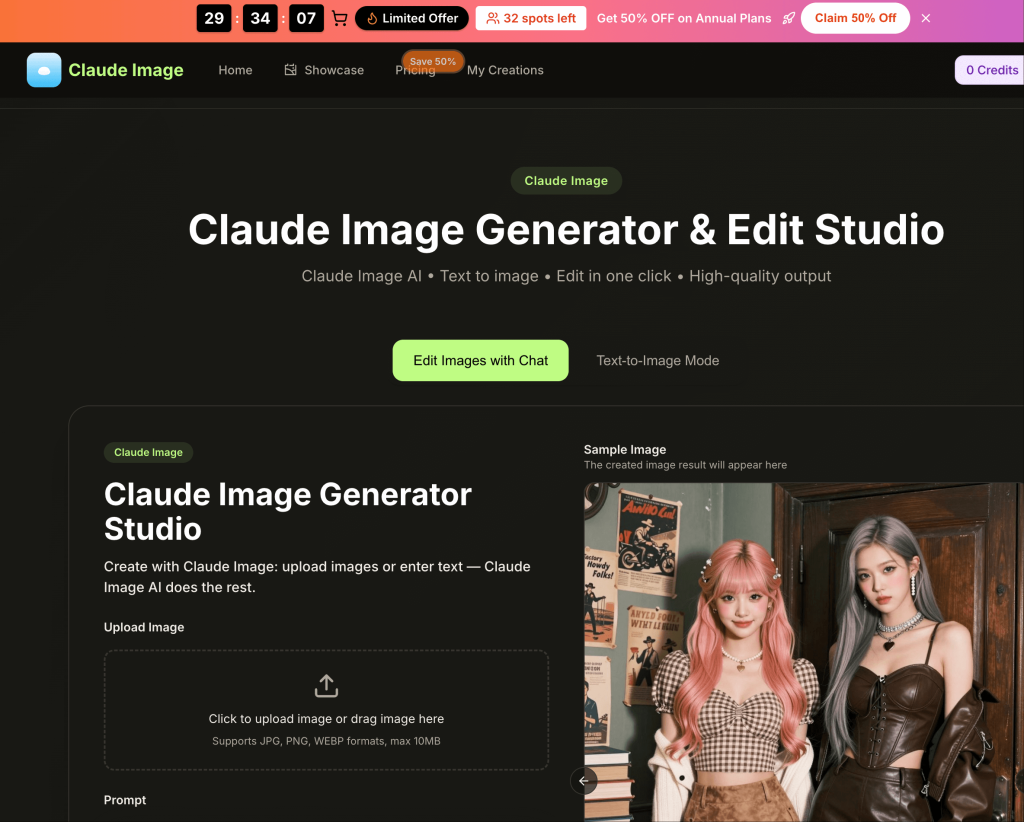

Claude Image is your free Claude Image Generator and Claude Image AI tool. Create and edit images with Claude AI Image Model online. Try Claude Image Online Free — no signup required.
Key Points :
The Core Problem: Why Do We Need “Claude” for Images?
If you’ve used Midjourney or Stable Diffusion, you know the pain: Prompting is hard.
You type “a cool cyberpunk city,” and the AI gives you generic clip art. To get professional results, you need to know camera angles, lighting terminology, and artistic styles.
This is where claude-image.app shines. It doesn’t just “make an image.” It uses Claude’s LLM (Large Language Model) capabilities to understand your intent and translate it into the language the image generator needs.
How It Works: The “Brain to Brush” Workflow
I put the tool through a specific workflow to test its capabilities. Here is exactly how to get the most out of it.
1. The Setup
The interface is clean and minimal—very similar to what we are used to with standard chat interfaces. You don’t need to navigate complex Discord servers (looking at you, Midjourney).
2. The “Lazy User” Test
I started with a deliberately bad prompt to see how much heavy lifting the AI would do.
Related Posts
- My Input: “A sad robot in the rain.”
In a standard generator, this would result in a flat, boring image. But here, the tool (leveraging Claude) likely expanded the logic behind the scenes.
The Result: The image wasn’t just “sad robot.” It had atmosphere. It had mood. This confirmed that Claude was injecting descriptive keywords (like “cinematic lighting,” “melancholic atmosphere,” “rusted texture”) that I didn’t ask for but definitely wanted.
How to Master the Tool: My 3-Step Formula
After generating about 50 images, I cracked the code on how to control this thing. Don’t just ask for an image—collaborate with it.
Step 1: Describe the “Vibe,” Not the Image
Because Claude is excellent at nuance, speak to it in abstract terms.
- Instead of: “Draw a car.”
- Try: “I want an image that feels like a 1980s Miami fast-paced chase scene. Neon, motion blur, intensity.”
Step 2: Use the “Refine” Loop
One feature I loved was the conversational ability. If the first image is wrong, you don’t have to start over.
- Correction: “That’s good, but make it look more like an oil painting and less like a photograph.”
- Since the tool maintains context, it adjusts the style without losing the subject.
Step 3: Ask Claude for the Prompt
This is a pro tip. Sometimes you might want to take your image to another tool (like Midjourney) later. You can ask this tool: “Show me the exact prompt you used to generate that image.”
It will reveal the backend text, teaching you how to write better prompts yourself.
The “Helpfulness Gap”: What Other Reviews Won’t Tell You
Most tools aren’t perfect, and I promised to be honest. Here are the quirks I found and how to fix them.
- Text Rendering: Like many AI tools, it struggles with specific text on signs or T-shirts.
- The Fix: If you need a logo or specific text, generate the image clean, then use Canva or Photoshop to add the text later. Don’t fight the AI on this.
- The “Hallucination” Factor: Occasionally, if your prompt is too complex (e.g., “A cat riding a bike while eating pizza and juggling”), Claude tries to pack too much detail in, confusing the image generator.
- The Fix: Keep your main subject clear. Focus on One Subject + One Action + One Environment.
Comparing the Titans
| Feature | Claude-Image.app | DALL-E 3 (ChatGPT) | Midjourney |
| Ease of Use | High (Conversational) | High | Low (Discord) |
| Prompt Logic | Superior (Nuanced) | Good | Requires Manual Skill |
| Realism | Very High | High | Best in Class |
| Control | Conversational | Conversational | Technical Parameters |
My Final Verdict
So, what’s the bottom line?
If you are a prompt engineering wizard who loves tweaking –cw parameters in Discord, stick with Midjourney.
But, if you are a creator, blogger, or business owner who wants professional-looking images without learning a new technical language, claude-image.app is a fantastic bridge. It allows you to use the “Claude Brain” you already trust to drive the creative process.
My Recommendation: Use it for concept art, blog headers, and mood boards. It excels at turning abstract thoughts into visual reality.
Have you tried generating images with Claude yet? Did it understand your vibe better than ChatGPT? Let me know your results in the comments below!
 Login with Google