
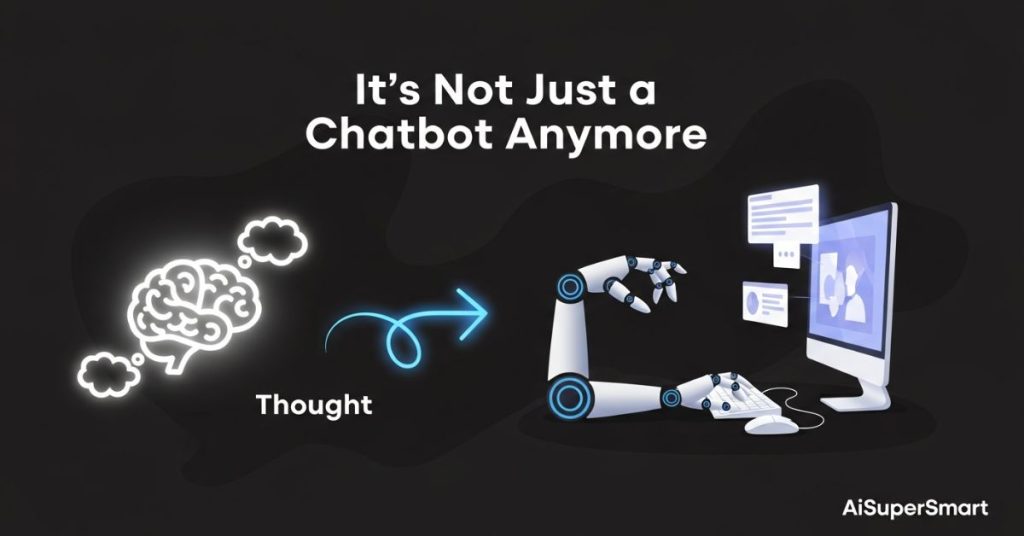
Feeling like you’re drowning in AI buzzwords? First, it was “LLMs,” then “multimodality,” and now “agentic AI” is everywhere. It felt like another complicated term I was supposed to just get. But it wasn’t until I gave one of these new AI “agents” a real job that I finally understood: this changes everything.
This isn’t just a smarter chatbot. It’s the first step towards an AI that can actually get things done for you.
[START BOX]
- What It Is, Simply: Agentic AI is an AI system that doesn’t just answer your questions—it can create a plan, take actions, learn from the results, and keep going until it achieves a goal you’ve given it.
- The Key Difference: A chatbot (like ChatGPT) gives you a recipe. An AI agent can actually go to the store, buy the ingredients, and cook the meal.
- Best Real-World Example: The Devin AI demo showed an agent acting as a software engineer—writing code, finding errors, and fixing them on its own to complete a real programming job.
- My Key Tip: The quality of the agent’s work depends entirely on the clarity of the goal you set. Be specific.
[END BOX]

So, How Does an AI “Agent” Actually Think? A Simple Analogy.
Forget the complex diagrams for a minute. Let’s use a simple analogy: planning a surprise birthday party.
If you ask a standard chatbot (like the free version of ChatGPT) for help, it will give you a great list of ideas. It might write a sample invitation, suggest a theme, and give you a checklist. You still have to do all the work.
An AI agent approaches the problem completely differently. It operates in a continuous loop, much like we do.
- Goal: You tell it, “Plan a surprise 30th birthday party for my friend Sarah in two weeks.”
- Step 1: Planning & Reasoning. The agent thinks, “Okay, to plan a party I need a guest list, a venue, a date, and a budget.” It breaks the big goal down into smaller, actionable tasks. It might create a to-do list for itself.
- Step 2: Taking Action (Using “Tools”). This is the magic part. The agent can use “tools”—which are other applications. It might start by accessing your contacts to draft a guest list. Then, it might use a web browser tool to research and check the availability of local restaurants.
- Step 3: Observing the Result. Let’s say its first venue search comes back with places that are all booked. A regular chatbot would stop. But the agent observes this result and thinks, “Okay, that didn’t work. My original plan needs to change.”
- Step 4: Self-Correction. The agent now creates a new plan. “I will expand my search radius to 10 miles. I will also check for non-traditional venues like breweries or event spaces.” It then takes a new action based on this learning.
It repeats this loop—Plan, Act, Observe, Correct—until the goal is achieved. It’s this ability to operate autonomously, learn from feedback, and stick with a problem that makes it “agentic.”

I Tried It: Asking an Agent to Plan a Weekend Trip
To see this in action, I used a framework that simulates an AI agent. My goal for it was: “Find me the best 3-day weekend hiking trip from my city for under $400, including travel and lodging.”
Here’s a simplified look at what it did.

Step 1: Breaking Down the Goal
First, it didn’t just search. It laid out its plan, which looked something like this:
- Identify the user’s home city (it asked me).
- Search for hiking destinations within a 4-hour drive.
- For each destination, find 3-5 top-rated trails.
- Research budget-friendly lodging (motels, cabins) near those trails.
- Estimate fuel costs.
- Combine findings into three distinct itineraries.
This initial plan was its roadmap. A standard AI would have just given me a list of parks. The agent created a multi-step project for itself.
Step 2: Hitting a Snag (And Fixing It)
The agent started by searching for “best hiking near [My City].” It got a bunch of blog posts, which weren’t very helpful for finding lodging.
This is where I saw the “agent” part kick in. I watched its log as it recognized the problem. It wrote a note to itself: “Initial search results are too broad. Need to search for specific state parks or national forests first, then find lodging nearby.”
It then changed its own plan and executed a new, more specific search. It was impressive because I didn’t have to guide it.
The Final Results: Good, But Not Perfect
After about 10 minutes of working, it produced three solid options in a document. Each included the destination, a link to a specific highly-rated trail, a link to a budget motel on Google Maps, and an estimated cost breakdown.
The result was about 80% of what I needed. The lodging it found was a bit generic, and it didn’t really capture the “vibe” I might have wanted. But, it did all the tedious research in minutes—work that would have taken me at least an hour.
So, Is This the Same as AGI?
No, not even close. And it’s a crucial distinction.

- Agentic AI is about autonomously achieving specific, narrow goals within a defined set of rules and tools. My trip planner can’t suddenly decide to learn physics.
- AGI (Artificial General Intelligence) is the hypothetical future AI with human-like intelligence that can understand, learn, and apply its knowledge to a wide range of different tasks, just like a person can.
Think of agentic AI as a highly skilled, incredibly fast intern. AGI would be like a seasoned expert who can do any job you throw at them. We are still a very, very long way from AGI. For more on this, I found this breakdown from AI researcher Andrew Ng to be a great source of clarity.
My Final Verdict: What’s the Bottom Line?
Agentic AI isn’t just another buzzword. It’s a fundamental shift from AI that knows things to AI that does things.
For now, these agents are still a bit clunky. They make mistakes and are best suited for digital tasks that involve research, planning, and summarizing. Don’t expect one to file your taxes for you just yet.
But the progress is happening incredibly fast. The difference between a tool that can write an email and an agent that can manage your entire inbox, schedule meetings based on the content, and archive everything automatically is profound. That’s the future agentic AI is pointing toward. My advice? Start playing with it now.
What’s the first task you would give to a personal AI agent? Share your ideas in the comments below




 Login with Google