
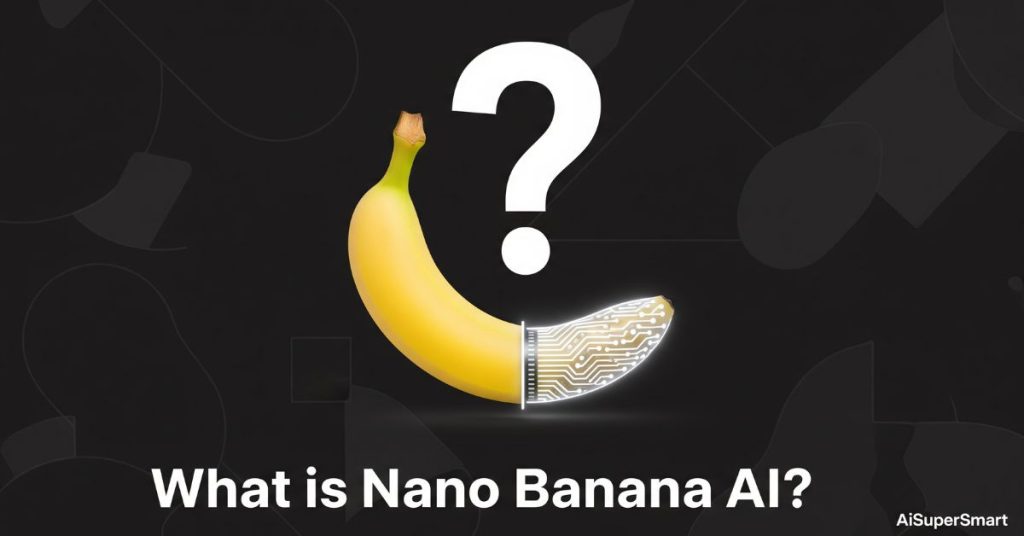
Have you ever seen a weird tech term online like “nano banana ai” and wondered if you missed the memo on some groundbreaking new technology? I did too, and it sent me on a quest for answers. After digging through confusing articles and strange search results, I’m here to tell you what’s really going on.
[START BOX]
- The Short Answer: “Nano Banana AI” is not a real, specific AI tool or technology. It appears to be a nonsensical phrase that has gained some traction online.
- What It Might Mean: People are likely confusing or combining two separate, real topics: AI in Nanotechnology (creating tiny, molecule-sized machines) and AI in Agriculture (like using computer vision to monitor banana crops).
- The Fun Part: You can, however, use AI image generators to create some wild and fascinating pictures of what a “nano banana” might actually look like.[END BOX]
First Off, Let’s Be Clear: “Nano Banana AI” Isn’t a Real Thing
Let me save you some time: you can stop searching for a product or company called “Nano Banana AI.” It doesn’t exist. My research suggests the term is likely a product of internet randomness, automated content farms generating nonsensical keyword combinations, or perhaps just a funny phrase someone coined that got picked up by search algorithms.

So, if it’s not real, why do you see search results for it? This often happens when automated bots or low-quality content websites generate articles based on trending search queries, even if the queries themselves are nonsensical. This creates a confusing loop where the existence of articles makes the term seem real.
But the good news is, the concepts behind the phrase are very real and incredibly interesting.
So, What Were You Probably Looking For?
It’s likely you landed on this term because you were curious about one of two very different, but equally fascinating, fields.
Option 1: The “Nano” Part – AI in Nanotechnology
The “nano” in “nano banana” almost certainly refers to nanotechnology, which is the science of building things at an atomic and molecular scale. Think of microscopic robots or materials with unique properties.

So, how does AI fit in?
- Design & Simulation: AI can design and simulate new nanomaterials and tiny machines way faster than a human could. This helps scientists predict how these tiny structures will behave before they ever try to build them.
- Robotics Control: AI algorithms are being developed to control swarms of nanobots, potentially for tasks like delivering medicine directly to cancer cells inside the body.
This is the kind of technology that feels like science fiction, but it’s happening right now. Researchers are constantly exploring how AI can accelerate discoveries in this field.
Option 2: The “Banana” Part – AI in Agriculture
The “banana” part is less abstract. AI is making a huge impact on farming, including the cultivation of bananas.

Farmers and researchers use AI for several key tasks:
- Disease Detection: AI-powered drones and cameras can scan entire fields, identifying signs of diseases like Panama disease in banana plants long before a human eye could catch them.
- Yield Estimation: AI models can analyze images of banana bunches to accurately count and estimate the future yield of a harvest.
- Automated Harvesting: Companies are developing robots that use computer vision to identify ripe bananas and harvest them without human intervention.
So, while there’s no “nano banana ai,” there absolutely is AI being used to make banana farming more efficient and sustainable.
I Used AI to Create the “Nano Banana”—Here’s What Happened
I couldn’t resist. I had to see what an AI would imagine if I asked it to create the “nano banana.” I decided to use an AI image generator to bring this fictional concept to life.

Step 1: Choosing the Right AI Image Tool
For this, I used DALL-E 3 because it’s great at interpreting creative and unusual text prompts. The goal was to see how it would blend the concepts of “nanotechnology” and “banana.”
Step 2: Writing the Perfect Prompt
A simple prompt like “nano banana” would be too vague. I needed to give the AI more direction. I landed on a more descriptive prompt to get interesting results.
Here’s the prompt I used: “Photorealistic image of a banana that has been bio-engineered with nanotechnology, glowing circuits and intricate microscopic machinery are visible under the peel, cinematic lighting, macro shot.”
Step 3: The Results – The Good, The Bad, and The Weird
The results were fascinating. The AI came up with a few different interpretations, showing just how creative these tools can be.
One version showed a banana with a peel that looked like a circuit board. Another depicted a banana that was semi-transparent, revealing tiny, complex machinery inside. My favorite was one that looked like a regular banana at first glance, but a macro view showed tiny robots working on its surface.
This little experiment proves that even though “nano banana ai” isn’t a real technology, it’s a fantastic creative prompt that pushes the boundaries of what AI can visualize.
My Final Verdict Is…
The “nano banana ai” isn’t the next big thing in tech you need to worry about missing out on. It’s a phantom, a ghost in the machine of search algorithms and internet weirdness.
But it’s also a perfect, accidental gateway into two of the most exciting frontiers in science and technology: the incredibly small world of nanotechnology and the incredibly practical world of AI-powered agriculture. My advice? Forget the “nano banana” and dive into the real-world applications that inspired the name.
If you’re interested in the mind-bending potential of tiny machines, start reading up on AI in nanotechnology. If the idea of technology helping to feed the world excites you, look into how AI is transforming modern farming.
What’s the weirdest AI term you’ve come across? Share it in the comments below




 Login with Google