
SHANGHAI — The gloves are off.
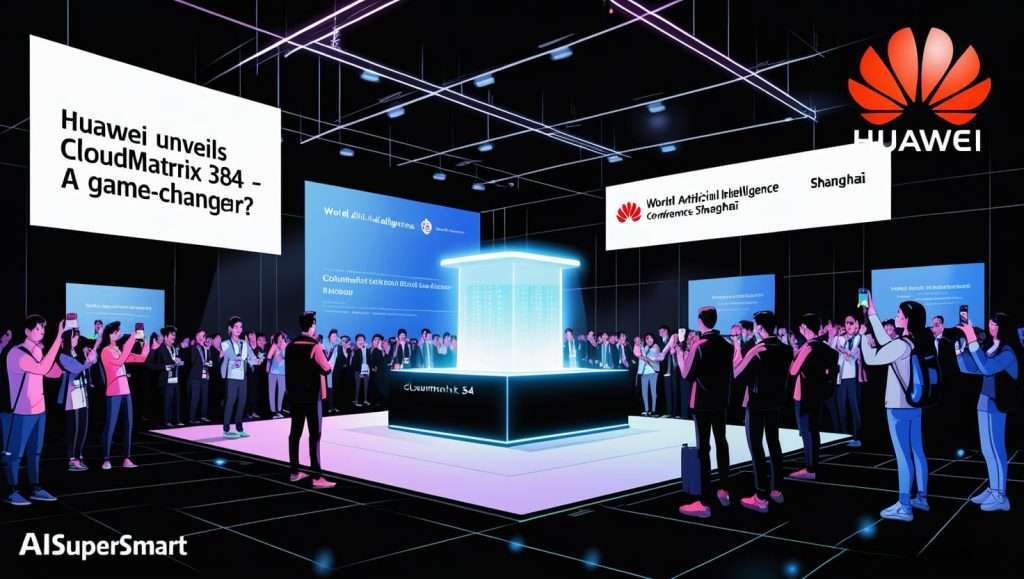
Huawei, China’s most prominent tech powerhouse, just took a bold swing at Nvidia—America’s AI chip titan. In a dramatic display at the World Artificial Intelligence Conference (WAIC) in Shanghai, Huawei revealed its latest heavyweight: the CloudMatrix 384, a next-gen AI computing system that analysts say could go toe-to-toe with Nvidia’s best-in-class GB200 NVL72.
It’s not just another product launch. It’s a message. And it’s loud.
As tensions between China and the U.S. remain high over technology exports and semiconductor development, Huawei’s public debut of the CloudMatrix 384 is being seen by many as a defiant statement of intent. The company, once crippled by U.S. sanctions, is not only standing—it’s sprinting forward.
A Crowded Booth, a Bold Reveal
At the three-day WAIC event in Shanghai, a sea of visitors swarmed Huawei’s booth, all eyes drawn to a sleek, humming machine on display: the CloudMatrix 384.
While the Huawei staff kept their lips sealed—declining to explain the system or offer interviews—it didn’t stop the buzz. Industry insiders, AI researchers, and curious onlookers huddled around, snapping photos and whispering comparisons to Nvidia’s top-tier computing system.
This was more than a product unveiling. It felt like a power move.
What is the CloudMatrix 384?
Huawei’s CloudMatrix 384 is a supercharged AI computing system, built with 384 of its homegrown Ascend 910C chips. It’s part of a growing trend in AI infrastructure where the battle is no longer just about who has the fastest chip, but who can scale performance more intelligently at the system level.
Nvidia’s GB200 NVL72—the current crown jewel in its AI arsenal—uses 72 powerful B200 chips. On paper, Nvidia’s chips pack more punch individually. But Huawei’s strategy? Outnumber and outmaneuver.

Instead of betting on sheer chip strength, Huawei plays the systems engineering game, connecting hundreds of its chips via a unique “supernode” architecture—an intricate web of high-speed interconnections that let the system work as a single, powerful brain.
And it works. According to SemiAnalysis, a respected semiconductor research firm, the CloudMatrix 384 outperforms Nvidia’s GB200 NVL72 in several key areas, especially when it comes to training massive AI models or running demanding inference workloads.
Analysts Are Watching Closely
Back in April, Dylan Patel, founder of SemiAnalysis, wrote a head-turning report: Huawei now has the system-level capabilities to beat Nvidia.
That’s a massive claim in the world of AI computing. Nvidia’s hardware powers nearly every major AI model—from OpenAI’s GPT to Google’s Gemini. To suggest Huawei could surpass it was borderline unthinkable just a few years ago.
Even Nvidia CEO Jensen Huang tipped his hat in May, telling Bloomberg that Huawei was “moving quite fast,” calling out the CloudMatrix system as a key example.
Let’s not forget: Huawei is operating under strict U.S. export restrictions, limiting its access to advanced chipmaking tools and Western software. And yet—here it is, building AI supercomputers that threaten Nvidia’s throne.
If that’s not impressive, what is?
Behind the Hardware: The Big Picture
The story here isn’t just about chips. It’s about geopolitics, national strategy, and the global race for AI supremacy.
Huawei’s AI ambitions are part of China’s broader push to become self-reliant in high-tech sectors, especially semiconductors. With U.S. sanctions squeezing access to Nvidia chips and other advanced tools, Chinese firms have poured money into domestic alternatives.
Huawei, already a global leader in 5G and telecom, has quietly built out its AI portfolio—from chips (like the Ascend 910C) to data centers and cloud services. The CloudMatrix 384 is the culmination of years of this groundwork.
Its use of the “supernode” architecture is especially critical. It lets Huawei bypass the need for bleeding-edge chips by focusing on smart interconnects and efficient system design. It’s like using teamwork to beat raw strength.
As of June, the CloudMatrix 384 is already operational on Huawei’s own cloud platform, according to Zhang Pingan, CEO of Huawei Cloud. That means it’s not just a prototype—it’s live, it’s real, and it’s already powering services.
What Does This Mean for Nvidia—and the World?
Nvidia has long been the undisputed champion of AI computing. Its chips are the brains behind ChatGPT, Midjourney, Anthropic, and more. Its stock has skyrocketed. It’s become the face of the AI boom.
But Huawei’s move changes the dynamics.
In China’s domestic market, where U.S. companies like Nvidia face export bans and policy hurdles, Huawei is in prime position to capture massive market share. The demand for AI compute in China is exploding—startups, universities, and tech giants all need powerful AI servers.

With the CloudMatrix 384, Huawei is now offering a credible, scalable, and locally made alternative.
Globally, Huawei may not dethrone Nvidia overnight—but this marks the beginning of a real challenge. For years, Nvidia has dominated without serious rivals in AI systems. That era may be ending.
The Road Ahead: Cloud Wars, AI Arms Race
AI isn’t just a trend—it’s a transformation. Every nation, every company is racing to build bigger models, train them faster, and deploy them smarter. This requires enormous computing power—something only a few companies in the world can deliver.
Huawei just proved it’s one of them.
Expect more. More AI chips. More cloud infrastructure. More geopolitical friction. And more headlines like this one.
Huawei’s CloudMatrix 384 is not just a machine. It’s a signal.
A signal that the AI race is now a two-horse race, not one.
Final Thoughts: From Sanctions to Spotlight
Three years ago, Huawei was on the ropes. U.S. sanctions blocked its access to Google apps, advanced chips, and global markets. Tech analysts predicted a slow decline.
But instead of folding, Huawei retooled, refocused, and rebounded.
Now it’s back on the global stage, not with smartphones or 5G towers—but with AI supercomputers.
It’s the kind of comeback story that feels more like a movie than real life.
And it’s just getting started.
Stay tuned—because Huawei just rebooted the AI war. And the next chapter could change everything.

 Login with Google