
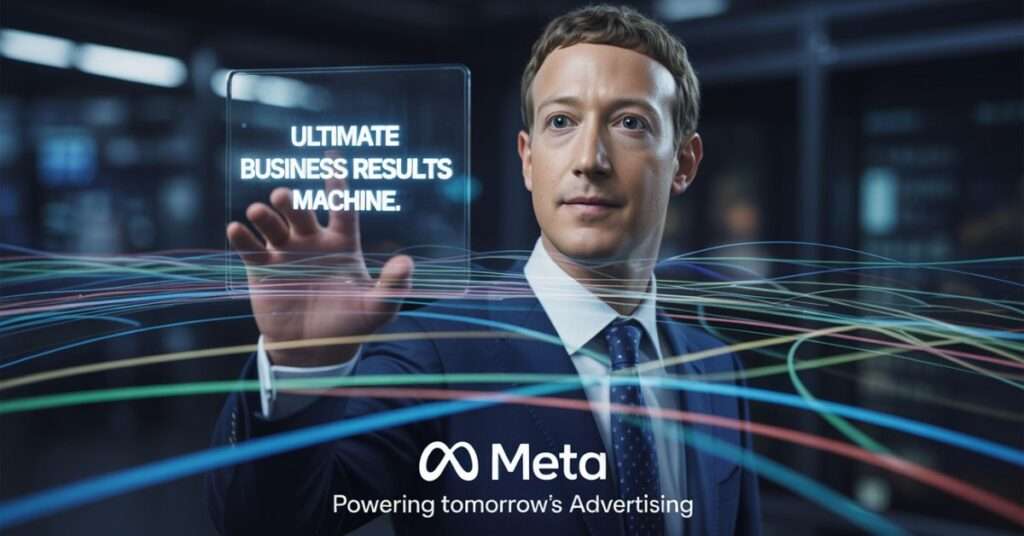
SAN FRANCISCO – In a move that could fundamentally reshape how businesses advertise online, Meta CEO Mark Zuckerberg has unveiled ambitious plans for what he’s calling the “ultimate business results machine” – an AI-powered system designed to automate virtually every aspect of digital advertising from creation to delivery.
Speaking to a packed audience at Stripe’s Sessions conference in San Francisco yesterday, Zuckerberg outlined a future where advertisers may never need to design an ad again. Instead, they would simply connect their bank accounts, state their objectives, set a budget, and let Meta’s AI handle everything else.
“The basic end goal here is any business can come to us, say what their objective is — we get new customers to do this thing, or sell these things — tell us how much they’re willing to pay to achieve those results, connect their bank account, and then we just deliver as many results as we can,” Zuckerberg explained, gesturing enthusiastically as he paced across the stage.
4,000 Ad Variations: Users Become Testing Grounds
Perhaps the most striking – and potentially controversial – aspect of this new system is how it would optimize advertising. Zuckerberg revealed that Meta’s AI would generate and test thousands of ad variations simultaneously.
“We’re gonna be able to come up with, like, 4,000 different versions of your creative and just test them and figure out which one works best,” said Zuckerberg, seemingly unfazed by the implications of flooding user feeds with test advertisements.
This approach would essentially transform Meta’s platforms – Facebook, Instagram, and Threads – into massive testing laboratories for AI-generated content, with users unknowingly participating in what amounts to the largest A/B testing experiment in advertising history.
Building on Existing Technology
This isn’t entirely new territory for Meta, which has already integrated generative AI capabilities into its current advertising tools. What’s different is the scale and comprehensive nature of what Zuckerberg is proposing.
The Meta CEO first hinted at this vision last week during an appearance on Ben Thompson’s Stratechery podcast, where he introduced the concept of an end-to-end AI advertising system. Yesterday’s announcement provided more concrete details about how such a system would function.

According to Zuckerberg, Meta’s current ad tools are already so sophisticated that the company doesn’t even recommend customers specify target demographics anymore. “Meta’s tools can find interested users better than human marketers can,” he claimed, suggesting that AI-driven targeting has already surpassed human capabilities.
Industry Disruption or Evolution?
The announcement has sent ripples through the advertising industry, raising questions about the future role of creative agencies and marketing professionals.
“This isn’t just another tool in the advertiser’s toolkit – this is potentially a complete reimagining of the advertising ecosystem,” said Samantha Rodriguez, digital strategy director at Global Marketing Partners, who attended the conference. “If it works as described, it could significantly reduce the need for traditional campaign planning and creative development.”
Zuckerberg himself acknowledged that creative ad agencies would continue to exist but suggested smaller businesses might bypass the creative process entirely, letting Meta’s AI handle everything from conception to delivery.
“For small businesses who don’t have marketing departments, this could level the playing field,” Rodriguez added. “But it raises serious questions about creative quality and brand differentiation when everyone’s using the same AI system.”
User Experience Concerns Mount
While businesses might welcome these automated tools, questions remain about how users will respond to platforms increasingly populated by AI-generated advertisements.
Meta’s platforms are already experimenting with AI-generated images and comments in feeds, as well as AI chatbots users can interact with. The company recently launched a social portal and dedicated app spotlighting generative AI content. Adding thousands of AI-generated test advertisements could significantly alter the user experience.
Consumer advocacy groups have expressed concern about the direction Meta is taking. “At what point does a social platform stop being social?” asked Jeremy Lin, director of the Digital Consumer Rights Coalition. “If users are primarily interacting with AI-generated content – including advertisements – rather than content from friends, family, and brands they choose to follow, that fundamentally changes what these platforms are.”
Lin added that transparency would be crucial. “Will users know when they’re being shown one of these 4,000 test advertisements? Will they have any choice in the matter?”
Creative Industry Pushback
The advertising industry itself has shown mixed reactions to Meta’s vision. There’s been significant pushback against generative AI in creative fields, with over 11,000 creators signing an open letter in October 2024 condemning the use of human-generated art to train AI systems.
Several creators have filed lawsuits against companies developing AI art tools like Midjourney and Stability AI, arguing that these systems were trained on copyrighted work without permission.
Not everyone in the industry shares these concerns, however. Johnny Hornby, founder of ad agency The&Partnership, published an op-ed yesterday arguing that creating successful branding campaigns remains a uniquely human task. “AI can optimize and iterate, but it can’t understand human emotion and cultural nuance the way creative professionals can,” Hornby wrote.
The Black Box Concern
Privacy advocates and marketing ethicists have raised concerns about the “black box” nature of Meta’s proposed system. With AI making all decisions about who sees which advertisements, there could be limited transparency into how these decisions are made.
“When you have an AI system creating thousands of ad variations and then deciding who sees what, you risk reinforcing existing biases or creating new problematic patterns that even Meta might not be aware of,” explained Dr. Maya Patel, professor of marketing ethics at Stanford University.
“Without proper oversight and transparency, we could see advertisements that unintentionally target vulnerable populations or exploit psychological triggers that humans might have filtered out,” Patel added.
Financial Implications
For Meta, the financial implications of this new advertising approach could be substantial. The company derived approximately 98% of its revenue from advertising in 2024, according to its annual report.
Wall Street analysts have responded positively to Zuckerberg’s announcement. Meta’s stock rose 3.2% in morning trading following the conference, with several analysts upgrading their price targets.
“If Meta can deliver on this vision, it potentially creates an even stronger moat around their advertising business,” said Thomas Chen, tech analyst at Morgan Stanley. “Advertisers would become even more dependent on Meta’s proprietary AI systems, potentially increasing both ad spend and platform lock-in.”
What’s Next
Zuckerberg didn’t provide a specific timeline for when this “ultimate business results machine” would be fully operational, but he described it as “one of the most important and valuable AI systems that gets built.”
As Meta continues to develop these capabilities, users can expect to see an increasing number of AI-generated advertisements appearing in their feeds, optimized in real-time based on engagement metrics.
For the advertising industry, this potentially shifts the value proposition from creative development and demographic targeting to simply defining objectives and budgets – a fundamental change that could reshape the industry for years to come.
Whether users and advertisers embrace or reject this AI-driven future remains to be seen, but one thing is clear: Mark Zuckerberg is betting big on artificial intelligence to drive Meta’s next phase of growth in the advertising space.




 Login with Google