
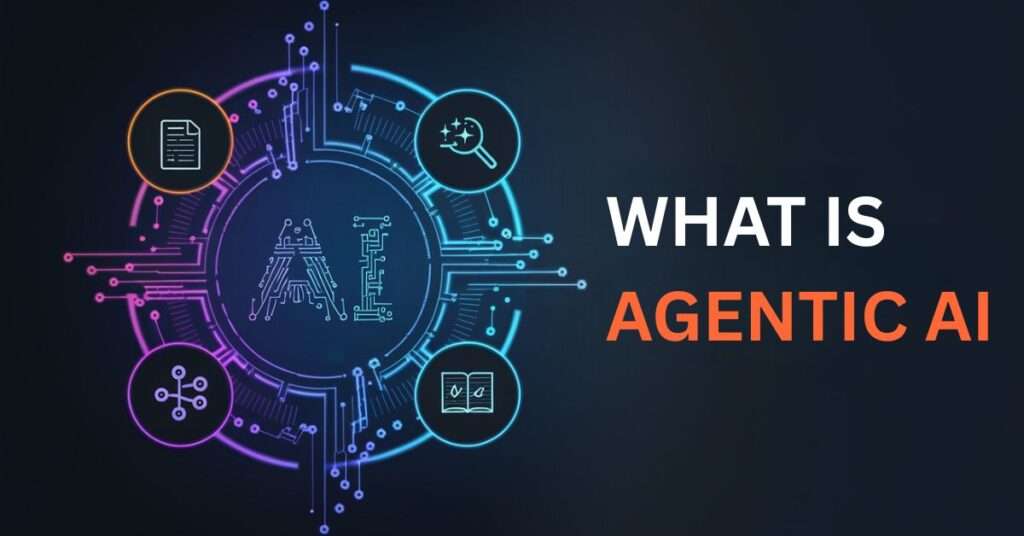
Agentic AI systems are like digital assistants or intelligent agents that don’t need constant human supervision: it senses your needs, reasons through goals, acts on its own (booking travel, managing workflows, you name it), and learns from every outcome. By 2028, experts expect these smart agents to handle nearly 15% of routine business decisions, supercharging efficiency across industries. In this guide, you’ll discover what Agentic AI is, how it works, real-world uses, benefits and pitfalls, and step-by-step advice to bring it into your organization.
What is Agentic AI?
At its core, Agentic AI refers to AI systems that can automatically make decisions and take actions to achieve goals, without constant human input. These systems go beyond simple chatbots or rule-based automation. They are often built on large language models (LLMs) or other machine learning engines that give them reasoning abilities. Unlike a traditional AI that only generates text or predictions on request, agentic AI is proactive and goal-oriented. It works with a purpose: for example, an agent might be given the goal “plan a trip” and then autonomously survey flight and hotel data, make bookings, and adjust the plan if things change.
Agentic AI systems share four key characteristics:
- Autonomy: They can act with minimal human guidance. For instance, an AI planner might independently arrange meetings by scanning everyone’s calendars and picking the best slots. They don’t just produce an answer when prompted; they initiate actions toward a goal.
- Adaptability: They respond dynamically to new information or changing conditions. If a delivery robot encounters unexpected traffic, an adaptive agent could reroute itself without being reprogrammed.
- Goal-focused: Every action is directed toward a target objective. For example, an AI marketing agent might work towards the goal of increasing engagement and will choose which content to post based on that aim.
- Continuous Learning: They improve over time. By analyzing feedback and outcomes, the system refines its strategies. For instance, an AI writing assistant can learn a user’s style from edits and write more naturally in future drafts.
These traits set agentic AI apart from other AI types. Generative AI (like GPT-4) focuses on creating content in response to prompts (writing text, generating images, etc.), but it only responds passively to user commands. Predictive AI analyzes historical data to forecast outcomes (like demand or risk). Agentic AI, in contrast, autonomously decides what to do next and then does it. You can think of generative AI as a creative tool, predictive AI as an oracle, and agentic AI as an independent worker that plans and executes tasks.
Behind the scenes, agentic AI is powered by a blend of advanced technologies: Large Language Models (LLMs) for reasoning and language understanding; machine learning (ML), often including reinforcement learning (RL), for adapting behavior; natural language processing (NLP) to interpret instructions; and knowledge retrieval methods. For example, Retrieval-Augmented Generation (RAG) is commonly used so the agent can pull in real-world data from documents or databases when needed. The agent’s “brain” might consist of an LLM with memory and planning modules. In summary, an agentic AI system combines AI components so it can perceive, think, act, and learn on its own – much like a mini autonomous organization with its own goals.
How Does Agentic AI Work?
Agentic AI operates in a continuous loop of Perceive → Reason → Act → Learn. First, the agent perceives its environment by gathering data: this could be text from a user, sensor readings, images, or any relevant inputs. Next, it reasons about the best way to achieve its goal, often using an LLM or planning algorithm as its “brain”. The agent then acts, which means it uses tools, APIs, or even robotic actuators to carry out steps (for example, it might call a scheduling API or send an email). Finally, it learns by observing the outcome and adjusting its approach over time. This entire cycle lets the agent tackle complex, multi-step tasks that a simple prompt-response system couldn’t handle.

Imagine a friendly AI travel planner that learns your preferences, scouts the best flights and hotels, and books them for you—then tweaks the itinerary if prices or schedules change. Under the hood, it uses an LLM with short‑ and long‑term memory to break your trip into manageable steps and call the right APIs. A retrieval layer (RAG) keeps its data fresh, so it always pulls in the latest information rather than relying on old training alone.
In practice, an agentic system might use components like knowledge graphs or vector stores for memory, LLM embeddings for understanding queries, and planning algorithms (e.g. PDDL or task networks) to sequence actions. Integration frameworks such as LangChain, AutoGPT, or custom orchestration layers help glue these pieces together. The result is a sophisticated workflow: the agent continuously observes, plans, executes, and adapts. This loop enables it to handle real-world challenges – for instance, if a new situation arises, the adaptability lets the agent change its plan on-the-fly (much like a human would), rather than sticking to rigid rules.
Real-World Applications
Agentic AI is already finding real uses across many fields. Businesses and researchers are experimenting with autonomous agents everywhere. Some illustrative applications include:
- Healthcare: AI agents can monitor patient data and provide alerts. For example, in assisted living, an AI “virtual caregiver” agent can chat with seniors, remind them about medication, and call for help if needed. In diagnostics, agents analyze medical images and lab results to suggest possible conditions and next steps. IBM also points to use cases like personalized treatment planning and remote patient monitoring powered by agents. These agents enhance doctors’ work by filtering information and spotting issues faster.
- Finance: Autonomous AI advisors can manage portfolios and detect fraud. In banking, agents autonomously analyze transactions in real time and flag anomalies for suspicious activity. They also help with tasks like loan processing – automatically reviewing applications and supporting decisions (see Loan Processing in Banking in the figure). High-frequency trading is another agentic domain: trading bots continuously adjust strategies based on market conditions without human input.
- Customer Service: Many companies use agentic AI in chatbots and help desks. Advanced virtual assistants can independently resolve complex queries by pulling from knowledge bases, scheduling actions (like resetting passwords or issuing refunds), and even engaging in multi-turn conversations that adapt to user emotions. One telecom example is Elisa, which built an agentic support bot that helps handle customer issues end-to-end. Gartner even predicts that by 2029, AI will solve 80% of common service issues with no human help.
- Education: Agentic AI enables adaptive learning platforms and tutoring systems. An AI tutor can assess a student’s performance in real time, personalize lesson plans, and give instant feedback on assignments. For instance, platforms like Duolingo are exploring AI agents that automatically adjust course difficulty to each learner’s progress (as the Hyperight article notes). Grading automation is another use: agents can autonomously evaluate essays and provide feedback, freeing teachers to focus on coaching.
- Manufacturing & Supply Chain: Smart factories use agentic AI for predictive maintenance and quality control. AI agents continuously monitor equipment via IoT sensors and schedule maintenance before breakdowns. On the production line, computer-vision agents inspect every item, catching tiny defects humans might miss. Agents also optimize supply chains: they forecast demand, autonomously adjust inventories, and re-route shipments in response to delays. For example, an autonomous supply-chain specialist agent might continuously rebalance stock levels across a network of warehouses.
- Other Fields: Agentic AI appears in insurance (automating claim processing), smart homes (intelligent energy and security management), retail (dynamic pricing and inventory agents), and more. The figure below highlights a few common use cases across sectors.

These examples show the breadth of agentic AI. In every case, the AI agent is doing work end-to-end: it gathers data, reasons, takes actions (e.g. making purchases, sending alerts, optimizing a process), and then continues learning from outcomes. As one HBR summary puts it, think of agents that “plan your next trip overseas and make all the arrangements; [act as] humanlike bots that act as virtual caregivers for the elderly; or AI-powered supply-chain specialists that optimize inventories on the fly”. All of these autonomous agents are powered by the core agentic AI technologies and can operate around the clock, driving real value in the real world.
Benefits of Agentic AI
When implemented well, agentic AI delivers major productivity and innovation gains. Key benefits include:
- Greater Productivity & Efficiency: By delegating routine and multi-step tasks to AI agents, employees are freed to focus on strategic work. Glide notes that agentic AI “handles repetitive tasks… relieving employees of labor-intensive work” so teams can tackle higher-value projects. For example, an agent can automatically update databases, send follow-ups, or sort data 24/7 with no break.
- Better Decision-Making: Agents continuously process real-time data and apply complex logic, so decisions are faster and more informed. Because they “work with current information… making decisions or suggesting actions based on what’s happening right now”, they eliminate delays of manual data gathering. This leads to smarter choices – whether it’s adjusting marketing strategies on the fly or rerouting shipments when traffic changes.
- Personalization & Responsiveness: Agentic AI enables highly personalized experiences. Agents can learn individual preferences and context to tailor actions in real time. For instance, agents could autonomously curate a user’s schedule, adapt learning content to a student’s needs, or dynamically adjust an app’s behavior based on user mood. As one analysis puts it, agentic AI delivers “hyper-relevant recommendations, content, or solutions tailored to individual preferences”, raising the bar for personalization.
- Innovation Acceleration: With AI agents handling routine tasks, organizations can innovate faster. They can prototype new ideas quickly by deploying agents for experimentation. Multi-agent collaboration (agents working in teams) opens up possibilities too: agents can brainstorm and test scenarios among themselves, which can lead to novel solutions. Glide’s guide also highlights that multiple AI agents can coordinate, “creating more efficient, interconnected workflows across your organization”. In short, agentic AI not only speeds up existing work but also enables entirely new capabilities – from autonomous labs experimenting with compounds to software bots co-developing products.
- Scalability: AI agents can scale effortlessly with growth. Unlike human teams, adding more workload doesn’t require hiring more people; you simply deploy additional agents or expand their capacity. Glide notes that agentic systems “can manage increasing amounts of data and automate more tasks to grow alongside your business”. This means an autonomous AI-driven process won’t hit a bottleneck as demand surges – the agents keep running and learning.
Overall, agentic AI transforms data-to-action. ThoughtSpot observed that these agents make information “more actionable and intuitive than ever”, bridging the gap between insights and actions in real time. In plain terms, your business moves faster: insights lead directly to automated actions. The bottom line is higher productivity, better outcomes, and new innovation opportunities.
Risks and Ethical Considerations
While agentic AI offers big upside, it also raises important risks and ethical issues that must be managed. Key concerns include:
- Bias and Fairness: Agentic AI systems learn from data, and if that data contains biases, the agents can perpetuate discrimination. For example, an agent hiring assistant might favor certain demographics if trained on biased hiring data. LexisNexis and others warn that these agents “can inherit and perpetuate biases present in their training data”. Because agents adapt and learn over time, hidden biases can become even harder to detect. It is crucial to actively audit and mitigate bias – for instance, by using diverse, representative datasets and building fairness checks into the system.
- Accountability and Explainability: When AI makes autonomous decisions, it’s not always clear how those decisions were reached. This “black box” nature makes accountability tricky. If an agent causes a problem (say, it makes an incorrect trade or misdiagnoses a condition), who is responsible – the developer, the user, or the AI? Current legal frameworks aren’t fully equipped for this. Ethical guides stress the need for transparency so humans can understand agentic decisions. Techniques like explainable AI, clear logging of decisions, and keeping humans in the loop are important safeguards. Businesses should define governance structures (e.g. oversight committees or regulatory compliance teams) to clarify responsibility.
- Privacy and Security: Agentic AI often handles sensitive data and can automate decisions that affect individuals. This raises privacy issues. For example, a personal health agent has access to medical records, or a customer service agent sees personal info. Safeguarding data is critical. Systems must comply with privacy laws (like GDPR) and use security best practices. In high-stakes domains (like healthcare or legal), extra caution is needed to ensure agents don’t leak or misuse private information.
- Job Displacement: Automating tasks can change job roles. It’s natural to worry that AI agents will replace workers. Indeed, autonomous agents could take over some routine jobs (e.g. data entry clerks or simple analysts). However, experts emphasize planning for this transition. LexisNexis notes that businesses should consider how to support employees as roles evolve. In practice, agentic AI often augments human work rather than eliminating it: people can shift to more creative, interpersonal, or supervisory tasks. Still, organizations should invest in retraining and communicate clearly with staff to mitigate fear and disruption.
- Safety and Control: Highly autonomous systems pose safety risks if they behave unpredictably. For example, an agent managing a power grid must have fail-safes to prevent cascades. Best practices here include setting strict bounds on agent actions, continuous monitoring, and “kill switches” to shut down misbehaving agents. Ethical frameworks (such as IEEE’s AI ethics guidelines) recommend extensive testing and scenario analysis. Building in a human-in-the-loop (where significant decisions require approval) can also ensure safe operation.
Best Practices: To address these concerns, companies should follow AI governance standards and ethical guidelines. This includes conducting bias audits, maintaining transparent records of agent decisions, enforcing data privacy, and establishing accountability (who audits and approves the agent’s actions). Regularly monitoring agents in operation – with logs and performance checks – is vital. Also, start with low-risk pilot projects, learn from them, and scale up gradually. By embedding ethics from the start (for example, diverse development teams and external reviews), businesses can harness agentic AI while minimizing harm.
How to Implement Agentic AI in Your Business
Implementing agentic AI is a multi-step journey. Below is a practical roadmap – think of it as how to implement agentic AI in business – plus some tools and platforms to use.
- Identify Use Cases & Goals: Start by pinpointing tasks or processes that would benefit most from autonomy. Good candidates are multi-step workflows or decision chains that are currently manual or involve multiple systems. Define clear objectives (e.g. “reduce average customer inquiry handling time by 50%”). As Gartner suggests, look for processes that consume human attention routinely.
- Gather and Prepare Data: Agentic AI needs data – not only for training but also to operate. Assemble relevant datasets, knowledge bases, or APIs. For example, a sales agent might need access to CRM and product catalogs. Clean and organize the data so the agent can retrieve and use it. If using an LLM, prepare any fine-tuning data for domain-specific language. Also, plan how the agent will access live data (RAG connections, sensor feeds, etc.).
- Design the Agent Architecture: Choose the core AI models and components. Will you use an LLM (e.g. GPT-4, Gemini) as the “brain”? You may include reinforcement learning modules or rule-based filters. Determine what tools (APIs, scripts, RPA bots, robotic arms) the agent will call. For complex tasks, you might design multiple specialized agents (a multi-agent system) that collaborate. Reference architectures can help: for instance, NVIDIA’s AI Blueprints show how to integrate LLMs (NVIDIA NeMo) with retrieval (NIM) and planning in one pipeline.
- Prototype & Develop: Build a proof-of-concept agent. Use frameworks like LangChain, Azure AI Orchestrator, or OpenAI’s function-calling to connect your LLM with the chosen tools. You can leverage no-code/low-code platforms: for example, UiPath Agent Builder provides a drag-and-drop environment to create AI agents. NVIDIA also offers AI Blueprints – prebuilt templates for common agents (e.g. PDF summarizer or virtual assistant) that you can customize. IBM’s watsonx Orchestrate includes an “orchestrator agent” for enterprise workflows, which orchestrates multiple AI steps autonomously. These platforms accelerate development.
- Test Thoroughly: Before full rollout, simulate the agent’s environment and test it with a variety of scenarios. Check for correctness, bias, and unexpected behavior. Gather feedback from pilot users. Implement human-in-the-loop controls initially, so supervisors can intervene. Validate that the agent’s decisions meet legal and ethical standards (for example, review privacy compliance and fairness metrics).
- Deploy & Monitor: Launch the agent in production, ideally in a limited scope at first. Set up monitoring dashboards to track performance (accuracy, speed, error rates). Use logging to audit decisions. Continuously collect data on the agent’s actions so you can retrain or adjust it. Remember to update the agent’s knowledge sources (via RAG) regularly so it stays current.
- Iterate and Scale: Use the monitoring insights to refine the agent. Over time, train it on new data, tweak its goals, and expand its capabilities. Once stable, replicate the solution in other departments or processes. Also consider creating multiple agents that coordinate: one agent might gather data, another might plan, and a third might execute, all working together as a system.
Practical Checklist: As you implement agentic AI, ensure you: define clear objectives; involve stakeholders early (especially for data governance and ethics review); pick the right platform (e.g. NVIDIA AI Blueprints for enterprise, UiPath Agent Builder for RPA-rich environments, or cloud AI services); prepare robust data pipelines; embed monitoring/metrics from day one; and plan for security. By following these steps and leveraging modern AI tooling, you can embed autonomous agents into your business processes safely and effectively.
Future Trends
Agentic AI is still evolving. In the next decade, we expect several major trends:
- Robotics Integration: As robotics matures, agentic AI will power more autonomous machines. We’re already seeing factory robots guided by AI agents that adapt to changes on the line. In the coming years, autonomous vehicles (drones, delivery robots, self-driving cars) will use agentic algorithms to make real-time navigation and logistics decisions. Imagine delivery bots that coordinate routes and recharge themselves, or warehouse robots that self-organize to optimize packing.
- Smart Cities & IoT: AI agents will be woven into urban infrastructure. Traffic management could be controlled by a network of traffic-light agents that autonomously smooth congestion. Energy grids might use agentic systems to balance renewable supply and demand in real time. Essentially, every “smart” device – from home thermostats to city streetlights – could have embedded agents collaborating for efficiency and safety.
- Multi-Agent Ecosystems: Rather than single, monolithic agents, we’ll see large-scale multi-agent systems. Different specialized agents (e.g. a finance agent, a compliance agent, an operations agent) will work together to solve complex tasks. Advances in multi-agent coordination and communication protocols will enable these ecosystems. For example, a self-driving car could be one agent in a network that negotiates traffic flow with other cars and city sensors.
- Fusion with Generative AI: Agentic AI will increasingly integrate generative models. For instance, GPT-style models will be used within agents for creative problem-solving and human-like interaction, while the agentic layer handles decision loops. We’re already seeing “generative agentic” products on the rise – combining LLM content creation with planning. This could mean more agents that not only act but also generate useful content or hypotheses as part of their workflow.
- Advanced Personal Assistants: Expect more human-like AI assistants that proactively manage your digital life. These agents will not only answer questions, but take initiative – scheduling meetings, optimizing your finances, or even managing simple daily tasks without a prompt. They’ll maintain a model of user preferences (privacy-protected) and anticipate needs.
- Ethical and Governance Maturation: As agentic AI spreads, regulations and standards will tighten. We anticipate frameworks (like those emerging in the EU) that specifically address autonomous AI liability and safety. Businesses will need to comply with emerging “AI Act” style rules and industry-specific guidelines. This will be an ongoing challenge: keeping up with new laws around AI accountability, auditing, and fairness.
In short, agentic AI’s future is expansive but also complex. The technology will become embedded in everything from deep space probes and exploration rovers to your personal virtual assistant at home. The big challenge will be ensuring these powerful agents remain aligned with human values and objectives. As Hyperight notes, we’ll need continued innovation in areas like AI safety, federated learning (to protect privacy), and multi-agent ethics to guide this growth. Businesses that stay abreast of these trends – and invest in upskilling teams now – will be best positioned to capitalize on the next wave of autonomous intelligence.
FAQ
How is Agentic AI different from Generative AI or Predictive AI?
Generative AI (e.g. ChatGPT or DALL·E) focuses on creating new content based on a prompt. Predictive AI uses data to forecast trends or outcomes. Agentic AI, by contrast, makes decisions and takes actions autonomously to achieve goals. In other words, generative AI waits for a user request to generate text or images, while agentic AI actively runs workflows and uses tools on its own.
Is Agentic AI safe and trustworthy?
Agentic AI can be safe when designed and governed responsibly. Like all AI, it can have issues (bias, errors, security). Best practices include building in oversight – for example, having humans review high-stakes decisions – and using explainable models so you understand why an agent did something. Rigorous testing, privacy safeguards, and alignment checks are crucial. By applying AI ethics frameworks and continuously monitoring agents, companies can mitigate risks and build trust.
How do I start implementing Agentic AI in my organization?
Begin with a clear business goal. Choose a manageable project (e.g. automating customer queries or scheduling). Use available tools: for instance, NVIDIA AI Blueprints provide templates for common agents, making it easy to “build and deploy custom AI agents”. UiPath Agent Builder offers a low-code interface for designing and testing agents. IBM watsonx Orchestrate has an “orchestrator agent” feature for complex workflows. Combine these with open frameworks (like LangChain or RAG pipelines) as needed. The main steps are data preparation, model selection, prototyping, and iterative testing with user feedback.
How do Agentic AI systems make decisions?
They follow a loop of perception, reasoning, and action. An agent uses sensors or data inputs to understand the situation, then an LLM or planning module figures out steps (often break down the problem into sub-tasks), then the agent calls tools or APIs to carry out those steps. For example, an agent might “plan” an email response using an LLM, then send it via an email API. Its decisions are guided by predefined goals and continuously refined by feedback and learning.
Can you give examples of Agentic AI in action?
Sure. Picture an AI travel agent that autonomously books your flights and hotels, adjusting plans if prices change; or a virtual caregiver bot that checks in on elderly patients and alerts nurses if health data is off, as discussed in HBR. In business, examples include insurance agents that automatically process claims, or retail agents that manage inventory levels dynamically. The telecom bot “Elisa” mentioned above is a real case: it autonomously handles customer support tickets from start to finish. All these agents sense information, decide on actions, and act without someone at the keyboard.
What are the main risks of Agentic AI?
The big risks are bias, accountability, privacy, and job impact. Agents learn from data, so they can pick up biases (e.g. favoring certain groups). Their autonomy raises accountability questions – we need clear policies on who is responsible if an agent errs. Because they handle a lot of data, security and privacy (especially for personal or sensitive info) are vital concerns. And finally, organizations must consider workforce impacts and plan for reskilling. By proactively addressing these issues (ethical design, transparency, regulations, human oversight), companies can reap agentic AI’s benefits while minimizing harm.
Conclusion
Agentic AI represents the next frontier of autonomous intelligence. Unlike earlier AI, these agents can take initiative, execute complex plans, and learn on their own, bringing unprecedented efficiency and innovation potential. We’ve defined agentic AI and shown how it works (the perceive-reason-act-learn loop), and seen its impact across industries – from virtual caregivers in healthcare to smart factories in manufacturing. The benefits are clear: higher productivity, better decision-making, and personalized experiences, all at scale.
However, these powerful systems also demand responsible use. Bias mitigation, human-in-the-loop checks, and robust governance are non-negotiable. With careful design and ethical safeguards, agentic AI can free your team for higher-value work, drive growth, and unlock new capabilities. The era of autonomous AI is here – and your business can be part of it. Get started today: explore a small pilot project, experiment with an agentic AI platform (like NVIDIA Blueprints or UiPath), and build your organization’s AI expertise. The future of intelligence is autonomous, and it’s within our reach.


 Login with Google