
Introduction
- Relatable Hook: I’ll start with the common frustration of spending hours on a blog post only for it to get limited reach.
- Key Takeaways Box: This will summarize the main benefits and tools.
Conclusion:
A direct concluding thought, actionable advice, and an engaging question.
Let’s start writing!# I Turned 1 Blog Post into 10 Human-Sounding Social Posts with AI: Here’s My Step-by-Step Workflow
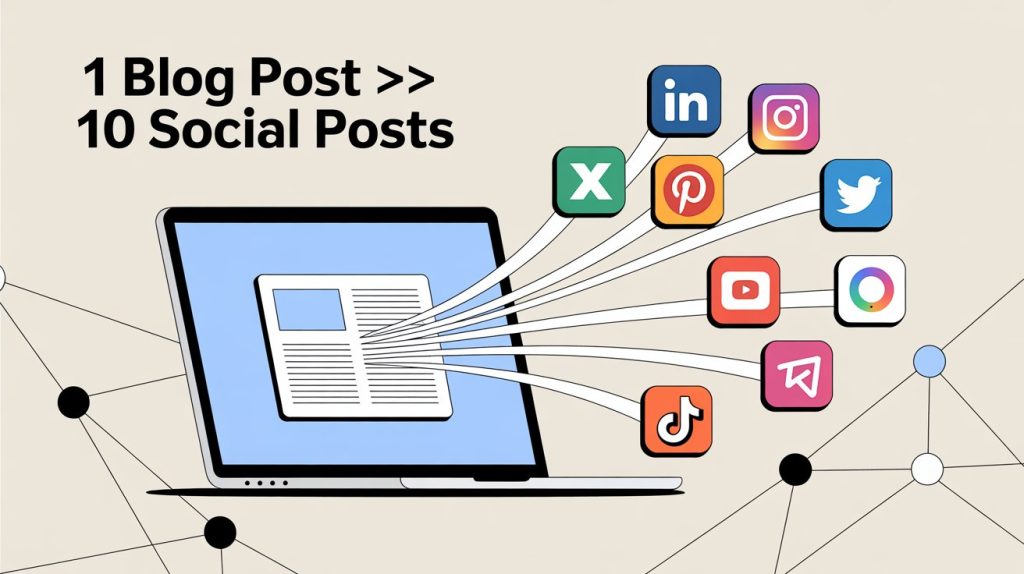
Ever poured your heart and soul into a killer blog post, only to watch its reach dwindle after a few days? I’ve been there, staring at a published article, wondering how to give it a second, third, or tenth life without spending another full day crafting social media content. That’s exactly why I dug deep into how AI can genuinely help, and I’m stoked to share my workflow for transforming one blog post into ten distinct, engaging social media posts.
Key Takeaways for Turning 1 Blog Post into 10 Social Posts with AI:
- Best AI Strategy: Use AI as a smart assistant for drafting and idea generation, never for a final, unedited output.
- My Go-To Tools: ChatGPT (for versatility and drafting), Claude (for nuanced rephrasing), and a dash of Canva for visual ideation.
- My Key Tip: Always start with a strong “persona” and “tone” instruction in your prompts, and provide examples of your own writing to train the AI to sound like you.
- Biggest Time-Saver: Breaking down the blog into core themes and angles before generating platform-specific content.
The Repurposing Headache: Why Your Blog Posts Need a Social Media Makeover
For years, I’d publish a blog post, share it a couple of times on social, and then… crickets. It felt like I was constantly on a content treadmill, churning out new articles while older, valuable pieces gathered digital dust. My biggest frustration was knowing that my audience hung out on LinkedIn, X, Instagram, and Facebook, but I just didn’t have the bandwidth to tailor every single idea from a long-form article for each platform.
The problem, as I quickly learned, is that simply sharing a link to your blog post with a generic “Read my new article!” caption just doesn’t cut it anymore. That’s the “post and pray” method, and it rarely delivers the engagement and traffic we’re all hoping for.
The power of content atomization – breaking down a larger piece of content into smaller, digestible, and platform-specific nuggets – is undeniable. It’s about maximizing the value of your effort and ensuring your message reaches people where they already are, in the format they prefer. But doing it manually? Whew, that’s a job in itself.
Beyond Basic Summaries: My “Human-First” Approach to AI Repurposing
Here’s the deal: I’ve seen a lot of AI-generated social media content, and honestly, a lot of it sounds… well, robotic. It’s bland, generic, and screams “AI wrote this!” That’s a huge turn-off for audiences and can actually hurt your brand’s credibility. The goal isn’t just more content, it’s more effective, human-sounding content.
My philosophy has always been this: AI is your super-smart assistant, not a replacement for your brain. I use it for the heavy lifting of drafting, brainstorming, and rephrasing, but I retain full creative control and apply the crucial human touch. Think of it like having an incredibly fast intern who needs clear direction and a meticulous editor (that’s you!) to refine their work.
For this guide, I’m going to walk you through how I repurposed one of my own recent blog posts about “The Future of AI in Marketing: Trends You Can’t Ignore” into 10 distinct social media posts.
Phase 1: Breaking Down Your Blog Post (The AI Pre-Game)
Before I even think about specific social platforms, I feed my blog post into an AI (I usually start with ChatGPT or Claude) to help me dissect its core. This saves me so much time and ensures I don’t miss any valuable angles.
Step 1: Extracting Core Themes and Key Insights
I start by asking the AI to act like a content strategist and pull out the main ideas.
Here’s a prompt I’d use:
“Hey AI, act as a content strategist. I’m giving you a blog post. Your first task is to read it thoroughly and then extract 5-7 core themes or key insights. For each theme, identify the single most important takeaway.
Blog Post: [Paste your entire blog post here]”
I find that by giving the AI a persona (“content strategist”) and a clear goal, the output is much more focused and useful. This step helps me see the forest and the trees in my own content.

Step 2: Identifying Potential Social Angles & Hook Ideas
Once I have the core themes, I go a step further. I ask the AI to brainstorm different angles for each theme, imagining how they might resonate on social media. I’m looking for “hooks” that grab attention.
Here’s a follow-up prompt:
“Great! Now, for each of the 5-7 core themes you identified, give me 3-4 distinct social media angles. Think about different ways to frame the topic:
- A provocative question
- A surprising statistic or fact
- An actionable tip or ‘how-to’
- A contrarian opinion or myth-busting statement
- A call for discussion/community input
Keep each angle to a single sentence.”
This step is critical for avoiding repetitive posts. I want 10 distinct posts, not just 10 summaries of the same point.

Phase 2: Crafting 10 Distinct Social Media Posts (The Nitty-Gritty Workflow)
Now that I have my themes and angles, it’s time to create the actual posts. I generally use ChatGPT (GPT-4 for its creative prowess) as my primary drafting tool, occasionally switching to Claude for more nuanced or longer-form rephrasing if I feel the ChatGPT output is too stiff.
My AI Tool Stack (Why I Chose Them)
- ChatGPT (Plus/Pro): It’s my workhorse. Excellent for generating initial drafts, brainstorming, and adapting content for different tones. Its strength lies in its versatility.
- Claude: I often turn to Claude when I need something to sound a bit more natural, less “list-y,” or if I’m struggling with a block of text that feels too formal. It has a great ability to infuse a more conversational flow.
- Canva (Magic Write / Visual Ideation): While not a text generator for posts, I use Canva’s AI-powered features for brainstorming visual concepts or quickly drafting short, punchy copy directly within a design.
Let’s get to the 10 posts!
Post 1: The “Big Idea” LinkedIn Post (Professional & Thought-Provoking)
LinkedIn is all about professional insights and thought leadership. I pick one of the broader themes from my blog, like “AI’s Role in Hyper-Personalization,” and ask AI to craft a detailed, value-driven post.
Here’s a prompt I’d use, feeding it the specific theme and takeaway:
“Using the core theme ‘[Hyper-Personalization]’ and the takeaway ‘[AI is making 1:1 marketing scalable for the first time],’ draft a LinkedIn post that is:
- Professional, but engaging.
- Around 150-200 words.
- Includes a strong hook, explains the ‘why’ and ‘how,’ and offers a clear call to action (e.g., ‘What are your thoughts?’).
- Suggest 3-5 relevant hashtags.
- Adopt the persona of a friendly, knowledgeable expert (like my blog’s tone).“
I then review the output. I always edit for flow, add personal anecdotes, and ensure my voice shines through.

Post 2-3: The Twitter/X Thread (Punchy & Scannable)
X (formerly Twitter) thrives on concise, impactful statements and threads. I choose 2-3 key points or a series of actionable tips from my blog to break down.
My prompt often looks like this:
“From the blog post about ‘The Future of AI in Marketing,’ create a 5-tweet X/Twitter thread focused on the theme of ‘[Ethical AI in Marketing].’
- Each tweet should be punchy, max 280 characters.
- The first tweet should be a strong hook.
- The last tweet should have a clear call to action and encourage engagement.
- Use relevant hashtags for each tweet, but don’t overdo it.
- Make sure it sounds like a human sharing insights, not a bot regurgitating facts.“
I usually ask for slightly more tweets than I need, then pick the best ones and fine-tune them. Sometimes I’ll ask the AI to rephrase a tweet to be more “controversial” or “question-based.”

Post 4-5: Instagram Carousel Concepts (Visual & Bite-Sized)
Instagram is all about visuals and quick, scannable information. I’ll pick 3-5 key learnings from a section of my blog and ask AI to help me structure them for a carousel. I use AI for the “slides” content and the caption.
“From the section of the blog post discussing ‘[AI-Powered Content Creation],’ generate 5 short, impactful takeaways suitable for an Instagram carousel.
- For each takeaway, provide a 1-sentence ‘slide title’ and a 2-3 sentence ‘explanation.’
- Then, draft a compelling Instagram caption (around 100-150 words) that introduces the carousel, uses emojis, and includes 5-7 relevant hashtags.
- Bonus: Suggest a simple visual concept for each slide (e.g., ‘Chart icon,’ ‘Lightbulb with gears’).”
I love the visual concept bonus – it helps me quickly brief my designer or even create something basic in Canva myself.

Post 6-7: Facebook Discussion Starter (Community & Engagement Focused)
Facebook is a great place to foster community and discussion. I’ll take a thought-provoking question or a common challenge from my blog and turn it into a conversation starter.
“Based on the blog post’s point about ‘[AI Overwhelm and Tool Fatigue],’ draft a Facebook post designed to spark discussion.
- Start with a relatable question or a personal observation.
- Keep it concise (100-120 words).
- Use a friendly, conversational tone.
- Include 2-3 relevant hashtags and an emoji or two.
- End with an open-ended question to encourage comments.”
Facebook audiences appreciate a more relaxed, conversational tone, so I make sure to explicitly ask for that.

Post 8: The “Quick Tip” Pinterest Pin Description (Actionable & Searchable)
Pinterest is a visual search engine, so pins need actionable tips and keyword-rich descriptions. I pick one super-specific, actionable tip from my blog.
“From the blog post, extract one clear, actionable tip related to ‘[Leveraging AI for SEO].’
- Write a Pinterest pin description (150-200 characters) that summarizes this tip.
- Include 3-5 relevant keywords/hashtags for searchability (e.g., #AISolutions, #SEOTips, #DigitalMarketing).
- Make it enticing so people click through to the blog for more.”
This is all about getting straight to the point and providing immediate value.

Post 9: YouTube Short Script Idea (Engaging & Short-Form Video)
Even if I’m not a video creator, getting an AI to draft a 30-second script helps me think visually and concisely. I pick a compelling statistic or a surprising revelation from the blog.
“From the blog post’s discussion on ‘[The Rise of Generative AI in Marketing],’ create a 30-second YouTube Short script.
- Include a strong hook (first 3 seconds).
- Present a problem or surprising fact.
- Offer a quick solution or insight from the blog.
- End with a call to action to learn more (e.g., ‘Link in bio for the full story!’).
- Suggest very brief visual cues.”
I’ve found this helpful for even just creating audiograms or simple animated text videos.

Post 10: Quora Answer (Value-Driven & Authoritative)
Quora is fantastic for establishing expertise, but you can’t just drop a link. People want real answers. I identify a common question that my blog post answers and have AI craft a thorough, helpful response.
“Find a common question related to ‘[Measuring AI ROI in Marketing]’ that my blog post addresses. Draft a comprehensive Quora answer (200-300 words) that:
- Directly answers the question.
- Extracts key points and examples from the blog post without just copying and pasting.
- Offers genuine value and actionable advice.
- Includes a soft call to action to read the full blog post if they want more depth.
- Ensure it sounds like a human expert patiently explaining, avoiding generic AI phrasing.“
Adding a personal touch here is key, as Reddit users often complain about generic AI answers on Quora. I’ll make sure to inject my own voice during the editing phase.

My Top Tips for Getting Non-Robotic AI Output (Learned the Hard Way!)
I won’t lie, my first few attempts at AI content repurposing sounded like they were written by a very polite but uninspired robot. Over time, I’ve honed my approach.
The Power of Specificity: “I Want It to Sound Like THIS…”
The most important lesson I learned is that you have to tell the AI exactly how you want it to sound. If you want it to sound like you, give it examples of your writing. My go-to prompt addition now is: “Adopt the persona of a friendly, knowledgeable expert (like my blog’s tone). Avoid corporate jargon and keep it conversational.” Sometimes, I’ll even paste a paragraph of my own blog post and say, “Match this tone.”
Iteration is Your Best Friend: Don’t Settle for the First Draft
Rarely is the first output perfect. I treat AI like a junior writer. I’ll prompt, review, then prompt again: “Make this punchier,” “Add a question at the end,” “Can you rephrase this to be more empathetic?” The more you refine, the better the output gets.
The Human Edit is Non-Negotiable (Addressing Hallucinations & Blandness)
This is perhaps the most crucial tip. Every single piece of AI-generated content needs a human review and edit. Not just for grammar, but for accuracy (AI does hallucinate!), for brand voice, and to inject that unique human spark that connects with your audience. I promise you, taking 5-10 minutes to edit each post will make all the difference.
Don’t Forget the Visuals! (AI for Image Prompts)
While the focus here is text, remember social media is highly visual. I often ask AI to suggest image ideas or even generate image prompts for tools like Midjourney or DALL-E based on the social post’s content. “Give me 3 descriptive image prompts for a post about ‘ethical AI in marketing,’ focusing on a futuristic, trustworthy aesthetic.”
Common Mistakes I’ve Seen (And How to Avoid Them)
From my own trials and errors and seeing what trips others up, here are a few pitfalls to dodge:

- Posting Identical Content Everywhere: This is the easiest way to make your content look spammy and your audience tune out. Each platform has its own rhythm and audience expectations. Customize, customize, customize!
- Over-Automating Too Soon: While automation tools are cool, trying to automate the entire process from day one often leads to generic, low-quality output. Master the manual/semi-manual AI process first, then look for smart ways to automate specific, repetitive tasks.
- Forgetting Your Audience: It’s easy to get caught up in the AI’s output and forget who you’re actually talking to. Always ask yourself: “Will my audience find this valuable and engaging?” If the answer is “meh,” go back to the drawing board (or the AI chat).
- No Clear Call to Action: Every social post should guide your audience to do something – click, comment, share, visit your blog. Don’t waste the effort of repurposing by leaving your audience hanging.
So, What’s the Bottom Line?
Repurposing your blog posts into 10 distinct social media updates using AI isn’t just possible, it’s a smart strategy to multiply your content’s reach and impact without burning yourself out. My workflow, built on strong prompts, iterative refinement, and a human-first editing mindset, has truly transformed how I approach content distribution. You’re not just creating more content; you’re creating smarter, more engaging content that resonates with your audience across every platform.
What AI tools have you tried for content repurposing, and what were your biggest wins or challenges? Share your results and insights in the comments below!

 Login with Google