
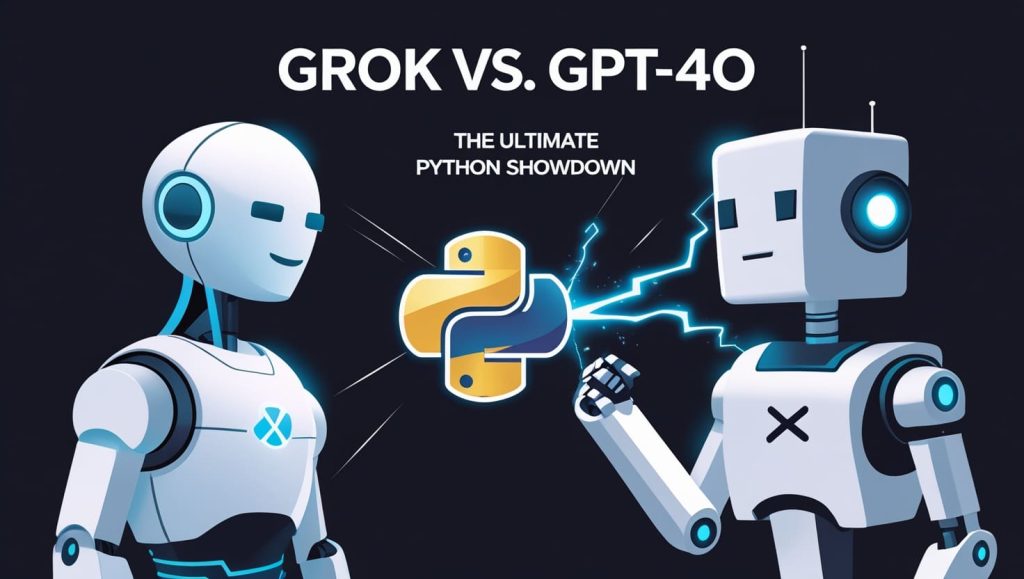
We’ve all seen the slick demos. An AI coding assistant seemingly builds a full-blown application from a single sentence, no bugs, no fuss. But when I actually try to use these tools for my own Python projects, the reality is often a lot messier.
So, I decided to cut through the hype and pit the two biggest names in AI right now—xAI’s Grok and OpenAI’s GPT-4o—against each other in a real-world Python coding challenge. I didn’t just ask them to write a script; I made them debug it and refactor it, too. One of them felt like a true coding partner, while the other… well, the other felt like a problem.
- The Winner for Most Projects: GPT-4o was consistently better across the board, producing more accurate, robust, and Pythonic code from the start.
- Best for Debugging: GPT-4o was significantly more effective at identifying and fixing bugs, understanding the context of an error message far better.
- Where Grok Has an Edge: Grok’s real-time web access is its one unique advantage, making it potentially useful for scripts that need up-to-the-minute data (e.g., scraping social media or news feeds).
- My Key Tip: The quality of your initial prompt is everything. Be hyper-specific about the libraries you want to use, the structure of the output, and your error-handling expectations.
The Coding Challenge: A Real-World Python Task
To make this a fair fight, I needed a task that was simple enough to explain but complex enough to be a meaningful test. It had to cover the kind of work a Python developer actually does.
The Goal
I tasked each AI with writing a Python script that would:
- Scrape the homepage of a popular tech news site (I chose Hacker News for this test because its structure is simple and stable).
- Extract all the article titles.
- Analyze the titles to count the occurrences of specific keywords (e.g., “AI”, “Python”, “Google”).
- Save the results into a clean, well-formatted CSV file named analysis_results.csv.
Why this test?
This challenge is perfect because it combines several core skills: web scraping (requests, BeautifulSoup), data processing (string manipulation, dictionaries), and file I/O. It’s a classic “quick script” a developer might write on a Tuesday afternoon.
To keep things perfectly even, I used the exact same initial prompt for both models.

Round 1: The First Draft – Who Writes Better Code Out of the Box?
A great AI assistant should give you a strong starting point. A bad one gives you a mess you have to fix yourself. Here’s what happened.
GPT-4o’s First Attempt
I fed my prompt to GPT-4o, and in about 10 seconds, it produced a script. My first impression? It was clean.
- It correctly chose to use the requests library for fetching the page and BeautifulSoup4 for parsing the HTML. Standard and correct.
- It defined the keywords in a simple list, which is exactly what I would have done.
- The logic for finding the titles, counting keywords, and writing to a CSV file was all there and easy to follow.
It was a solid piece of code that looked like a human developer had written it. It even included comments explaining each part of the process.

Grok’s First Attempt
Next, I gave the same prompt to Grok. The result was… different.
The code was functional, mostly. It also used requests and BeautifulSoup, which was good. However, the structure was less intuitive. It put the keyword analysis logic inside the main scraping loop, making it a bit less modular and harder to read.
More importantly, it made a rookie mistake. The CSS selector it used to find the article titles was overly specific and likely to break if the site made a small HTML change. GPT-4o’s selector was more robust. It felt like Grok made a “good guess,” while GPT-4o knew the right way to do it.
Verdict for Round 1: A Clear Early Lead
GPT-4o takes this round, easily. The code it produced was not only functional but also well-structured, commented, and used best practices. It was a script I could confidently run. Grok’s version would have needed some cleanup first.
Round 2: The Inevitable Bug – Who Is the Better Debugger?
No code is perfect, especially not AI-generated code. A truly useful AI partner doesn’t just write code; it helps you fix it when things go wrong.
The Problem
To simulate a real-world scenario, I ran the code but pretended that Hacker News had changed its HTML. I modified the code with a deliberately incorrect CSS selector (‘.article-title’ instead of the correct ‘.titleline’) to ensure it would fail and produce a TypeError when the script tried to process a non-existent element.
I then took the full error message and traceback from my terminal and fed it back to each AI.
How I Asked for Help
My prompt was simple and direct: “I ran the script you gave me, and I got this error. Can you fix the code?” followed by the pasted traceback.

GPT-4o’s Debugging Skills
GPT-4o’s response was incredible. It correctly diagnosed the problem in seconds.
It said, “It looks like the script is failing because the CSS selector ‘.article-title’ isn’t finding any elements, so it’s returning None… The most likely reason is that the website’s HTML structure has changed. The correct selector for Hacker News titles is usually ‘.titleline’. Here is the corrected code block.”
It not only identified the root cause but also explained it clearly and provided the corrected code immediately. This is exactly what you want from a debugging partner.
Grok’s Debugging Skills
Grok’s attempt was, frankly, a failure.
Its first response was generic. It suggested adding a try-except block to handle the error. While that would prevent the script from crashing, it doesn’t actually fix the underlying bug. It’s like putting a bucket under a leak instead of fixing the pipe.
It didn’t seem to understand that the core problem was the incorrect CSS selector. It took me two more follow-up prompts to guide it toward the real solution. It couldn’t make the logical leap from “TypeError” to “your HTML parser is broken.”
Verdict for Round 2: One Found the Needle, The Other Blamed the Haystack
GPT-4o wins this round by a landslide. Its ability to understand the context of a traceback and pinpoint the exact cause of an error is a massive advantage. Grok’s debugging advice was superficial and unhelpful.
Round 3: From Functional to Fantastic – Who Refactors Code Better?
Finally, I wanted to see which AI could take the working script and elevate it. I wanted more efficient, more readable, more “Pythonic” code.
My Refactoring Prompt
My prompt was: “Please refactor this working code. Make it more efficient, add type hints for clarity, and wrap the main logic in a function for better reusability.”
GPT-4o as a Code Reviewer
GPT-4o did an excellent job. It wrapped the entire logic in a main() function, added type hints to all the function signatures and key variables, and even replaced a standard for loop with a more efficient list comprehension. The result was a script that felt professional and production-ready.

Grok as a Code Reviewer
Grok’s refactoring was okay, but less impressive. It successfully put the code into a function but failed to add the type hints I requested. It also didn’t make any of the more advanced “Pythonic” improvements that GPT-4o did, like using a list comprehension. The code was functionally the same, just wrapped in a function. It did the bare minimum.
Verdict for Round 3: The Difference Between a Junior and Senior Dev
GPT-4o wins again. It didn’t just follow my instructions; it anticipated my needs as a developer and applied best practices that I hadn’t even explicitly asked for. It refactored like a senior developer. Grok refactored like a junior developer who just learned what a function is.
The Final Scorecard: A Side-by-Side Feature Breakdown
| Feature | GPT-4o | Grok | Winner |
| Initial Code Generation | Clean, robust, Pythonic | Functional but flawed | GPT-4o |
| Debugging & Error Handling | Excellent, insightful | Poor, superficial | GPT-4o |
| Code Refactoring | Professional, insightful | Basic, minimal | GPT-4o |
| Speed | Very Fast | Fast | GPT-4o |
| “Pythonic” Quality | High | Low-to-Medium | GPT-4o |
So, What’s the Bottom Line? My Personal Verdict.
After running this head-to-head test, the conclusion is pretty clear. For 95% of Python scripting tasks, GPT-4o is the superior tool. It’s a more knowledgeable, reliable, and insightful coding partner. It writes better code, debugs more effectively, and refactors with a level of skill that genuinely surprised me.

The only scenario where I might reach for Grok is if a script’s core function depends on accessing truly real-time information from the web, especially from X/Twitter. That is a unique skill, but for the day-to-day work of building, debugging, and refining Python code, my primary tool is now unquestionably GPT-4o. It just works better 🙂
Now I want to hear from you. What have your experiences been? Have you run your own tests? Share your results in the comments below

 Login with Google