
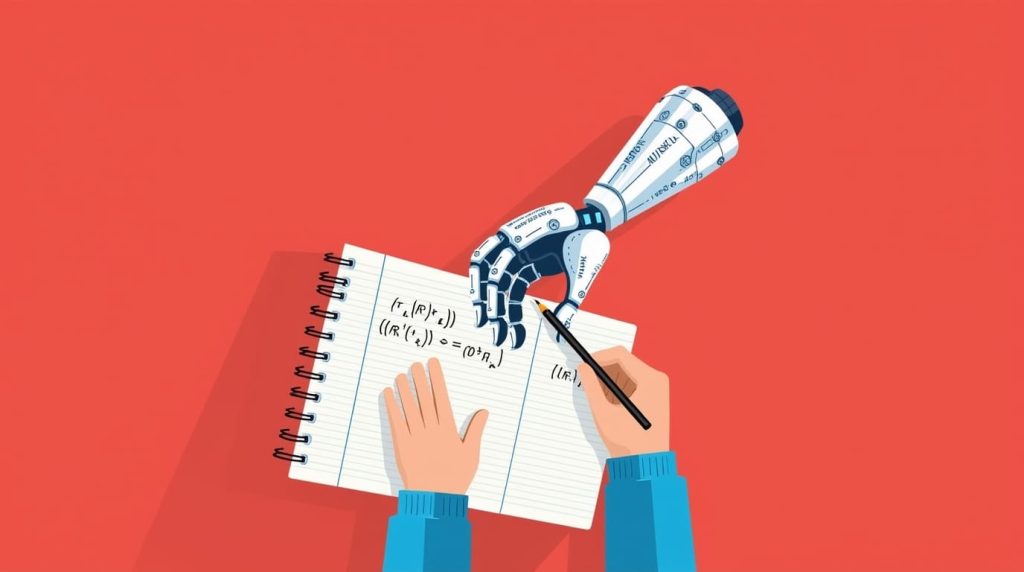
CHICAGO – The essay introduction was perfect. Flawless grammar, elegant sentence structure, and sophisticated vocabulary. For any English teacher, it should have been a moment of pride. For me, it was a moment of profound dread.
In my ninth-grade classroom, surrounded by well-worn copies of Lorraine Hansberry’s “A Raisin in the Sun,” I felt my heart sink. This wasn’t the voice of my student. This was the voice of a machine.
The student, who I’ll call David to protect his privacy, had beamed as he handed me his paper. We’d been working all year on his spelling, his comma usage, his confidence. And suddenly, here it was: a piece of writing that, on the surface, was brilliant. But something was off. The words were too perfect, the flow too seamless. It was like a stranger had walked into my classroom and started speaking for him.
“This is great,” I said, trying to keep my voice neutral. “Tell me, what does this word here mean?” I pointed to a particularly advanced term.
David’s smile faltered. He shifted his weight. He couldn’t define it.
“Okay, no problem,” I continued, my internal alarm bells ringing louder. “Just summarize this first paragraph for me in your own words.”
Silence. He stared at the page, his own words now alien to him. He couldn’t do it.
I took a deep breath. The question hanging in the air between us was the elephant in the room, the modern-day version of “Did you copy this from your friend?” Only this was a friend with near-infinite knowledge and zero scruples.
“David,” I asked gently. “Did you use AI to write this?”
The transformation was instant and heartbreaking. The pride drained from his face, replaced by a flush of shame. His shoulders slumped. He shrank right there in front of me, a fifteen-year-old caught in the crosshairs of a technological revolution he never asked for.
I didn’t feel anger. I felt a deep, aching sadness. And worry.
The Shortcut to Nowhere
Our essay assignment was a classic for a reason. We were analyzing the American Dream—specifically, the brutal barriers that marginalized people, like the Youngers in the play, face when trying to achieve it. We talked about institutional racism in 1950s Chicago housing and the interpersonal conflicts that tear families apart.
The real work, the human work, was in the struggle: digging back into the physical play text, a messy document full of stage directions and dialogue, to find the perfect piece of evidence to support an idea. It’s frustrating. It’s hard. Most of my students were looking for a way out of that process.
And who can blame them? When a tool exists that can deliver a perfectly polished paragraph in seconds, the temptation is immense. For a student who struggles, it feels like a lifeline.
But here’s the hard truth I explained to David: “I would rather have your most fragmented, incoherent, misspelled writing than this perfect AI-generated text. I want your voice. I want your effort. I want to see your brain at work.”

His frustration with me was palpable. I was asking him to push past the discomfort, to return to the frustrating text, to be resilient. And that’s a skill his Individualized Education Program (IEP) specifically stated he needed to build.
The Lost Art of Struggle: Why “Academic Resilience” Isn’t Just a Buzzword
This is about so much more than one essay or one student. This is about the slow erosion of what educators call “academic resilience.”
Academic resilience is the magic that happens when a student stops seeing a challenge as a brick wall and starts seeing it as a mountain they can climb. It’s when frustration, impatience, and self-doubt are slowly replaced with self-belief, determination, and hard-won confidence.
Think about the skills David bypassed by clicking “generate”:
- Patience & Determination: Flipping through the book, scanning pages, and re-reading to find that one crucial quote.
- Bravery: Raising his hand to ask me, his teacher, for help.
- Collaboration: Leaning over and asking a classmate, “Hey, what scene was that in?”
- Motor Skills: The physical act of turning pages, underlining evidence, placing a Post-it note, writing by hand. These aren’t trivial; they forge neural pathways.
- Memory: Stopping at the end of a page to summarize what you just read—that’s weightlifting for your short-term memory.
AI didn’t just write an essay for David. It robbed him of the opportunity to sharpen a whole toolkit of essential human skills. With every digital shortcut, we are quietly disabling their ability to navigate the real world.
This Isn’t Just About English Class. This Is About Life.
Let’s be blunt: most of these kids won’t grow up to be literary critics. So why does it matter?
Because the muscle you build struggling with “A Raisin in the Sun” is the exact same muscle you need to survive and thrive in adulthood.
High frustration tolerance is the key.
- Reading a lease or a contract: It’s a dense, frustrating text. You need to slog through it, find the concerning clauses, and understand what you’re signing away.
- Understanding legislation during voting season: It requires researching, asking questions, and making connections about how policies will affect your life, your family, and your community.
- Navigating a conflict with a coworker or family member: It requires patience, listening, and working through the frustrating parts to find a solution.
When we outsource our thinking to AI for a quick, easy grade, we are training a generation to outsource their power. Their insight. Their innate capacity to make connections. Without these skills, they become passive passengers in their own lives, vulnerable to anyone with a slick presentation and an easy answer.
Books Are Technology, Too
We have to stop talking about technology as if it only exists on a screen. This is a dangerous false divide.
The printed book is one of the most transformative technologies in human history. The serialized novels of Charles Dickens exploded in popularity in the 1800s precisely because of a technological revolution—the Industrial Revolution—which made printing faster and cheaper than ever before.
Holding a physical book, wrestling with its pages, annotating its margins with a pencil—this isn’t an aberration from technology. It is a legitimate, powerful, and proven form of engaging with it. It’s technology that builds you up, rather than thinking for you.
The Path Forward: Discernment, Not Denial
AI is here. It is powerful, and it is unavoidable. Banning it outright is as futile as banning calculators. The answer isn’t to police and punish, but to teach and guide.
Our new, most critical lesson plan must be discernment.
We must teach students to ask: “When does this tool support my brain’s development, and when does it replace it?”
- Using AI to brainstorm ideas? Maybe a good starting point.
- Using it to summarize a complex article to understand it better? Potentially useful.
- Using it to write your essay, think your thoughts, and find your evidence? A catastrophic shortcut that steals your education.
My job, as I see it now, is to convince a generation of Davids that their messy, struggling, imperfect voice is infinitely more valuable than the most flawless AI output. Their voice is theirs. It is human. And it is the only tool they have that will truly last a lifetime, capable of critical thought, empathy, and genuine creativity.
I sent David back to his desk that day, with his play and a pencil. He was frustrated. I was tired. But we were both engaged in the most human work of all: the struggle that leads to growth. And that is a headline worth writing.

 Login with Google