
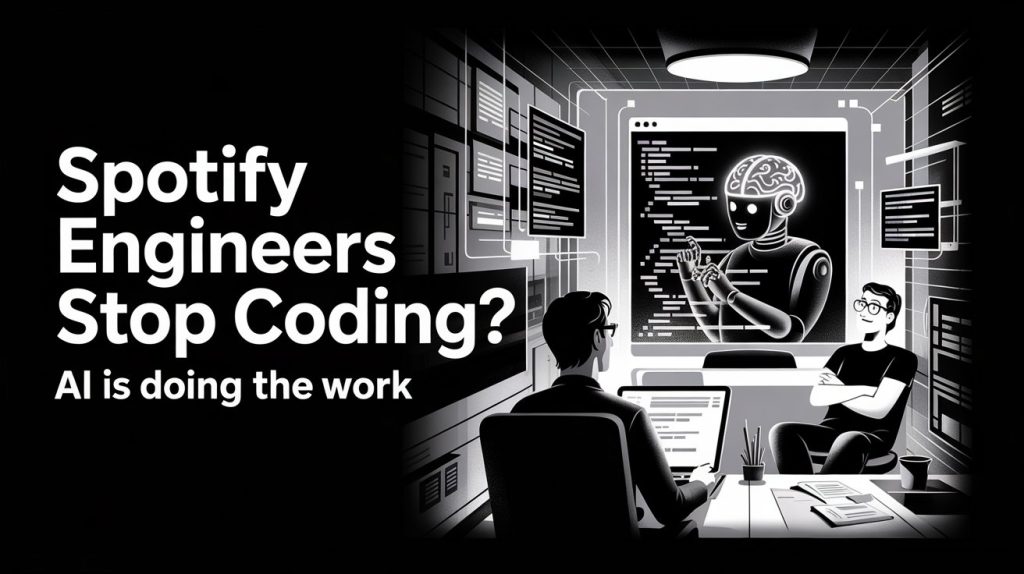
It sounds like a tech joke, but it came straight from the top.
At a recent earnings call, Spotify quietly dropped a line that made the tech world sit up: the company’s best developers have not written a single line of code since December 2025. Not one. Zero. Zilch.
The man who said it, Gustav Söderström, did not say it like a warning. He said it like a proud update. According to him, an internal AI system called Honk is now doing most of the coding work inside Spotify. The engineers? They tell the AI what to do, check the results, and move on to bigger decisions.
For many people, this sounded like the future arriving early. For others, it sounded a bit scary. And for the rest of us, it raised a simple question: if the best developers are not writing code anymore, what exactly is happening inside one of the world’s biggest music apps?
The AI behind the curtain
Honk is not some random chatbot. It is built on technology from Anthropic, a company known for its work on advanced AI models for writing and coding. Inside Spotify, Honk is connected to Slack, the same chat tool many offices already use for daily work.
This means an engineer can type a request in Slack like, “Fix this bug,” or “Add this feature,” and Honk will get to work. The AI writes the code, runs tests, and can even prepare the deployment. The human engineer then reviews what the AI did, approves it, or asks for changes.
In simple words, Spotify’s developers have turned into editors and directors, while the AI has become the writer and builder.
Söderström summed it up in one short line that is already being quoted everywhere: “Honk handles execution. Humans handle judgment.”
Faster than ever before
Spotify says this setup has changed the speed of its product updates in a big way. In 2025 alone, the company pushed out more than 50 new features and changes to its app. That is a lot for a platform used by hundreds of millions of people every day.
Then, in early 2026, the company rolled out several AI-powered features within weeks of each other. In the past, such a fast pace would have needed large teams working late nights, writing and rewriting code, fixing bugs, and waiting for tests to pass. Now, much of that work is being done by Honk in the background.
Söderström was clear about one thing: this speed would not have been possible without AI support. The engineers still guide the work, but the heavy lifting is no longer done by human hands on keyboards.
The day the keyboards went quiet
Inside Spotify’s offices, the change has been slow but steady. Engineers did not just wake up one morning and stop coding. At first, Honk helped with small tasks: fixing simple bugs, cleaning up messy code, or writing test scripts. Over time, the AI got better, and the trust grew.
By December 2025, something strange happened. The top developers, the people who usually write the most complex parts of the system, realized they were not typing code anymore. They were planning, reviewing, and deciding. The actual typing was being done by the machine.
One engineer, who did not want to be named, joked to a colleague, “My keyboard is just for chatting now.” It was meant as a joke, but it also showed how much the job had changed.
Humans are still in charge… for now
Spotify is very careful to say this is not about replacing engineers. The company says humans are still “very much in the loop.” Their role, however, is different.
Instead of spending hours writing repetitive code, they now spend more time on big questions: How should this feature work? Is this change safe? Does this design make sense for users? Is the AI’s solution clean and secure?

In other words, the engineers have moved up a level. They are less like factory workers and more like architects and editors. They design the building. The AI lays the bricks.
This idea fits a bigger trend in the tech world. Many companies are trying to use AI not just as a tool, but as a co-worker. Spotify just happens to be one of the first big names to say it out loud, and with numbers to show for it.
The internet reacts
When the news came out on February 10, 2026, it spread fast. Tech sites like TechCrunch and India Today picked it up within hours. Even international outlets such as Gigazine wrote about it.
The headlines were dramatic. “Developers stop coding.” “AI takes over Spotify.” “The end of programmers?” Some people celebrated it as a sign of progress. Others worried about jobs, skills, and what happens when machines write most of the software we use every day.
On social media, developers argued in long threads. One group said this is just like moving from assembly language to higher-level languages years ago. The tools change, but the job stays. Another group said this feels different, because now the tool is not just helping you write code, it is writing the code for you.
The money story behind the tech
This announcement did not come in a vacuum. Spotify’s earnings call also showed strong business numbers: about 13% revenue growth and around 290 million paid subscribers. The company is clearly in a good place financially.
That matters, because it means this AI push is not a desperate move. It is a confident one. Spotify is not saying, “We had to do this to survive.” It is saying, “This is how we move faster and build better things.”
In the music business, speed matters. Trends change quickly. New features can decide whether users stay or leave. If AI can help Spotify test ideas faster and ship them quicker, that is a big competitive edge.
Is this really the future of work?
Still, the big question remains: is this just Spotify, or is this the start of something much bigger?
Many experts think we are looking at the early days of AI-led development. Today, it is one company saying its best engineers do not code anymore. Tomorrow, it could be many companies saying the same thing.
But there are also limits. AI can make mistakes. It can misunderstand a request. It can produce code that works but is unsafe or hard to maintain. That is why Spotify keeps repeating the “human in the loop” line. Someone still has to take responsibility.
As one senior developer put it, “If something breaks at 3 a.m., the AI won’t get the angry call. We will.”
No new drama, just a big shift
Since the announcement, there has been a lot of talk, but no major new drama. No big backlash. No sudden changes. The story, for now, is simple: Spotify is doing this, it seems to be working, and the rest of the industry is watching closely.
Some companies will copy it. Some will wait. Some will say it is too risky. That is how tech changes usually spread, slowly at first, then all at once.
A quiet moment before a loud future
Maybe the strangest part of this story is how calm it all sounds. No layoffs were announced. No big warning bells were rung. Just a simple statement: our best developers have not written code for months, and things are going great.
In a few years, we might look back at this moment as the point where software work really changed. Or we might say it was just one company experimenting in its own way.
For now, one thing is clear: somewhere inside Spotify, the keyboards are quieter, the chat windows are busier, and an AI named Honk is writing a lot of code that millions of people use every day—while humans watch, judge, and decide what comes next.




 Login with Google