

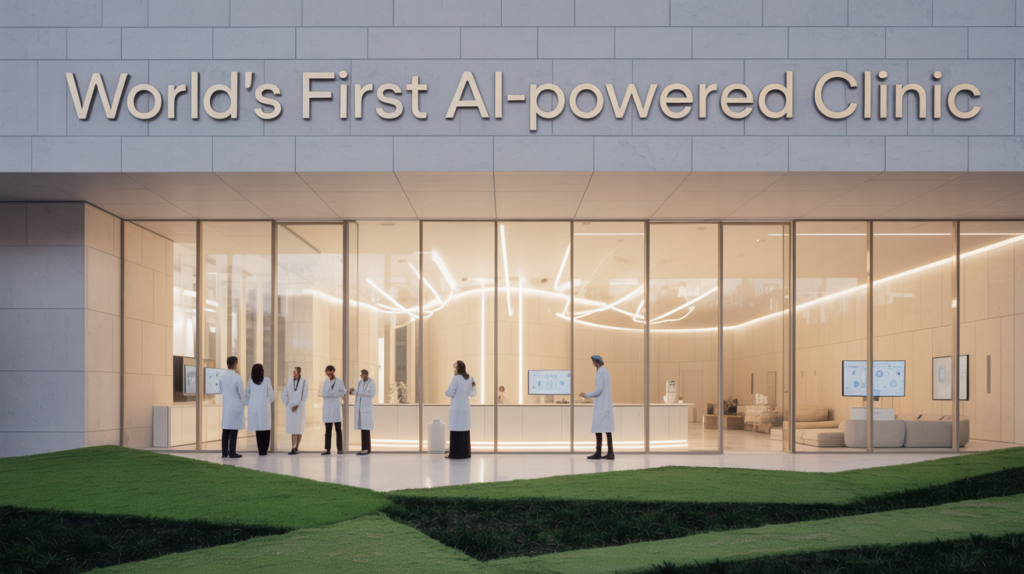
In a breakthrough that could revolutionize healthcare as we know it, Saudi Arabia has launched the world’s first clinic where artificial intelligence, not humans, serves as the primary physician. Located in the eastern province of Al-Ahsa, this pioneering facility opened its doors to patients last month, marking what many experts are calling a watershed moment in the evolution of medical care.
Behind this bold initiative is a partnership between China-based medical technology company Synyi AI and Saudi Arabia’s Almoosa Health Group. The clinic represents the culmination of years of research and development in medical AI applications and could potentially reshape how healthcare is delivered globally.
“We’re witnessing the beginning of a new chapter in healthcare,” said Dr. Abdullah Al-Rashid, Director of Healthcare Innovation at Almoosa Health Group, during the clinic’s opening ceremony. “This isn’t about replacing human doctors – it’s about extending quality care to more people by leveraging cutting-edge technology.”
Meet Dr. Hua: Your AI Physician
The star of this futuristic medical facility is “Dr. Hua,” an artificial intelligence system designed to function as a virtual physician. Unlike AI tools currently used in other healthcare settings that merely assist human doctors, Dr. Hua independently manages the entire patient journey – from initial consultation through to diagnosis and treatment planning.
When patients arrive at the clinic, they’re greeted by staff who direct them to a private consultation room equipped with a tablet interface. Through this device, patients interact directly with Dr. Hua, describing their symptoms just as they would to a human doctor. The AI then processes this information, asking follow-up questions tailored to the patient’s responses.
“It was strange at first, talking to a computer about my breathing problems,” said Mohammed Al-Harbi, 43, one of the clinic’s first patients. “But the questions it asked were exactly what my regular doctor would ask – maybe even more thorough.”
The AI doesn’t work entirely alone, though. Human assistants help collect vital signs and perform basic physical examinations as directed by Dr. Hua. The system can also analyze medical images and laboratory results, incorporating this data into its diagnostic process.
Humans as “Safety Gatekeepers”
While Dr. Hua handles the bulk of the clinical work, human physicians haven’t been eliminated from the equation. Instead, they’ve taken on a new role as what Synyi AI calls “safety gatekeepers.”
These medical professionals review each diagnosis and treatment plan generated by the AI before final approval, providing an essential layer of oversight. It’s a collaborative approach that maintains human judgment in the loop while allowing the AI to handle routine clinical tasks.
“All AI-generated treatment plans must be reviewed and signed off by qualified physicians before implementation,” explained Zhang Shaodian, CEO of Synyi AI. “What makes our system revolutionary is that the AI independently completes the full chain of medical operations from inquiry to prescription, with humans serving as the final quality check.”
This dual-layer system seems to be working. During testing phases prior to the clinic’s launch, Synyi AI reported an impressively low error rate of just 0.3 percent – a figure that will be closely monitored as the trial continues.
Starting Small, Thinking Big
Currently, Dr. Hua’s expertise is limited to respiratory conditions, with capabilities to diagnose and recommend treatment for about 30 common ailments including asthma and pharyngitis. However, Synyi AI has ambitious plans to expand the system’s knowledge base.
“Within the next six months, we aim to increase Dr. Hua’s diagnostic capabilities to cover approximately 50 diseases spanning respiratory, gastroenterological, and dermatological conditions,” said Zhang. “Our ultimate goal is to create an AI doctor capable of addressing the majority of primary care needs.”
This measured approach reflects the company’s commitment to safety and accuracy. Rather than rushing to deploy an all-encompassing system, they’re methodically expanding Dr. Hua’s capabilities while carefully validating performance at each stage.
Technology Behind the Innovation
What sets Dr. Hua apart from other medical AI systems is its foundation in specialized large language models (LLMs) customized specifically for healthcare applications. Unlike general AI models, Dr. Hua has been trained on vast datasets of medical literature, clinical guidelines, and patient records – all while adhering to strict data privacy protocols.
“What AI has done in the past is to assist doctors, but now we are taking the final step of the journey to let AI diagnose and treat the patients directly,” Zhang noted during a demonstration of the technology.
Importantly, the system has been localized to account for regional differences in medical practice, language nuances, and cultural considerations relevant to Saudi Arabian patients. This localization effort represents a significant advancement over one-size-fits-all AI solutions.
The company, which boasts backing from tech giant Tencent, Hongshan Capital, GGV Capital, and local government support, has invested heavily in ensuring their AI can understand and respond appropriately to the specific healthcare context of the region.
Addressing Global Healthcare Challenges
The timing of this innovation couldn’t be more significant. Healthcare systems worldwide are grappling with physician shortages, uneven distribution of medical expertise, and rising costs. These challenges are particularly acute in remote and underserved areas where access to qualified doctors is limited.
“In many parts of the world, patients wait weeks or even months to see a specialist,” said Dr. Sarah Chen, a global health policy researcher not affiliated with the project. “AI-powered clinics like this could potentially bridge critical gaps in healthcare access, especially in areas with physician shortages.”
The economic implications are equally significant. By automating routine diagnostic procedures and consultations, healthcare systems could potentially reduce costs while maintaining or even improving quality of care. Patients might benefit from shorter wait times and more consistent care experiences.
“When properly implemented, AI has the potential to democratize access to medical expertise,” said Dr. Chen. “But the key is ensuring these systems maintain high accuracy standards while addressing legitimate concerns about the human element of healthcare.”
Looking Toward Regulatory Approval
While the clinic is currently operating as a pilot program, Synyi AI is already looking ahead to full regulatory approval. The company will submit comprehensive diagnostic data to Saudi health authorities, with the expectation that formal approval could come within 18 months.
This regulatory process will be watched closely by health authorities worldwide, many of whom are developing frameworks to evaluate and approve AI-driven healthcare solutions. The Saudi implementation could serve as a valuable case study for other nations considering similar innovations.
“We’re in uncharted territory here,” admitted Dr. Al-Rashid. “But Saudi Arabia has positioned itself at the forefront of healthcare innovation as part of our broader Vision 2030 initiative. This project aligns perfectly with our goal to become a global leader in healthcare technology.”
The Human Element: Concerns and Considerations
Not everyone is entirely comfortable with the concept of AI doctors. Critics worry about the loss of the human touch in healthcare – the empathy, intuition, and rapport that characterize the traditional doctor-patient relationship.
“There are aspects of medicine that extend beyond symptom recognition and treatment protocols,” noted Dr. Fatima Al-Qahtani, a medical ethicist at King Saud University. “The question is whether patients will feel comfortable discussing sensitive health issues with an AI, and whether the AI can truly understand the social and emotional dimensions of illness.”
Privacy concerns also loom large. As healthcare becomes increasingly digital, patients and regulators alike are questioning how medical data is stored, who has access to it, and how it might be used beyond direct patient care.
Synyi AI and Almoosa Health Group have sought to address these concerns by implementing robust data protection measures and emphasizing that human doctors remain involved in patient care. They’ve also been transparent about the current limitations of the technology.
“We don’t claim that Dr. Hua can handle every medical situation,” Zhang said. “Complex cases, emergencies, and conditions requiring physical examination beyond basic measurements will still require direct human physician involvement.”
The Future of Healthcare?
As the Al-Ahsa clinic continues its operations, healthcare professionals and technology experts worldwide will be watching closely. The success or failure of this pioneering initiative could significantly influence the future trajectory of AI in healthcare.
If the pilot program demonstrates positive outcomes – accurate diagnoses, effective treatments, and good patient satisfaction – similar clinics could begin appearing in other regions. Saudi Arabia’s willingness to embrace this cutting-edge approach positions the kingdom as a leader in healthcare innovation, consistent with its Vision 2030 goals.
“We’re at the beginning of what could be a transformative journey in healthcare delivery,” reflected Dr. Al-Rashid. “The integration of AI doesn’t mean the end of human doctors – rather, it represents an evolution in how we leverage technology to extend quality care to more people.”
For patients like Mohammed Al-Harbi, the focus remains squarely on results. “I don’t really care if it’s a human or a computer diagnosing me,” he said as he left the clinic with his prescription. “What matters is getting the right treatment so I can feel better. If the AI can do that, I’m all for it.”
As this bold experiment unfolds in Saudi Arabia’s eastern province, one thing is certain: the relationship between technology and healthcare is evolving rapidly, and the implications extend far beyond a single clinic in Al-Ahsa. The world will be watching to see if Dr. Hua represents the future of medicine or merely an interesting detour on healthcare’s evolutionary path.




 Login with Google