
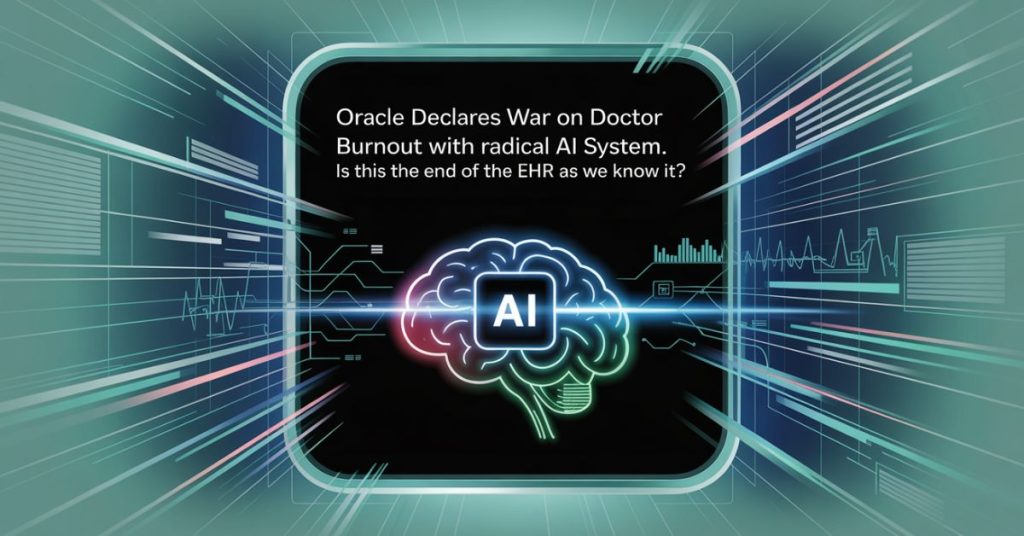
REDWOOD SHORES, CA – For years, it’s been the silent crisis simmering in every hospital and clinic. It’s the source of the thousand-yard stare on a doctor’s face at the end of a 12-hour shift. It’s the reason your family physician is clicking through a dozen windows on a computer screen instead of looking you in the eye. They call it “click fatigue,” and it’s fueling an epidemic of burnout that’s threatening the very foundation of our healthcare system.
This week, tech behemoth Oracle stepped into the ring, threw down a gauntlet, and declared that it has the solution. It’s not just another update or a fancy new feature. It’s a complete, ground-up reinvention of the most hated tool in a doctor’s arsenal: the Electronic Health Record (EHR).
Oracle Health has officially launched what it’s calling a “next-generation” EHR, powered by artificial intelligence. And if their promises hold true, it could change everything about how doctors work. The system is now rolling out to outpatient clinics across the U.S., with the hospital-focused version slated for next year, though it’s still awaiting the final stamp of approval from federal regulators.
But let’s be real. We’ve heard promises of a healthcare tech revolution before. So, is this for real, or is it just more corporate hype? I dug in to find out.
Goodbye Clicks, Hello Conversation: The ‘JARVIS’ for Doctors
The centerpiece of this new system sounds like something straight out of an “Iron Man” movie. Oracle has built a “Clinical Digital Assistant” – essentially a voice-controlled AI that lives inside the health record. The goal is to make interacting with a patient’s chart as simple as having a conversation.
Imagine a doctor, standing by a patient’s bedside, not tethered to a keyboard.
Instead of the endless clicking – click to open the chart, click for labs, click for meds, click, click, click – the doctor can simply speak.
“Show me Mrs. Jones’s latest potassium levels.”
Poof. The results appear.
“What are her current allergies?”
Instantly, the list is on the screen.
“Queue up a prescription for 500mg of Amoxicillin, twice a day for ten days.”
The order is drafted, waiting for a final, quick review and signature.
This isn’t just about voice-to-text dictation, which has been around for ages. This is about contextual understanding. The AI is designed to know what a “basic metabolic panel” is, to understand the difference between a consult note and a lab result, and to pull the precise piece of information a doctor needs from a sea of data.
Perhaps most powerfully, a doctor could ask, “Give me the highlights of this patient’s last three visits.” The generative AI would then digest pages of notes and data, creating a clean, concise summary. This alone could save countless hours and, more importantly, prevent critical details from being missed.
The ultimate target here is what doctors grimly call “pajama time” – the two to three hours many spend at their kitchen tables every night, long after their families have gone to bed, catching up on the soul-crushing administrative work they couldn’t finish while seeing patients. Oracle is betting that by eliminating the keyboard and mouse as the primary tools, they can give doctors back their time, and in doing so, return the focus of the medical encounter from the computer screen back to the human patient.
A $28 Billion Bet and the Ghost of Cerner
To understand why Oracle is making such a radical move, you have to rewind to 2022. That’s when Oracle shocked the tech and health worlds by plopping down a staggering $28.4 billion to buy Cerner, one of the biggest but also one of the most criticised EHR vendors.
Frankly, many insiders were skeptical. Cerner’s flagship product, Millennium, was powerful but widely seen as clunky, difficult to use, and built on aging technology. Oracle didn’t just buy a company; it bought a massive problem. This new AI-powered EHR is Oracle’s first real answer to those critics. It’s their attempt to prove that the $28 billion wasn’t a blunder, but the foundation for a complete overhaul of health tech.

Seema Verma, the executive vice president of Oracle Health and a former administrator of the Centers for Medicare & Medicaid Services, didn’t pull any punches in her statement. “While our competitors seem content with bolting features onto antiquated technology,” she said, “we took on the enormous and highly complex challenge of creating an entirely new EHR, built in the cloud for the Agentic AI era.”
That shot was fired directly at Oracle’s chief rival, Epic Systems.
The Epic Showdown and the Battle for the Modern Hospital
You can’t talk about EHRs without talking about Epic. The privately held Wisconsin-based company is the undisputed king of the market. According to recent data from Klas Research, Epic controls over 42% of the acute care hospital market in the U.S. Oracle, through its Cerner acquisition, holds just under 23%.
For years, the battle has been one of attrition. But Oracle is changing the rules of the game. They aren’t trying to build a better version of Epic’s system; they’re trying to make it obsolete. By moving from a click-based to a voice-based paradigm, Oracle is attempting to leapfrog the competition entirely.
The timing of this announcement is no accident. It comes just days before Epic is set to host its massive annual Users Group Meeting, where it’s widely expected to unveil its own new AI integrations. The message from Oracle is clear: Whatever you’re showing, we’re already a generation ahead.
It’s a bold, high-stakes strategy. But Oracle’s reputation could use the boost, especially given the dark cloud hanging over its massive government contract to modernize the Department of Veterans Affairs’ EHR system—a project inherited from Cerner that has been hammered by delays, safety concerns, and furious complaints from VA doctors. A big win with this new commercial product is essential for Oracle to rebuild trust, not just with hospitals, but with the federal government.
The Reality Check: Can It Actually Work?
A flashy press release is one thing. A functioning, safe, and adopted piece of life-critical software is another beast entirely. The road ahead for Oracle is filled with massive hurdles.
First and foremost is accuracy. If I ask my home smart speaker to play the wrong song, it’s annoying. If a clinical AI misinterprets a dosage or pulls up the wrong patient’s lab results, people can die. Oracle claims its AI is trained on specialized medical data to prevent these kinds of errors, and that all AI-generated content will be clearly labelled with its sources. But the trust of clinicians, who are trained to be skeptical, will have to be earned one flawless interaction at a time.
Then there’s privacy. The system is built on the Oracle Cloud Infrastructure (OCI). While Oracle touts its world-class security, the idea of sensitive patient conversations and records being processed in the cloud will rightly face intense scrutiny.
And let’s talk about the cost and chaos of implementation. Switching an entire hospital’s EHR system is often compared to performing open-heart surgery on the hospital itself. It’s a brutal, multi-year, multi-hundred-million-dollar process. Oracle has to convince already-strained health systems that the pain of the transition is worth the promised land on the other side.
Finally, there’s human nature. Doctors, nurses, and technicians have spent decades learning the “language of clicks.” Moving to a voice-first system will require a fundamental rewiring of their professional muscle memory. Adoption won’t be automatic; it will require immense training and a cultural shift.
The First Dominoes: A Cautious Rollout
Oracle isn’t naïve about these challenges. That’s why they’re starting small. The initial launch is for ambulatory, or outpatient, clinics. The workflow here is simpler and more predictable than in the chaotic, high-stakes environment of a hospital emergency room or ICU. This gives Oracle a real-world sandbox to test, refine, and prove the system’s value before taking it to the big leagues of acute care next year.
But even this first step is conditional. The system is still “pending certification” from the Office of the National Coordinator for Health IT (ONC). This is the U.S. government’s gatekeeper, ensuring any new health tech meets strict standards for security, data sharing, and patient safety. Without that certification, this new EHR is going nowhere.
The war on clicks has officially begun. Oracle has fired a cannonball across the bow of the entire health tech industry, promising a future where doctors can be doctors again, not data-entry clerks. It’s a compelling vision, and one that every burned-out clinician is desperately hoping will come true.
But for now, it remains a promise. The coming months will show whether Oracle has truly built the future of medicine or just a very expensive, very sophisticated dream. The entire healthcare world will be watching.

 Login with Google