
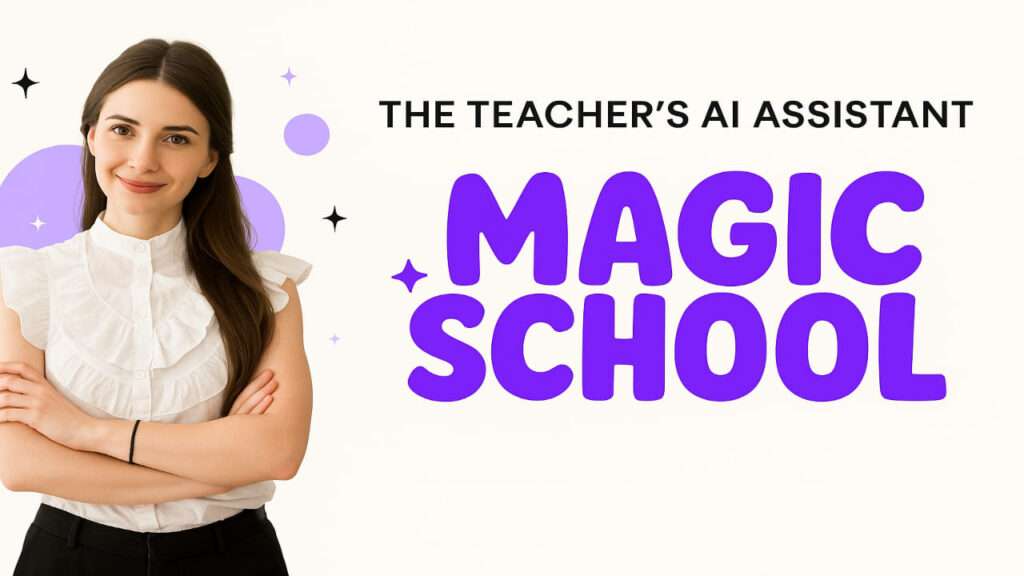
Magic School AI is an innovative educational technology platform that puts powerful AI tools into the hands of teachers and students. In today’s classrooms, AI for teachers is no longer optional – it’s essential. As one educator explains, “Every educator needs to learn about AI and how we can leverage this technology to benefit our students and enhance our own work”. Magic School AI was created by teachers, for teachers, to simplify those time-consuming tasks that lead to burnout. (Did you know 44% of K–12 teachers report feeling very often overwhelmed at work?) Magic School AI helps lighten that load so teachers can focus on students, not paperwork.
Magic School AI positions itself as “the AI copilot for educators and students,” streamlining lesson planning, grading, and content creation with generative technology. In short, it’s AI in education tailored specifically for the classroom. Unlike general chatbots, it’s built on a secure, K–12-aware model, with hundreds of AI tools in K–12 education aligned to standards. For example, it can generate curriculum plans, quizzes, behavior support plans, and even report-card comments in seconds. By automating these routine tasks, Magic School AI lets teachers reclaim precious prep time – in turn boosting student engagement and learning outcomes. (As MagicSchool founder Adeel Khan says, “AI will never replace a teacher. It’s the teacher’s expertise that makes a difference, and AI is the assistant”.)
What is Magic School AI?
Magic School AI (often called MagicSchool) is an all-in-one AI operating system for schools. It provides over 80 teacher-focused AI tools and 50+ student-facing tools, all in one secure platform. Its core mission is simple: “educators are the magic, not the AI.” The system is built by former teachers and principals who understand classroom realities. According to MagicSchool, educators experience burnout “at higher rates than any other profession,” so their platform is designed to take on repetitive prep work.

In practice, Magic School AI offers features like lesson plan generation, quiz/assessment creation, rubric and feedback builders, writing support, and more. As an Anthropic case study notes, “MagicSchool, an AI copilot for educators and students, transforms education… by streamlining lesson planning, providing personalized student feedback, and creating engaging content”. It even includes a dedicated teacher chatbot (“Raina”) to answer questions and suggest ideas instantly. And because it’s K–12 focused, it enforces strict privacy and safety rules: it’s SOC 2, FERPA, COPPA, and GDPR-compliant, with a 93% privacy rating from Common Sense Media. In short, Magic School AI is an educational technology platform built to help teachers (and administrators) work smarter, not harder.
Getting Started with Magic School AI
Magic School AI is easy to adopt. There is a free forever plan that provides all core features at no cost. Indeed, over 10,000 schools and districts have joined Magic School AI, making it “the most used AI for education platform in the world”. The Free tier includes:
- 80+ AI-powered teacher tools (lesson planners, quiz generators, content creators, etc.).
- Raina, the AI chatbot built specifically for educators (your personal “thought partner” for any question).
- MagicSchool for Students – 50+ student tools to build AI literacy (Study Bot, Quiz Me, writing feedback, etc.).
- Classroom & Analytics Features: “Student Room Insights” for real-time engagement data, plus one-click export of slides to Google Slides.
- Robust privacy & security: Verified by Common Sense for 93% privacy, fully compliant with education laws.
If you need more power, Magic School AI also offers a low-cost Plus subscription (about $100/year) that unlocks unlimited AI generations, unlimited student rooms, extended chat history, and advanced features like Google/Microsoft SSO and LMS integration. Enterprise plans (school/district-wide) provide custom AI tools, district analytics dashboards, professional development support (certification courses, exemplars, PD materials), and dedicated onboarding.

To begin: teachers simply sign up with an email (there’s a free plan and trial options). Magic School AI integrates with popular education platforms, so you can log in with Google or Microsoft accounts and export content to Google Classroom/Slides or Canvas LTI. New users are guided by built-in prompts and there are plenty of training resources (help center, video walkthroughs, PD courses) to get started. In fact, MagicSchool offers certification courses and webinars so teachers feel confident “teaching with AI” safely.
Key Tools and How to Use Them
Magic School AI’s strength is its toolkit. Teachers can pick from dozens of AI tools to automate nearly any classroom task. Here are a few key tools (and how teachers use them):
- Lesson Plan Generator: Enter your topic or learning objective and MagicSchool instantly creates a complete lesson outline with activities, objectives, and standards. Teachers save hours on planning.
- Quiz/Assessment Maker: Generate multiple-choice or short-answer quizzes based on any topic, standard, or text. It auto-creates questions and even an answer key — ideal for formative checks, exemplifying the efficiency of AI-supported grading systems in schools.
- Rubric & Feedback Tools: Want a rubric for a project? The Rubric Generator writes one in table form for your assignment. When students finish writing, upload their drafts to the Writing Feedback tool. MagicSchool will highlight strengths and areas for growth per your custom criteria. (It’s essentially an instant writing tutor before you grade.)
- Report Card Comments: Quickly generate personalized comments on each student’s report card. Input a few notes, and MagicSchool drafts warm, constructive statements about strengths and next steps.
- Text Summarizer/Rewriter: Any long passage can be simplified or rewritten at a different reading level. Useful for differentiating texts for ELLs or special ed.
- Presentation Generator: Create Google Slides decks on a topic with one click; includes title slide, images, and speaker notes. (Slides are exportable to Google Slides for easy editing.)
MagicSchool also has engaging student tools for building AI literacy, boosting student engagement with educational technology.
- Study Bot & “Quiz Me!”: Students can quiz themselves on any subject via a chatbot interface.
- Character Chatbot: Let students “interview” a historical figure, author, or character, practicing question-asking and critical thinking.
- AI Resource Bot: Teachers can create a custom AI chatbot (e.g. “Mrs. Smith’s Science Bot”) by feeding in guidelines. Students then chat with it as a study partner.
- Research Assistant: Students enter a topic and get an outline with curated sources to jumpstart projects.
- Writing Feedback (Student Edition): Similar to the teacher version, students can run drafts through MagicSchool themselves for on-the-spot feedback before turning in work.
For hands-on use, you’ll find an intuitive menu (“Most Loved Teacher Tools” and “Student Tools” tabs). Each tool has a short tutorial. The built-in chatbot Raina can jump in from any tool to suggest prompts or answer questions; as one Technology Director put it, MagicSchool has become teachers’ “coveted ‘thought partner’” for day-to-day tasks. In practice, teachers report that even beginners can get useful results with minimal prompts – MagicSchool’s “education-first design” means it often needs less tinkering than general AI bots.
Real-World Applications and Case Studies
Magic School AI isn’t just hype – hundreds of districts are seeing real impacts. Here are some examples:
- Aurora Public Schools (Colorado) – A large, diverse district (38,000 students) saw a 28% jump in students meeting grade-level literacy expectations after adopting MagicSchool. Teachers used the Writing Feedback and Text Scaffolding tools to support English learners, struggling readers, and students with IEPs, providing immediate, personalized feedback to every student. MagicSchool also helped them meet literacy goals without extra cost or staffing.
- Rockford Public Schools (Illinois) – Rockford (29,000 students) built an AI literacy initiative for teachers. They started by training staff on AI fundamentals, then rolled out MagicSchool. Educators found the platform’s “education-first design” intuitive and responsive to their needs. As one leader noted, “MagicSchool was responsive to what teachers needed, not just in features but in how easy it was to use.” By early 2024, teachers were effortlessly creating fully personalized units – complete with rubrics and materials – on fun themes (Minecraft, pizzas, etc.). The extra time allowed them to “infuse creativity into lessons, build stronger student relationships, and focus on the why behind learning”.
- West Vancouver Schools (British Columbia, Canada) – A forward-looking district launched a MagicSchool pilot across K–12. Within weeks, over 50% of teachers were actively using MagicSchool tools. Superintendent Chris Kennedy emphasized the need for AI that is “safe and specifically designed for the K–12 environment”. Teachers reported higher student engagement and more advanced use of language in assignments (AI was scaffolding learning). In short, West Vancouver credited MagicSchool with rapidly increasing teacher AI literacy and improving student learning without compromising safety.
- Innova Academy (New York) – In a recent research project, a small school tackled a struggling student and school culture issues with AI. MagicSchool’s Math Story Problem tool generated basketball-themed fraction problems to match a boy’s interests, dramatically improving his math confidence and scores. At the same time, teachers used MagicSchool’s Restorative Reflection Generator to handle a disciplinary incident more constructively. The result: not only did the student’s performance improve, but the entire school culture became more positive and inclusive.
These cases include glowing feedback. For example, a South Carolina district called Magic School AI “the single most powerful tool that’s ever been launched in our district.” Crosstown High’s Tech Director (Memphis, TN) says it’s their “coveted ‘Thought Partner’” for teacher tasks. And across the platform, teachers report that “when they get their time back, we trust teachers to repurpose it effectively” – using saved hours to reach out to struggling students or enrich learning.
Addressing Common Concerns
Naturally, educators have questions about using AI in schools. Here’s how MagicSchool tackles them:
- Student Cheating & Academic Integrity: Instead of relying on unreliable AI-detection tools (even OpenAI has scrapped theirs), MagicSchool recommends reframing assignments to be “AI-resilient.” Their blog advises focusing on design and student thinking rather than policing – for example, use open-ended prompts and creative projects that AI can’t simply spin out. By engaging students in responsible AI use, teachers maintain integrity.
- Privacy & Security: MagicSchool was built for education. It’s independently rated as the safest and most privacy-focused AI platform – compliant with SOC 2, FERPA, COPPA, GDPR, and all state laws. Common Sense Media gave it a 93% privacy rating. The system automatically strips any student names from AI-generated IEPs or comments. In short, student data stays protected.
- Bias & Accuracy: Using Claude’s “constitutional AI,” MagicSchool focuses on factual, high-quality output. In testing, Claude produced more accurate math worksheets and answer keys than earlier models. The platform adds warnings about bias and factual errors in prompts, and teachers can always review and edit content. The goal is for educators to remain “human in the loop,” ensuring AI is a helper, not a sole authority.
- Role of Teachers: Schools worry AI might replace teachers. MagicSchool emphatically says teachers are irreplaceable. The founder famously notes “AI will never replace a teacher… AI is the assistant”. The platform is designed to support teachers, not supplant them. In fact, it emphasizes that educators see all student-AI interactions through a dashboard so they can guide usage and teach critical thinking. Students are reminded “AI is a tool – not a replacement for your thinking”.
- Equity & Access: MagicSchool’s content is K–12-safe by default (restricted categories are blocked in prompts). There are built-in age checks and moderation to ensure all tools are grade-appropriate. Importantly, all teachers and students get equal access to the free features, and low-cost options for advanced use, helping close the edtech gap.
By proactively addressing these concerns, Magic School AI helps schools adopt AI confidently. (And for any issues, they continually update safeguards – for example, MagicSchool is “much safer than open-ended systems like ChatGPT” due to its moderation layers.)
Comparing Magic School AI with Alternatives
Magic School AI stands out in several ways:
- Specialized vs General: Unlike ChatGPT or Bard (general AIs), MagicSchool is built solely for education. It is COPPA/FERPA-compliant and rated “minimal risk” for K–12. This means you won’t inadvertently expose students to adult content or personal data mishaps.
- Scope of Features: Many AI tools focus on one niche (e.g. math tutoring or quiz generation). MagicSchool offers a hundred+ tools for both teachers and students in one place. You get everything from lesson planning to language practice in the same interface.
- Adoption & Trust: With 3 million educators and 5,500+ district partners already on MagicSchool, its large user base is unmatched by most newer edtech startups. That scale means more real-world feedback, more classroom-tested content, and more reliability.
- Integrations: MagicSchool plugs into your existing edtech stack. It supports single sign-on (ClassLink, Google, Microsoft) and offers LMS integrations (Canvas, Schoology, etc.). Other AI tools often require separate accounts or data workarounds. MagicSchool streamlines this by fitting into teacher workflows and gradebooks directly.
- Cost & Access: Because of its free plan for educators, MagicSchool is very accessible. Many competitors charge per-teacher or per-student. Here, any teacher can start for free with the full suite of tools.
| Feature/Tool | Magic School AI | EssayGrader | SchoolAI | Khanmigo |
| Number of Tools | 60+ | Focused on grading | 20+ | Tutoring-focused |
| Free Version | Yes | Yes | Limited | No |
| FERPA Compliance | Yes | Yes | Yes | Yes |
| Integration | Google Classroom, Canvas | Limited | Google Classroom | Limited |
| Price | $11.99/month | $9.99/month | $12/month | $10/month |
In summary, while there are other AI edtech options (e.g. adaptive math platforms, writing assistants), Magic School AI’s combination of breadth, security, and scale is unique. It’s explicitly built to work with teachers, not against them, in a K–12 context.
Best Practices for Using AI in Education
To maximize the benefits and minimize risks, schools should follow these guidelines when using MagicSchool or any AI:
- Start with Teacher Training: Build AI literacy among educators first. As Rockford’s experience showed, an immersion session on AI fundamentals helped teachers feel comfortable. MagicSchool offers certification courses and PD resources to get staff up to speed.
- Set Clear Policies: Work with administrators to define how AI fits district guidelines. Use MagicSchool’s compliance features (district settings can lock certain tools or prompts) to ensure alignment with school policies.
- Blend AI with Pedagogy: Use AI tools for preparation and differentiation, but keep learning goals central. For example, have students use the writing feedback tool to revise drafts under your rubric, rather than relying on AI as a shortcut to answers. Constantly remind students that “AI is a tool – not a replacement for your thinking”.
- Design Smart Assignments: Instead of banning AI, create assignments that use it productively. Embrace ideas from MagicSchool’s blog to make work “AI-resilient”: ask students to critique AI outputs, or base projects on real-world problems that require human insight.
- Review and Verify Outputs: Always check AI-generated materials for accuracy and bias before using them in class. For instance, quickly skim a teacher-created quiz or rewrite any strange phrasing.
- Protect Student Data: Never feed student PII into AI prompts. MagicSchool automatically strips names and personal info, but teachers should still model caution. Use built-in safeguards like the “avoid PII” alerts.
- Monitor Usage and Feedback: Use the Analytics Dashboard to track how teachers and students use the platform. If some tools are underused, offer mini-trainings or share success stories from other schools. Encourage teachers to provide feedback (MagicSchool has a built-in feedback button) so issues get addressed quickly.
By following these best practices, schools can ensure Magic School AI enhances learning while maintaining trust and control.
The Future of AI in Education
The trajectory is clear: AI will become a standard part of K–12 learning. Magic School AI is already looking ahead to this future. Educators predict more personalized, project-based learning driven by AI. MagicSchool’s founder envisions a shift toward “more meaningful project-based learning,” where students use AI to create portfolios of real-world achievements. Imagine students using AI to design a small business, compose digital art, or conduct scientific simulations – all under teacher guidance.
Some trends to watch:
- AI Literacy Curriculum: Teaching students how to think about and use AI safely will become part of every grade level. MagicSchool’s emphasis on student AI tools (like study bots and chatbots) prepares schools for this future by building understanding alongside skills.
- Seamless Integration: Future LMS and curriculum platforms will embed AI. MagicSchool is already integrating with Canvas and Google tools. We can expect AI lesson planning and assessment to be as common as digital gradebooks.
- Ethical AI Focus: Schools will demand transparency and ethics from AI. MagicSchool’s focus on “constitutional AI” and Common Sense ratings shows the way – tools will have visible guardrails and teach students about bias and accuracy from day one.
- Adaptive, Inclusive Learning: AI will help close gaps by adapting lessons to each learner. The positive results in Aurora and Innova Academy hint at this: struggling readers or math students can get the extra support they need. We anticipate more real-time data (MagicSchool’s dashboards) to flag when a student needs help.
- Teacher Empowerment, Not Replacement: Perhaps most importantly, the future holds AI that amplifies human teaching, not replaces it. As one MagicSchool researcher put it, “[When] teachers get their time back, we trust teachers to repurpose it effectively” on student relationships and higher-order lessons. School leaders and EdTech experts expect AI to make education more inspiring and efficient, not less human.
In short, Magic School AI is at the forefront of the AI-in-education revolution. By providing responsible, classroom-ready AI tools now, it prepares schools and students for a future where technology and teaching go hand in hand.
Conclusion
Magic School AI represents a major leap in educational technology, designed to put AI directly into the teacher’s toolkit. We’ve seen how it reimagines teaching with AI-powered lesson planning, personalized feedback, and creative student experiences, all while keeping teachers in control. It addresses real classroom needs – from teacher burnout to varied student learning levels – with proven results (like the 28% literacy gains in Aurora).
Most importantly, MagicSchool operates on a simple philosophy: “We believe teachers are irreplaceable”. The AI “magic” is in service of educators and learners. By following best practices, addressing concerns, and choosing tools wisely, teachers can master Magic School AI to enhance every aspect of instruction. When used responsibly, AI becomes a powerful assistant – helping educators save time, customize learning, and inspire students – and making the classroom a more engaging, future-ready place for everyone.

 Login with Google