
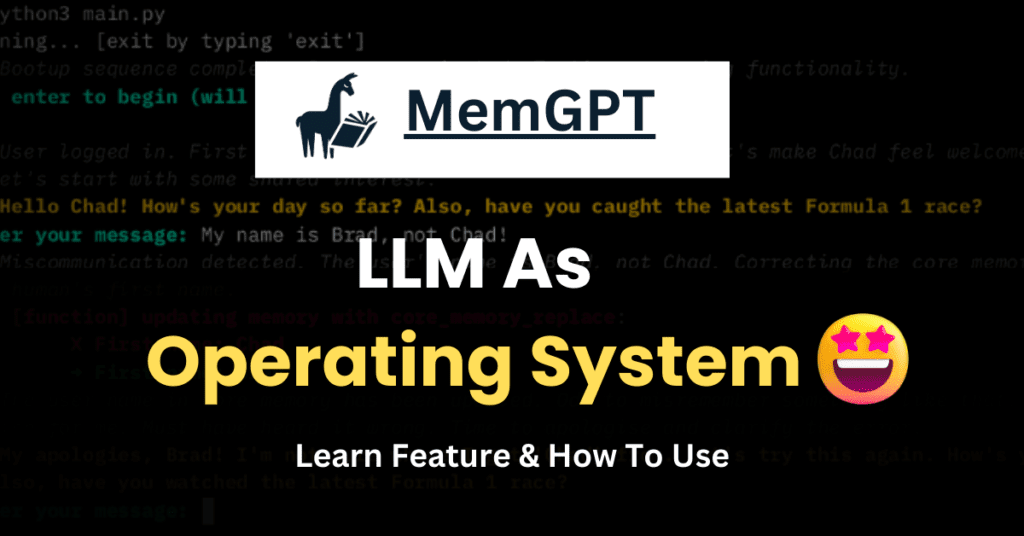
In a world where technology is constantly evolving, something extraordinary has happened: a groundbreaking technique has been introduced, and it’s called MemGPT. MemGPT takes a large language model (LLM) and turns it into an operating system, which is pretty unique. If you’re an older tech enthusiast, you might already be familiar with how operating systems function. However, for the younger generation, let’s quickly recap the fundamentals of operating systems.
Operating Systems: A Memory Perspective
Operating systems (OS) are the heart and soul of any computer. They come equipped with two key types of memory: primary memory (RAM – Random Access Memory) and secondary memory (usually a hard disk or SSD). The RAM isn’t vast – your computer may have around 16-32 gigs of it. But the secondary memory, such as a 256 GB or 512 GB hard disk, offers much more storage. The OS constantly swaps data between these two types of memory to ensure seamless operation.
The OS creates something called virtual memory. This virtual memory relies on data transfer between fast and slow memory (similar to the primary and secondary memory) to give the illusion of a massive memory space. This concept has been around for years, allowing us to use computers, smartphones, and tablets effectively.
.
MemGPT: A Paradigm Shift
Now, imagine applying the same concept to Large Language Models (LLMs). LLMs have transformed the AI landscape, but they have limitations, particularly in extended conversations and document analysis, due to their constrained context windows. To overcome this, MemGPT introduces the concept of “virtual context management.” It draws inspiration from hierarchical memory systems in traditional operating systems to create the illusion of an expansive context window.
What is MemGPT?
MemGPT, or MemoryGPT, is a system designed to intelligently manage different memory tiers within LLMs, allowing them to operate effectively beyond their limited context window. This opens up possibilities for long and uninterrupted conversations. This system knows precisely when to save critical information to a database and when to retrieve it later in a conversation.
.

.
How MemGPT Works?
MemGPT lets the LLM manage its own memory. When you send a message, the LLM handles the memory operations. It can either respond to your message or update its memory, learning about you and your conversation.
.

.
Example: Memory Updates
For instance, if you mention a birthday or favorite cake, MemGPT updates its working memory. So when it wishes you a happy birthday, it remembers your preferences. It’s like your LLM has a scratchpad in the back of its mind where it jots down important details.
.
Practical Application: Give MemGPT a Spin!
You can try out MemGPT as a conversational agent in Command Line Interface (CLI) mode by running ‘main.py’ :
python3 main.py
Additionally, you can create a new user or persona for MemGPT by simply creating a .txt file in the appropriate directory and using the ‘–persona’ or ‘–human’ flag when running ‘main.py.’
Learn More About How To Use Here
.
Interactive CLI Commands
While using MemGPT through the CLI, you can use various commands:
- /exit: Exit the CLI.
- /save: Save a checkpoint of the current agent/conversation state.
- /load: Load a saved checkpoint.
- /dump: View the current message log.
- /memory: Display the current contents of agent memory.
- /pop: Undo the last message in the conversation.
- /heartbeat: Send a system message to the agent.
- /memorywarning: Send a memory warning system message.
.
Support and API Access
By default, MemGPT uses the gpt-4 model, so your API key will require gpt-4 API access.
.
The Limitation: GP4 Dependency
It’s important to note that MemGPT currently relies on the GP4 model fine-tuned for function calls. Other models, including GP3.5, have shown limitations in generating correct function calls. So, for those with GP4 API access, this exciting journey into MemGPT’s capabilities awaits!
In a world where LLMs are becoming increasingly versatile, MemGPT stands as a testament to the power of innovation. This breakthrough opens up a world of possibilities, ushering in an era where we can redefine what it means to interact with language models. Whether it’s for perpetual chats, self-editing memories, or expansive conversational agents, MemGPT is leading the way into a bright future.
.
FAQ :
.
In Conclusion: A Bold New Direction
MemGPT represents a revolutionary step in AI development. It essentially transforms LLMs into operating systems, granting them the ability to manage their own memory and operate beyond the constraints of limited context windows. With MemGPT, we can create conversational agents capable of remembering, reflecting, and dynamically evolving through long-term interactions with users.
Intriguingly, the MemGPT code and data for experiments are available for those who want to dive deeper into this transformative technology. You can access them at https://memgpt.ai. and also use on Discord and on Local Machine!



 Login with Google