
By the end of 2025, something felt off in the tech markets.
One week, AI stocks were flying high, pulling entire indexes up with them. The next, they were tumbling just as fast. Big deals were announced, debt was raised, valuations climbed higher — and then suddenly, fear crept in. Was this still a healthy boom, or the early cracks of an AI bubble?
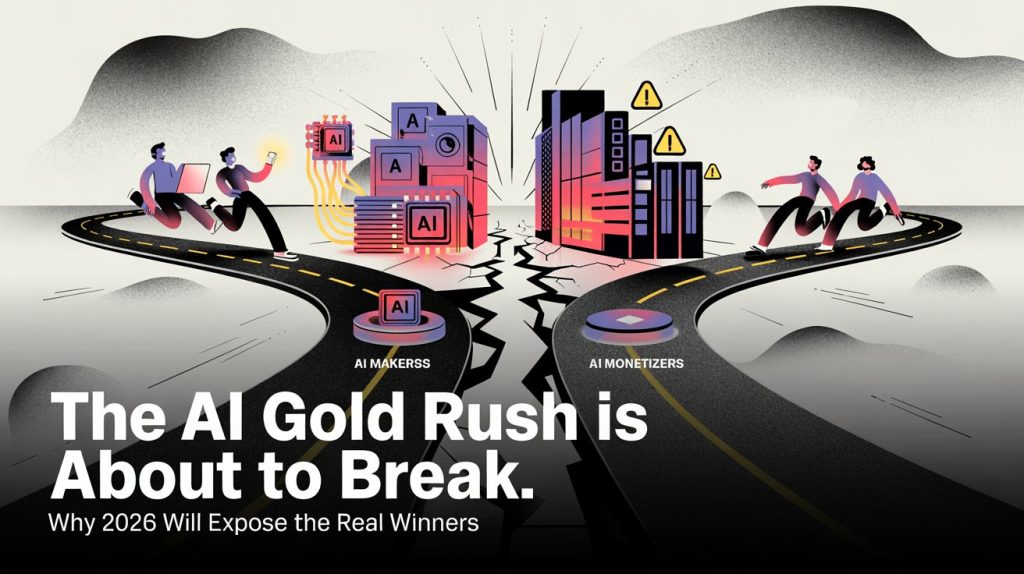
Market watchers say this wild ride may be sending an early warning. According to investors closely tracking the space, 2026 could be the year the AI market splits apart — sharply. Not everyone will win anymore.
And that changes everything.
From “Everyone Wins” to “Show Me the Money”
For the past two years, AI investing has felt simple. If a company mentioned artificial intelligence — even once — its stock often jumped. ETFs bundled dozens of AI-linked names together, and retail investors poured in without worrying too much about the details.
Stephen Yiu, chief investment officer at Blue Whale Growth Fund, says that approach may soon stop working.
“Up to now, every company seems to be winning,” Yiu said in recent comments. “But AI is still in its early innings. Very soon, it will be important to differentiate.”
That word — differentiate — keeps coming up.
The AI market, Yiu argues, has been treated as one big story. But in reality, it is made up of very different players, with very different risks.
And the market is finally starting to notice.
Three AI Camps, One Big Reality Check
Yiu breaks the AI world into three main groups.
First are the private AI labs and startups. Think OpenAI, Anthropic, and a growing list of model builders promising smarter, faster, more powerful systems.
Second are the big AI spenders — giants like Amazon, Microsoft, Meta, and Google — writing massive checks to build data centers, buy chips, secure land, and lock down energy.
Third are the infrastructure sellers, the companies quietly cashing in by selling the “picks and shovels” of the AI gold rush. Nvidia and Broadcom sit firmly in this camp.
For years, investors treated all three as part of the same trade. In 2026, that may no longer hold.
The Startup Boom: Big Money, Big Questions
Private AI labs continue to attract staggering sums. According to PitchBook data, AI startups pulled in $176.5 billion in venture capital in just the first three quarters of 2025.
That number alone tells you how strong belief in AI still is.
But belief is not a business model.
Many of these companies are racing to build better models, but clear paths to profit remain uncertain. Training costs are high. Compute is expensive. Competition is fierce.
Investors are starting to ask harder questions: Who will pay for this? How much? And when?
The money may keep flowing in 2026, but scrutiny will rise. Optimism alone will not be enough.
Big Tech’s Spending Problem
While startups chase funding, Big Tech is doing the spending.

Amazon, Microsoft, Meta, and Google are pouring billions into AI infrastructure. They are buying GPUs in bulk, building massive data centers, and locking in power supplies for years ahead.
This marks a major shift.
Once, these companies were asset-light software machines. Now, they are becoming something closer to industrial giants — heavy on capital, heavy on risk.
Dorian Carrell, head of multi-asset income at Schroders, says this changes how they should be valued.
“We’re not saying it’s not going to work,” Carrell said. “But should you pay such a high multiple with such high growth expectations already baked in?”
That is the key concern.
If AI revenue grows slower than AI costs, margins shrink. And when margins shrink, stock prices follow.
Debt Enters the Chat
To fund this massive build-out, some tech giants have turned to the debt markets.
Meta and Amazon both raised money this way in 2025. So far, analysts say the situation is manageable. These companies still hold strong cash positions.
But debt brings pressure.
Ben Barringer, global head of technology research at Quilter Cheviot, says balance sheets matter more than ever now. There is a big difference between companies borrowing from strength and those stretching thin.
As private debt markets heat up in 2026, investors will watch closely. If AI spending keeps rising without clear payback, patience could wear thin.
The Quiet Winners: Selling the Tools
While AI spenders face growing pressure, infrastructure suppliers are sitting in a stronger position — at least for now.
Companies like Nvidia and Broadcom are directly on the receiving end of AI spending. They sell the chips, networking gear, and components everyone else needs.
Yiu says this is where his firm prefers to be.
“When I’m looking at valuations in AI, I would not want to position into the AI spenders,” he said. “I would rather be on the receiving end.”
It is a classic gold rush lesson. The people selling shovels often make steadier money than the ones digging.
But even here, risks exist. Hardware depreciates. Chips age fast. And competition never sleeps.
Where the Real Bubble Risk Lives
Despite the noise, not everyone believes the entire AI market is overheated.
Julien Lafargue, chief market strategist at Barclays Private Bank, says the “froth” is concentrated — not widespread.
The biggest danger lies with companies riding the AI wave without real earnings.
Some quantum computing-related firms fall into this category. They benefit from AI hype but have little to show on the profit side.
“In these cases, investor positioning seems driven more by optimism than tangible results,” Lafargue said.
In simple terms: hope is doing more work than revenue.
That is rarely a good sign.
2026: The “Prove It” Year
Across Wall Street, one phrase keeps coming up when people talk about the future of AI: prove it.
Spending will continue. That much seems certain. AI is now a strategic priority, not a side project.
But announcements will no longer be enough.
Investors will demand evidence — real products, real customers, real cash flow.
If AI revenue does not outpace rising costs for power, chips, land, and maintenance, profit margins will come under pressure.
Yiu warns that depreciation is a hidden risk many investors are not yet factoring in.
“It’s not part of the P&L yet,” he said. “Next year onwards, gradually, it will confound the numbers.”
When those costs finally hit earnings reports, surprises may not be pleasant.
A Market That No Longer Moves Together
One of the biggest changes in 2026 may be how uneven AI stock performance becomes.
In the past, AI news lifted almost everyone. Going forward, gaps could widen sharply.
Companies with clear, profitable AI monetization may rise. Others may stall or fall, even if they keep spending.
The idea that “AI equals growth” will no longer be automatic.
Differentiation will rule.
What This Means for Investors
For everyday investors, especially those holding AI ETFs, the shift could be uncomfortable.
These funds often bundle together startups, spenders, and suppliers — very different businesses with very different futures.
As the market gets more selective, blanket exposure may not deliver the same results.
The AI story is not ending. Far from it.
But it is changing tone.
The Bottom Line
The AI boom of 2025 was loud, fast, and broad. Almost everyone felt like a winner.
2026 looks different.
It may be the year when the market stops cheering and starts counting. Counting costs. Counting cash flow. Counting real returns.
The split is coming — between those who make money from AI, those who burn money for AI, and those who sell the tools.
And once that split becomes clear, the ride could get a lot rougher.
For investors, the message is simple, even if the future is not: in the age of AI, belief is powerful — but profits still matter.




 Login with Google