
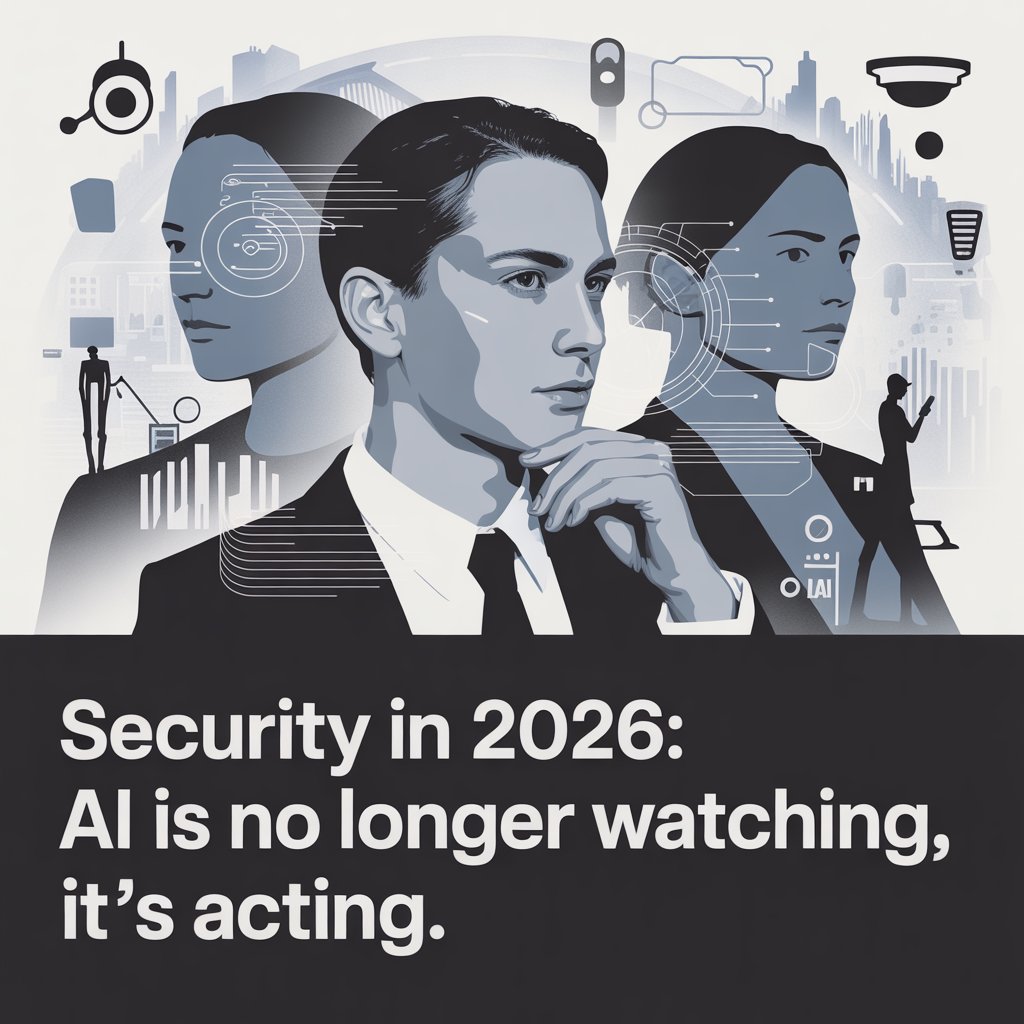
What sounded like hype just two years ago is now running real buildings, real cities, and real security teams. Here’s what’s actually happening behind the scenes.
In late 2023 and early 2024, the security industry was drowning in big promises. AI would “change everything.” Digital twins would “predict disasters.” Wearables and smart glasses would “replace human guards.”
Many of those claims felt rushed, half-baked, or stuck inside demo videos and conference slides.
But as 2026 approaches, something has clearly shifted.
This time, the change isn’t loud. It’s quiet, practical, and already happening in control rooms, data centres, airports, hospitals, ports, and corporate campuses across the world.
Security leaders are no longer asking what these technologies could do one day. They are dealing with what these systems are already doing, every hour, in live environments.
Three forces are now shaping security operations in a very real way: Agentic AI, Digital Twins, and Wearables powered by Augmented Reality (AR). Together, they are moving the industry from reaction to prediction, from manual work to machine-assisted judgment.
And unlike past tech waves, this one is sticking.
Agentic AI: When AI Stops Assisting and Starts Acting
AI in security is not new. Cameras have had analytics for years. Software has flagged alerts and anomalies for a long time.
What’s new in 2026 is Agentic AI — systems that don’t just analyse data, but take structured actions across multiple systems, without waiting for humans to glue everything together.
In simple terms, this is AI that works like a junior operator who never gets tired.
Instead of a human opening five dashboards, checking camera footage, pulling access logs, and calling someone to confirm details, an agentic AI does it in seconds. It ingests video feeds, access control data, sensor alerts, and environmental signals. It spots patterns, checks history, and prepares a clear summary.
In some deployments, it goes one step further.
When an alarm triggers, the AI doesn’t just notify a human. It gathers the last 30 minutes of relevant footage, correlates badge swipes, checks whether the behaviour matches past incidents, and then suggests a response — sometimes even initiating that response, waiting only for approval.
Security teams say the biggest benefit isn’t automation. It’s time.
Operators are no longer buried in data. They are presented with context. Decisions happen faster. Mistakes caused by overload go down. Fatigue matters less.
This shift is reflected in money, not just words. Industry forecasts now show Agentic AI taking more than 26% of global IT spending growth, with investment expected to cross US$1.3 trillion by 2029. That doesn’t happen unless companies see real returns.
The key lesson for organisations heading into 2026 is simple: stop experimenting in isolation. The winners are mapping out repeatable workflows — incident triage, patrol planning, evidence collection — and letting AI handle the boring, error-prone middle steps.
The question has changed from “Can AI do this?” to “Why are we still doing this manually?”
Digital Twins: From Fancy Models to Mission-Critical Tools
For years, digital twins sounded impressive but distant. A “virtual replica” of a building or facility felt more like a marketing phrase than a daily tool.
That perception is now outdated.
In 2026, digital twins are becoming operational backbones for large, complex environments. These are not static 3D models. They are live systems, constantly updated by cameras, sensors, access points, fire alarms, and environmental monitors.
Major technology players, including NVIDIA, are already using digital twins to manage massive data centres. Every door, corridor, rack, and sensor exists both physically and digitally, always in sync.
For security teams, the value is immediate.
Instead of guessing what might happen during an incident, teams can simulate it safely. What happens if one corridor is blocked during a fire? How does foot traffic change? Where do bottlenecks form? What if a lockout is triggered on one floor — does it affect emergency exits elsewhere?
These simulations are no longer theoretical exercises. They directly shape standard operating procedures, physical layouts, and technology placement.
For large sites like airports, ports, and multi-tenant towers, digital twins solve a long-standing problem: drift. Over time, systems change, upgrades happen, and documentation falls behind. A live digital twin shows what is actually happening, not what the blueprint says.
It also speeds up investigations. After an incident, teams can replay events across systems in one unified view, instead of stitching together logs from different vendors.
Looking forward, this changes how risk is managed. Instead of waiting for incidents to learn lessons, organisations can test decisions before making them real. Training, investments, and infrastructure planning become data-driven, not reactive.
Security slowly shifts from responding to the past to preparing for the future.

Wearables and AR: The Frontline Finally Gets Smarter Tools
Wearables and AR have had a rough journey. Early smart glasses were bulky. Interfaces were awkward. Many pilots quietly failed.
But in 2026, they are returning — and this time, they are different.
The difference is AI.
When combined with intelligent systems, wearables stop being cameras on a head or sensors on a wrist. They become real-time decision companions.
A guard wearing smart glasses can receive alerts in their field of view without looking down at a phone. An AR overlay can highlight a door that was forced open earlier. A voice assistant can answer questions like, “When was this area last checked?” or “Show me the last suspicious activity here.”
Crucially, these systems understand natural language. Guards don’t need to learn complex menus. They speak. The system responds.
This keeps hands free and attention focused on the environment — a small detail that makes a big difference in tense situations.
The market numbers tell a similar story. Global AR spending is projected to grow from US$35.8 billion in 2024 to over US$233 billion by 2030, with most of the money flowing into software and enterprise services. That signals real operational use, not consumer gadgets.
Adoption is still uneven. Not every site is ready. Battery life, comfort, and privacy concerns remain. But the direction is clear.
The future security worker will be augmented, not replaced.
The Bigger Picture: Integration Over Innovation Theater
What connects all three trends is not the hardware or the algorithms. It’s integration.
Agentic AI only works when systems can talk to each other. Digital twins only matter if they reflect real operations. Wearables only help if they deliver the right insight at the right moment.
For security leaders in 2026, the playbook is becoming clearer:
- Invest in platforms with open, auditable APIs
- Use digital twins to test and refine SOPs before incidents happen
- Pilot wearables where they reduce decision time, not just add novelty
Success is no longer measured by flashy demos. It’s measured by response times, reduced false alarms, and operator confidence.
After years of hype, security technology is finally growing up.
These tools are no longer promises. They are partners.



 Login with Google