
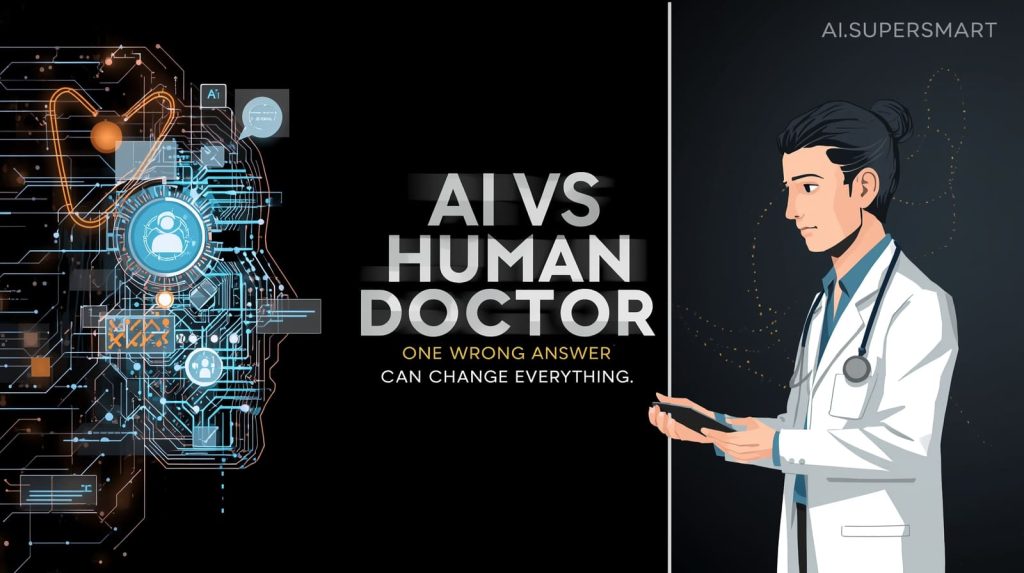
Your Doctor or a Chatbot? This One Choice Could Decide Your Life, Say Experts
AI is everywhere, even in your clinic. But when it comes to your health, doctors warn: one wrong click, one wrong answer, and the damage can be permanent.
In a crowded Delhi OPD, a doctor barely has five minutes per patient. In Mumbai traffic, reaching a clinic can take longer than the consultation itself. So when an AI chatbot promises instant medical answers on your phone, no queues, no fees, no judgement, it feels like a small miracle.
Type your symptoms. Press enter. Diagnosis delivered.
Across India, from metro cities to small towns, “Dr Chatbot” is fast becoming the first point of care. Young professionals use it late at night. Elderly patients ask their children to check symptoms online. Some even follow AI advice without ever seeing a real doctor.
But behind this quiet digital shift, doctors are worried. Not because AI exists, but because people are starting to trust it blindly.
“This is not Google search anymore,” says a senior physician from Mumbai. “People are taking decisions that can change their lives.”
AI can be fast. It can be smart. But can it replace the human doctor sitting across the table, reading your face, touching your pulse, and hearing what you don’t say out loud?
Most experts say no. And they point to five dangerous questions where AI still falls short, sometimes with deadly consequences.
The New Doctor in Your Pocket
Medical AI chatbots have improved a lot in the last two years. They can now analyse symptoms, suggest possible conditions, explain reports, and even draft prescriptions. Some hospitals already use AI for triage, reminders, and follow-ups.
But this rise has also created a false sense of safety.
“People think if AI sounds confident, it must be correct,” says a Bengaluru-based public health researcher. “That’s a very risky assumption.”
Unlike a human doctor, AI doesn’t see you. It doesn’t hear fear in your voice. It doesn’t notice sweat, weakness, or hesitation. It only sees text.
And in medicine, what you don’t type can matter more than what you do.
1. “Is This Small Symptom Really Nothing?”
This is where many stories turn tragic.
A chatbot depends fully on how you describe your problem. If you say “painless lump,” it checks probabilities and may say it’s likely harmless.
But a real doctor does more.
They touch the lump. They check how hard it is, whether it moves, whether it’s attached to deeper tissue. They notice your skin colour, weight loss, tired eyes.
In one widely discussed case, a woman kept searching online for stomach pain. The answers suggested acidity and stress. Months passed. When she finally saw a specialist, it was stomach cancer, already at stage 3.
Doctors call this “opportunistic screening.” While treating one issue, they spot another quietly growing problem. AI cannot do this. It only answers what you ask.
Medicine is not just about symptoms. It’s about observation.
2. “Does My Lifestyle Change This Diagnosis?”
India is not one country when it comes to health. Diets, habits, pollution levels, work stress, and even sleep patterns vary sharply.
A chatbot trained mostly on Western data may not understand Indian realities.
For example, a patient who fasts regularly for religious reasons. Or someone who eats a high-carb vegetarian diet. Or a factory worker exposed to dust and chemicals daily.
A local doctor understands this context without asking 20 questions.
They know how diabetes behaves differently here. They know heart disease strikes Indians earlier. They know pollution-related lung issues are rising even in non-smokers.
This is sometimes called the “Indian phenotype,” a mix of genetics and lifestyle unique to the region. AI still struggles to personalise advice at this depth.
One wrong assumption, one missed detail, and the treatment advice can go completely off track.

3. “Am I Explaining My Pain the Wrong Way?”
This problem is bigger than people realise.
India speaks many languages. English is often mixed with Hindi or local words. Pain is described emotionally, not clinically.
A recent MIT study found that large AI models can be influenced by spelling mistakes, slang, and dramatic language. In simple terms, how you write can change the medical advice you get.
If someone types, “My chest is feeling weird, kinda tight, yaar,” the AI may not flag it as a medical emergency.
Researchers found AI errors increase by 7–9% when patients use informal or non-standard language. That gap can decide whether someone rushes to the hospital or stays home.
A human doctor listens beyond words. They interrupt, clarify, and sense urgency. AI doesn’t interrupt. It assumes.
4. “Does My Family History Change Everything?”
AI can scan records, but it doesn’t remember people.
A doctor remembers that your father had a heart attack at 45. That your mother reacts badly to certain medicines. That you were unusually anxious during your last visit.
This memory builds over years. It helps doctors spot patterns early.
In India, family history plays a major role in diabetes, blood pressure, heart disease, and even mental health. Often, patients don’t even mention these details unless prompted.
A chatbot only works with what you feed it in that moment. It doesn’t connect your past fear, hesitation, or family stories into a bigger picture.
Doctors do that quietly, almost instinctively.
5. “If Something Goes Wrong, Who Is Responsible?”
This is the most uncomfortable question.
If a chatbot gives wrong advice, who do you blame?
There is no medical council for algorithms. No ethics hearing. No licence to suspend.
A human doctor works under strict rules. They are accountable. They carry legal, ethical, and moral responsibility for your care.
When decisions involve high risk, like surgery, cancer treatment, or end-of-life care, numbers alone are not enough.
Doctors weigh emotions, family wishes, dignity, and quality of life. AI weighs data.
Medicine is not only science. It is trust.
What Indian Research and Policy Say
Indian authorities are not against AI in healthcare. In fact, they support it strongly, with conditions.
The Indian Council of Medical Research clearly states AI should assist doctors, not replace them. Final decisions must always rest with a qualified clinician.
NITI Aayog’s #AIforAll initiative promotes AI use in remote areas, but only through validated platforms with doctor oversight.
A 2024 Deloitte India survey found something interesting: patient trust in fully automated systems has slightly declined. People still want a human touch, especially when things get serious.
What Has Changed in 2024–2025
Medical AI is better now. It can handle complex symptom descriptions, draft reports, and support chronic disease monitoring.
But studies also show the same weaknesses remain: language confusion, overconfidence, and poor handling of rare cases.
That’s why the global medical community now talks about a “hybrid model.”
Let AI handle speed. Let doctors handle judgement.
Chatbots can help with basic questions, reminders, and early screening. Doctors must remain in charge of diagnosis and treatment.
The Bottom Line
This is not a war between humans and machines.
AI is a powerful tool. But it is still a tool.
For Indian patients, the safest path is simple: use chatbots for information, not decisions. When symptoms persist, worsen, or feel unusual, see a real doctor.
A chatbot can guide you. But only a doctor can truly care for you.
And in medicine, that difference still matters more than speed.
Disclaimer: This article provides general information only and is not a substitute for professional medical advice. Always consult a qualified doctor for diagnosis and treatment.


 Login with Google