
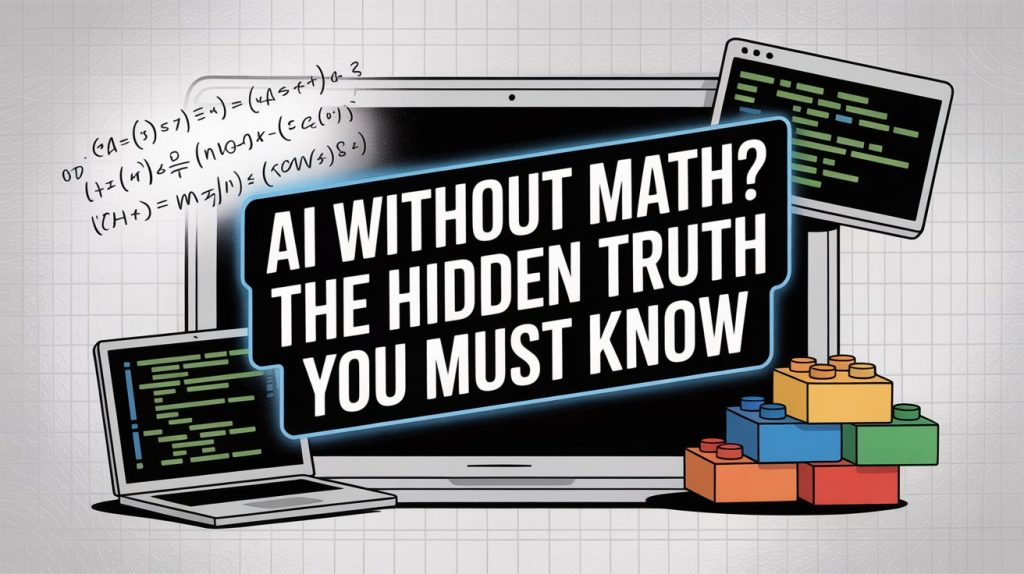
Imagine a world where anyone — yes, literally anyone — can jump into one of the most complex fields in technology without knowing the first thing about equations, probability, or calculus. Sounds impossible, right? But that’s exactly what’s happening in Artificial Intelligence (AI) and Machine Learning (ML) today.
With slick tutorials, drag-and-drop tools, and plug-and-play libraries, you don’t need to be a math wizard anymore to start building AI models. College dropouts, teenagers, or even people switching careers late in life are launching AI-powered apps without ever opening a linear algebra textbook.
But here comes the twist — while you can start without math, you probably shouldn’t stay there.
This is the growing debate shaking the AI education world in 2025: Is math optional, or is skipping it a dangerous shortcut that leaves learners stranded when the going gets tough? Let’s break it down like a reporter on the tech beat.
The Rise of Math-Free AI: How Beginners Are Hacking Their Way In
Scroll through YouTube today, and you’ll see thousands of tutorials with titles like “Build an AI in 15 minutes!” or “No Math Needed: Train Your Own Model”. It sounds like clickbait, but it’s not far from the truth.
Platforms like TensorFlow, PyTorch, and Scikit-learn have done the heavy lifting. The math is buried deep in the code. Beginners never touch it. Instead, they just import a library, feed it data, and watch as magic happens.
Here’s what entry-level learners are doing right now:
- Pre-built models & APIs: Tools like Hugging Face Transformers or OpenAI’s APIs let you summon powerful language models or image generators with just a few lines of code.
- Project-based learning: Coursera, Udemy, and YouTube tutorials guide learners step by step. No formulas, no theories — just results.
- AutoML platforms: Services like Google Cloud AutoML and Azure ML Studio give a Lego-block feel to AI. Drag, drop, and boom — a working model.
It’s democratization at its finest. Twenty years ago, AI was locked inside elite research labs. Today, a motivated teenager in Nairobi, Mumbai, or São Paulo can build an AI chatbot from their bedroom.
The Dangerous Illusion: Why Math Still Matters
But here’s the catch: this shortcut creates an illusion of mastery. You might think you’re an AI engineer when, in reality, you’re just a user of someone else’s code.
As every serious researcher warns — math is the language of machine learning. And like any language, if you don’t know the grammar, you’ll soon hit a wall.
Take this example: You’re training a neural network. Suddenly, your model is “overfitting” — performing great on training data but terribly on new data. Without understanding probability or statistics, you’re stuck in trial and error.
Or imagine tuning a model. Why does gradient descent work? What’s the meaning of a “learning rate”? Without basic calculus, you’re just guessing.
Here’s what math unlocks:
- Model Interpretability: Understanding why your model spits out certain results instead of blindly trusting it.
- Optimization: Going beyond trial and error to systematically improve performance.
- Algorithm Design: Building custom solutions instead of living inside black-box tools.
- Critical Thinking: Spotting biases, flaws, and unrealistic assumptions in your data.
Think of it like driving a car. Today’s AI tools give you the keys. You can press the pedal and go. But without knowing how the engine works, you won’t be able to fix it when it breaks — or build a faster one.
Industry Voices: The Great Divide
Talk to recruiters, and you’ll hear a clear divide in 2025’s AI job market.
On one side, entry-level roles now welcome non-math learners. Companies hire people who can quickly apply ready-made models for customer service bots, content tools, or data cleaning pipelines. “We value speed and creativity,” says one hiring manager at a U.S.-based startup. “We don’t care if you know calculus as long as you deliver a working prototype.”

But cross over into advanced AI research or high-paying senior roles, and the tone changes fast. Google, OpenAI, DeepMind, and other research-driven labs still demand strong math foundations. These are the people inventing new algorithms, not just using them.
A senior engineer at a European AI lab put it bluntly: “If you don’t know the math, you’re replaceable. The tools are easy. Anyone can use them. But the ones who can invent, those are rare.”
In short: skipping math may get you into the AI club, but it won’t get you into the VIP room.
The Emotional Side: Hope, Frustration, and Reality Checks
For beginners, this math question is not just academic — it’s emotional. Many people avoid AI because math scares them. They remember struggling with algebra in school and fear they’ll never keep up.
When they discover that they can start building AI without math, the relief is overwhelming. Social media is full of people celebrating: “I built my first AI chatbot with no math at all!”
But then comes frustration. After months of tinkering, they realize they don’t understand why their models work — or why they don’t. Tutorials stop making sense. Job applications ask about concepts they can’t explain. The dream starts cracking.
It’s like climbing a ladder where the first five steps are easy, but the rest are missing. Unless you start learning math, you’re stuck halfway up.
Global Trends: AI Literacy Without Borders
Here’s where the story gets bigger. This isn’t just about individuals. It’s a worldwide education shift.
Governments in Asia, Africa, and South America are investing in AI bootcamps for young learners. Many of these programs advertise: “No Math Needed — Just Bring Curiosity.”
It’s a smart move — millions of students can get excited about AI without fear. But experts warn that nations risk producing armies of “button pushers” who rely only on foreign-built tools.
In contrast, countries like China, Germany, and the U.S. are doubling down on math-heavy AI curriculums at the university level. They want not just users but inventors — the people who design the next generation of AI algorithms.
This global split may shape the future balance of AI power.
The Balanced Path: Hands-On First, Math Later
So what’s the right approach for learners in 2025? Experts suggest a middle road.
Start hands-on. Build projects. Use tools. See the magic of AI in action. That excitement is fuel. But don’t stop there. Slowly, start picking up the math in parallel.
Here’s a roadmap educators recommend:
- Start with intuition: Use visuals and analogies instead of equations at first.
- Learn just enough: Focus on statistics, linear algebra, and calculus basics directly tied to ML.
- Apply as you learn: Don’t memorize formulas. Connect them to the models you’re building.
- Climb gradually: Move from AutoML to custom tweaks, then deeper into algorithm design.
This approach keeps learners motivated while ensuring they don’t stay trapped in surface-level understanding.
The Final Word: The Shortcut That Becomes a Dead End
So, can you learn AI without math? The answer remains a big, bold yes. Thousands are doing it every day, and it’s opening doors for people who once thought AI was out of reach.
But the hidden truth is just as clear: staying math-free will eventually leave you stuck. The tools may get smarter, but the people who understand the math behind them will always have the edge.
As one AI educator summed it up: “AI without math is like cooking with pre-made packets. You’ll get a meal, but you’ll never be a chef.”
And in a world where AI is shaping economies, healthcare, security, and even politics, being a chef — not just a microwave user — is the difference between surviving and thriving.
Conclusion
The rise of math-free AI learning is one of the most exciting education revolutions of our time. It lowers barriers, inspires millions, and fuels innovation across the globe. But it also carries a warning.
If you treat math as optional forever, you’ll find yourself locked out of the deeper rooms where the real breakthroughs happen.
So here’s the headline takeaway for 2025: Start without math if you must, but don’t stop there. The future of AI belongs to those who can mix creativity with equations, intuition with rigor, curiosity with discipline.
In the end, it’s not math versus no math. It’s about balance. And those who master both will write the next chapter of the AI story.

 Login with Google