
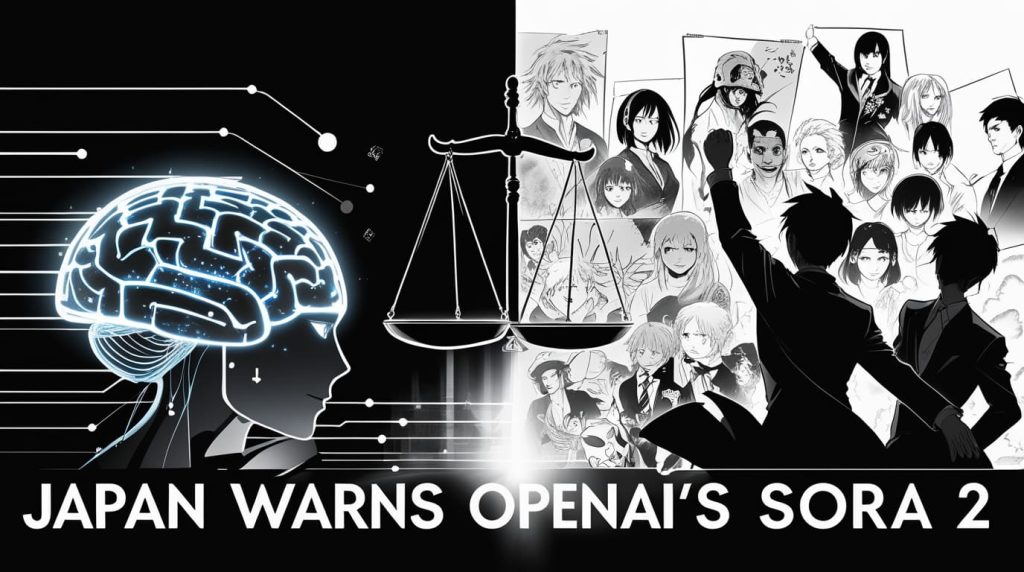
In what might become a landmark moment for creative rights in the age of artificial intelligence, 17 major Japanese publishers—along with influential industry bodies—have issued a joint warning to OpenAI over its new video-generation app Sora 2, saying it risks infringing the very foundations of Japan’s anime and manga culture.
The joint statement, released on 31 October, says the publishers are ready to undertake legal and other action against Sora 2’s use of copyrighted material without prior approval. The move underscores how national cultural treasures are colliding with burgeoning AI technology.
Who’s behind the warning?
Among the signatories are heavyweights such as Kadokawa Corp., Kodansha Ltd. and Shogakukan Inc.—three of Japan’s largest manga/anime publishers. The notice also bears the names of the Association of Japanese Animations and the Japan Cartoonists Association, giving the statement industry-wide weight.
In parallel, the anti-piracy organisation Content Overseas Distribution Association (CODA) submitted a request to OpenAI on 28 October, asking the company to stop training Sora 2 on member firms’ content without their consent. That body represents other major companies such as Shueisha Inc. and Toei Animation Co..
What’s at stake — and why they’re angry
Sora 2 is no ordinary app. Developed by OpenAI, it allows users to generate short videos using text prompts, including realistic likenesses of people and animated characters. According to OpenAI’s own description, users can upload themselves and drop their likeness into any Sora-generated environment.
The problem, as the publishers see it, is this: large arrays of anime/manga characters and scenes are being reproduced or “echoed” inside Sora 2. The publishers claim that they were not asked for consent to allow their works to be used in the training or generative process of the AI. The joint statement states clearly:
“Approval must be obtained from the publishing companies for copyright use during the learning and generative processes by the AI app.”
In other words: you can’t assume it’s okay to feed our works into your AI, or generate new works based on them, without our say-so.
They frame this as both a cultural and economic issue: anime and manga are more than entertainment—they are part of Japan’s national brand, worldwide export success, and intellectual-property ecosystem. If Sora 2 simply mashes them up without permission, the creators, artists, rights-holders and publishers say their efforts, investments and reputations are being undermined.
Legal and ethical lines drawn
By issuing this statement, the publishers are signalling that future action isn’t just rhetoric. They warn of “appropriate action from a legal and ethical perspective … to protect the efforts and dignity of everyone involved in the creative process.”
Legally speaking, they point out that under Japanese copyright law it is not enough to say “we’ll remove it later if you object.” Training an AI model on copyrighted works without prior approval may itself be infringement. CODA’s letter to OpenAI underscores this, arguing that the “machine-learning process itself … may constitute copyright infringement.”

Ethically, the publishers say this is about creative dignity—which could include the rights of individual manga artists, cartoonists, animators and even voice actors, to decide how their work is used. When AI comes in and says “we’ll do what we want unless you opt-out,” the industry says that flips the balance.
Japan’s government has also chimed in. The government has formally asked OpenAI to seek prior permission from rights holders rather than relying on opt-out models.
Why this matters—not just for Japan
While this may seem like a Japan-specific spat, the implications are far-reaching.
- Cultural export risk: Japan’s anime and manga industry is not only domestic—it’s global. When Japanese rights are used without permission, it threatens international licensing, localisation, royalties, and creative control.
- Precedent for creative industries: If Japanese publishers force OpenAI to change Sora 2’s business/technical model, similar bodies in other countries may follow suit. Rights holders in Hollywood, games, literature are watching.
- AI training morality: The question of whether AI systems should be allowed to learn from copyrighted works without permission is a global hot-button. Japan’s stance may mould future regulation and norms.
- Corporate and individual rights: It’s not just about big publishers; creators and individual artists are also involved. If AI takes their work, manipulates it, re-uses it without credit or reward, that affects livelihoods and creative incentive.
What OpenAI says and how they’re responding
OpenAI has acknowledged the concerns. According to press reports, the company announced it would give rights-holders “more granular control” over how their works or likenesses are used in Sora 2.
Specifically:
- They have shifted from an opt-out model (where rights-holders must ask to be removed) to a more robust opt-in or controlled permission model.
- OpenAI has stated they will respond to takedown or removal requests, particularly where the content may be infringing.
- They are working on monetisation models, giving rights-holders possible revenue participation when their characters or works are used.
Still, the Japanese publishers seem far from satisfied. Their warning implies they believe the changes aren’t enough—or not fast enough—and they are willing to escalate if the situation isn’t resolved on their terms.
What’s next?
The weeks and months ahead will likely see a tug-of-war:
- Will OpenAI negotiate individual agreements with Japanese publishers (and other rights-holders) to allow usage of their content in Sora 2 under licence?
- Will the Japanese government move from formal request to regulatory enforcement under the new AI Promotion Act, which gives powers to act on AI/copyright issues?
- Will other countries’ industries see the Japanese move as a template and press their own claims?
- How will the technical design of Sora 2 adapt—will there be filters, blocks, separate models for anime/manga, or licensing layers baked in?
- Will users of Sora 2 see fewer anime/manga-style generations, or will the platform attempt to isolate and permit only licensed works?
Why readers should care
Even if you’re not a die-hard anime fan, this story touches several big themes:
- IP vs AI: How do creative rights hold up in the age of generative AI?
- Cultural heritage: Japan is arguing its anime/manga culture is an “irreplaceable treasure”—should that afford extra protection?
- Global tech regulation: What happens in Tokyo may shape rules in London, New York or Bangalore.
- User-generated content: Many may simply want to make fun videos using beloved characters—but laws, licences and rights could limit that.
- Creator rights: Artists, illustrators and writers may find the tide shifting toward stronger protections—meaning a fairer deal in future.
Final word
The joint warning from 17 Japanese publishers and industry associations to OpenAI over Sora 2 marks a defining moment in the intersection of artificial intelligence and creative property. The message is loud and clear: you cannot treat anime, manga and their characters as raw fodder for AI training and generation—especially not without permission.
Whether OpenAI will swiftly comply, negotiate licences, push back with legal defences, or otherwise adapt remains to be seen. But for the world of AI-generated media, this could be the start of a new era—one where creative rights aren’t optional, but foundational.

 Login with Google