
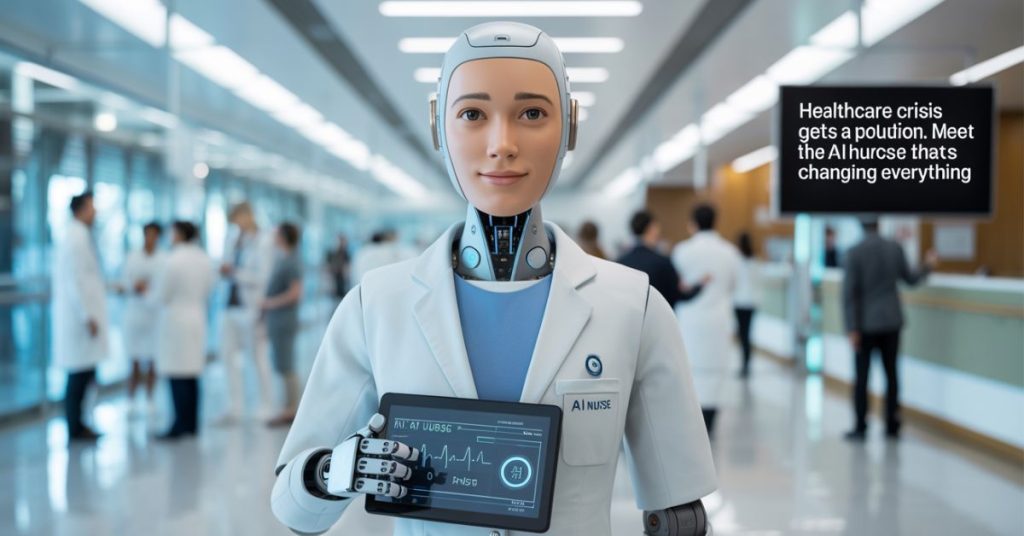
The alarm bells have been ringing in hospitals worldwide for years, but now they’re deafening. We’re staring down the barrel of a healthcare catastrophe that keeps hospital administrators awake at night and leaves patients waiting longer than ever for care. The numbers don’t lie – by 2030, we’ll be short 4.5 million nurses globally, according to the World Health Organization. That’s not just a statistic on paper; it’s real people suffering because there simply aren’t enough hands to help them.
But here’s where the story takes an unexpected turn. While healthcare systems around the world scramble to find solutions, a quiet revolution is brewing in the tech corridors of Taiwan. Meet Nurabot – a humanoid AI nursing assistant that’s already making waves in Taiwanese hospitals and could soon be walking the halls of medical facilities across the globe.
The Perfect Storm Hitting Healthcare
Picture this: You’re a nurse working a 12-hour shift, rushing between patients, delivering medications, transporting samples to labs, and somehow trying to find time for the actual patient care you signed up for. Now multiply that stress by the fact that one-third of your colleagues worldwide are experiencing burnout symptoms so severe they’re considering leaving the profession entirely.
This isn’t some distant future problem – it’s happening right now. The demographic tsunami heading our way makes it even scarier. By 2030, the number of people aged 60 and over will jump by 40% compared to 2019. Even more staggering, by the mid-2030s, there will be more people aged 80 and older than babies on this planet.
Sarah Martinez, a registered nurse at a busy metropolitan hospital, puts it bluntly: “Some days I feel like I’m drowning. There’s just not enough time to do everything properly, and that weighs on you. You got into nursing to help people, not to feel like you’re failing them because there aren’t enough of us.”
Enter the Digital Helper: Nurabot’s Remarkable Story
This is where Nurabot enters the picture, and frankly, its origin story sounds like something out of a sci-fi movie. Developed in just 10 months by Foxconn (the Taiwanese giant known for manufacturing iPhones), in partnership with Japanese robotics powerhouse Kawasaki Heavy Industries and AI leader NVIDIA, this isn’t your typical slow-moving healthcare innovation.
What makes Nurabot special isn’t just its impressive tech specs – though those are pretty remarkable. Standing about human height and moving on wheels, it has two articulated arms that can lift and manipulate objects, multiple cameras and sensors for navigation, and an AI brain that can understand and respond to both verbal commands and visual cues.
The real magic happened during development. Instead of spending years testing in actual hospitals (which would be disruptive and expensive), the team created a complete virtual version of a hospital. The AI learned everything from navigating crowded corridors to handling delicate medical supplies – all in a digital environment that could simulate thousands of scenarios without risking a single patient.
Alice Lin, Foxconn’s director of user design, explains their philosophy: “This is not a replacement of nurses, but more like accomplishing a mission together.” It’s a crucial distinction that addresses the elephant in the room – will robots take nurses’ jobs?
Real Results, Real Impact
The proof, as they say, is in the pudding. Since April 2025, Nurabot has been working alongside human nurses at Taichung Veterans General Hospital in Taiwan, specifically on a ward treating lung diseases, face and neck conditions, including lung cancer and asthma. These are high-stakes environments where efficiency can literally mean the difference between life and death.

The early results are impressive and frankly, a bit surprising even to the developers. Nurabot is reducing daily nursing workloads by 20-30%, according to Foxconn’s data. But here’s what makes those numbers meaningful – it’s not just about making nurses’ lives easier (though that’s important). It’s about freeing up highly trained medical professionals to do what they do best: make critical decisions, provide emotional support to scared patients, and use their years of experience to catch problems that only a human eye might notice.
Dr. James Chen, who oversees the pilot program at Taichung Veterans General Hospital, shares an example: “Yesterday, one of our nurses noticed a subtle change in a patient’s breathing pattern that indicated complications. That’s the kind of observation that requires human intuition and experience. Meanwhile, Nurabot was handling medication deliveries and sample transport – tasks that, while important, don’t require that level of clinical judgment.”
The Technology That Makes It Tick
Let’s talk about what’s actually under Nurabot’s hood, because this isn’t some simple remote-controlled toy. The robot combines Kawasaki’s proven “Nyokkey” service robot platform with Foxconn’s Chinese large language model for communication and NVIDIA’s cutting-edge AI infrastructure.
Think of it as a carefully orchestrated symphony of technologies. NVIDIA’s AI handles the complex task of navigation – imagine trying to program a robot to safely navigate a busy hospital where patients on gurneys, medical equipment, and staff are constantly moving. The language model lets it understand natural speech, so nurses can simply say, “Take this to room 302,” rather than inputting complex codes.
But perhaps most impressively, the robot can learn and adapt. During the virtual training phase, it encountered thousands of scenarios: crowded hallways during shift changes, emergency situations where it needs to move out of the way quickly, and even how to handle dropped items safely.
Mark Thompson, a robotics engineer who’s been following the project, explains: “What sets Nurabot apart is the integration. We’ve seen plenty of robots that can navigate, and AI systems that can understand speech, but combining all these capabilities into something that actually works reliably in a chaotic hospital environment – that’s the breakthrough.”
The Global Context: Why This Matters Now
The timing of Nurabot’s development isn’t coincidental. We’re facing what experts call a “perfect storm” in healthcare. Southeast Asia, where Nurabot was developed, is expected to be among the hardest hit by healthcare workforce shortages. But this problem isn’t limited to any single region.
In the United States, nursing turnover rates hover around 18% annually, with some specialties seeing even higher rates. The average cost to replace a single nurse can range from $40,000 to $100,000 when you factor in recruitment, training, and the productivity loss during transition periods.
The financial implications are staggering. The healthcare robotics market was valued at $72.24 billion in 2025, with the Asia Pacific region showing the fastest growth. This isn’t just venture capital money chasing the next big thing – it’s serious institutional investment in what many see as the future of healthcare delivery.
Not the Only Game in Town
Nurabot isn’t operating in a vacuum. The healthcare robotics revolution is already underway globally. In Singapore, Changi General Hospital operates more than 80 robots assisting with everything from administrative tasks to medicine delivery. In the United States, nearly 100 “Moxi” robots, built by Texas-based Diligent Robotics using NVIDIA’s AI platforms, are already working in hospitals across the country.
But each of these systems has learned from the failures and successes of earlier attempts. Remember the clunky, limited robots of even five years ago? The current generation represents a quantum leap in capability and reliability.
Lisa Rodriguez, a healthcare technology consultant who’s worked with multiple robot implementation projects, notes: “The difference between the robots I saw in 2020 and what’s available now is night and day. These new systems actually understand context, can adapt to unexpected situations, and most importantly, they’re reliable enough for hospitals to trust them with critical tasks.”
The Challenges Nobody Talks About
But let’s be honest – implementing AI nursing robots isn’t all smooth sailing. Rick Kwan, associate dean at Tung Wah College in Hong Kong, raises practical concerns that often get overlooked in the excitement: “You look at hospitals in Hong Kong: very crowded and everywhere is very narrow, so it doesn’t really allow robots to travel around.”
This infrastructure challenge is real and expensive to fix. Most hospitals worldwide were designed around human needs and workflows. Narrow corridors, tight doorways, and layouts optimized for human movement can become obstacles for even the most sophisticated robots.
Then there are the less obvious challenges. What happens when the robot malfunctions during a critical moment? How do you ensure patient data security when these systems are connected to hospital networks? What about the psychological impact on patients who might feel uncomfortable with robot assistance?
Dr. Emily Watson, who led a recent study on nursing robots, found mixed results: “While nurses reported feeling that robots increased efficiency and reduced their physical workload, we found a significant gap between perception and measurable outcomes. Technical malfunctions, communication difficulties, and the ongoing need for training all presented real challenges.”
The Human Factor: Acceptance and Resistance
Perhaps the most complex challenge isn’t technical – it’s human. Healthcare is fundamentally about human connection, empathy, and trust. How do patients and medical staff really feel about robots becoming part of the care equation?
The reactions are surprisingly varied. Maria Santos, a 67-year-old patient who interacted with Nurabot during her recent hospital stay, shares: “At first, I was nervous. But the robot was actually quite gentle, and it meant my nurse could spend more time talking with me about my concerns instead of running around doing errands.”
However, not everyone is convinced. Robert Kim, a veteran nurse with 15 years of experience, expresses caution: “I’m all for anything that makes our job easier, but medicine isn’t just about efficiency. Sometimes the most important part of a nurse’s job is noticing the small things – how a patient’s mood has changed, or catching a problem that isn’t showing up in the standard measurements yet.”
Economic Realities: The Money Question
Let’s talk dollars and cents, because that’s ultimately what will drive adoption. While Foxconn hasn’t announced Nurabot’s retail price, industry experts estimate similar systems could cost between $100,000 to $300,000 per unit, plus ongoing maintenance and software updates.
That might sound expensive until you consider the alternatives. The cost of nursing shortages isn’t just about higher salaries – it includes increased patient complications, longer hospital stays, higher readmission rates, and ultimately, increased mortality. A 2024 study found that adequate nursing staffing could prevent thousands of deaths annually and save billions in healthcare costs.
Hospital administrator Jennifer Park explains the calculation: “If a robot can reduce our staffing needs by even 10-15% while maintaining or improving patient outcomes, it pays for itself within two years. But the real value is in what it enables – better nurse retention, improved patient satisfaction, and the ability to handle our growing patient load without compromising care quality.”
Looking Ahead: The 2026 Commercial Launch
As Nurabot prepares for its commercial debut in early 2026, the healthcare industry is watching closely. The success or failure of this and similar systems could determine whether AI nursing robots become standard fixtures in hospitals worldwide or remain interesting experiments.
Lin from Foxconn acknowledges the pressure: “We know we’re not just launching a product – we’re potentially changing how healthcare works. That’s both exciting and terrifying.”
The integration timeline is ambitious but carefully planned. Later this year, Nurabot will be fully connected to the hospital information system, allowing it to access patient schedules, medication lists, and task assignments autonomously. Think of it as moving from a helpful assistant to an integrated team member.
The Bigger Picture: A Partnership, Not a Replacement
What’s most encouraging about the Nurabot story is the philosophy behind it. This isn’t about replacing human nurses – it’s about amplifying their capabilities. The robot handles the routine, physically demanding tasks that consume time but don’t require human judgment, freeing nurses to focus on patient care, critical thinking, and the emotional support that makes such a difference in healing.
Dr. Amanda Foster, a nursing researcher who’s been following the project, puts it in perspective: “Good nursing has always been about more than just completing tasks. It’s about advocacy, emotional support, clinical judgment, and human connection. If robots can handle the routine tasks, nurses can spend more time on what makes them irreplaceable.”
Global Investment: The Smart Money is Betting Big
The financial backing behind healthcare AI reflects serious institutional confidence in these technologies. Beyond NVIDIA’s involvement, companies like Amazon and Google are investing heavily in the $9.8 trillion healthcare market. Research predicts global AI healthcare spending will reach $36.1 billion by 2025.
This isn’t speculative investment – it’s based on real problems with measurable solutions. The nursing shortage alone is costing the U.S. healthcare system an estimated $90 billion annually in turnover costs, overtime payments, and temporary staffing.
The Verdict: Cautious Optimism
As we approach Nurabot’s commercial launch, the mood in healthcare circles is one of cautious optimism. The demographic trends are undeniable, the technology is finally mature enough to be reliable, and the economic case is compelling.
But success will ultimately be measured not in units sold or efficiency gains, but in whether these digital assistants actually improve patient outcomes and make healthcare more accessible and affordable.
The question isn’t whether AI will play a role in nursing – that ship has sailed. The question is whether we can integrate these technologies thoughtfully, preserving the human elements that make healthcare healing rather than just treatment.
As one hospital administrator put it: “We’re not trying to build robot hospitals. We’re trying to build better human hospitals with really smart tools.”
The healthcare crisis won’t be solved overnight, and AI nursing robots aren’t a magic bullet. But as Nurabot and its counterparts prove their worth in real-world settings, they represent something we desperately need: hope that technology can amplify human compassion rather than replace it.
The revolution in healthcare is here, and it’s walking on wheels down hospital corridors, carrying medicine and hope in equal measure.



 Login with Google