
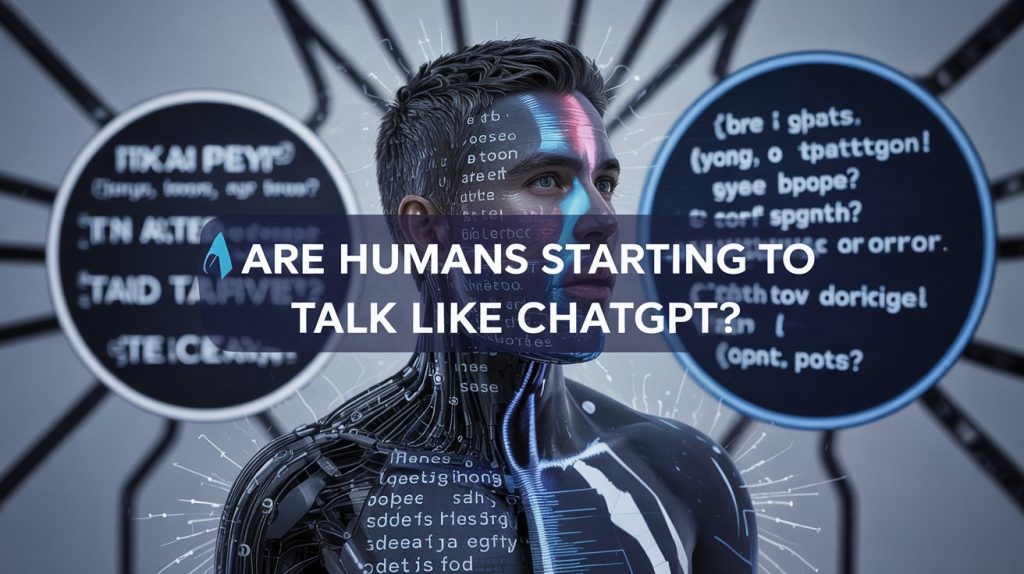
A quiet, unsettling shift is happening in our daily conversations. It’s not loud, not dramatic, and certainly not something most people notice in the moment. But according to a new study, humans across the world are beginning to speak and write in a way that sounds… surprisingly similar to ChatGPT.
And this isn’t just happening on the internet. It’s showing up in our podcasts, our political speeches, workplace memos, and even the way people talk to one another at home.
Researchers say the line between human communication and AI communication is blurring so quickly that one day, we may not be able to tell who shaped whose voice.
A strange, almost eerie cultural feedback loop has begun — and humans are right in the middle of it.
A New Study Sends a Warning: “Humans Are Starting to Sound Like ChatGPT”
The study, conducted by the Max Planck Institute for Human Development, analysed a massive amount of content:
- 360,000+ YouTube videos
- 770,000+ podcast episodes
- Countless comments and transcripts from before and after ChatGPT launched in late 2022
When the researchers compared the language patterns, they found something shocking: around early 2023, the vocabulary used in everyday speech took a sudden, measurable turn toward the type of words ChatGPT often generates.
Words like:
- meticulous
- delve
- realm
- underscore
- bolster
- comprehend
These are not words you usually hear in casual conversation. They sound polished, almost academic. But suddenly they are everywhere — on YouTube explanations, daily vlogs, podcasts, and even lifestyle videos.
The researchers called it an “abrupt and measurable increase.”
Not slow.
Not subtle.
Abrupt.
It was as if millions of people woke up one day and unknowingly started borrowing ChatGPT’s favourite vocabulary.
Reddit Moderators: “Everything Sounds AI, Even When It’s Not.”
The clearest evidence may not be in the data, but in the people who read human stories all day for a living: Reddit moderators.
When Wired interviewed several popular subreddit mods, they all described the same problem — an eerie rise in perfectly structured, polished, emotion-light posts that look like they were written by an AI, but were actually written by real people.
“These communities thrive on human messiness,” one moderator said.
“People share raw, chaotic, emotional stories. But now the writing feels… sanitized. Too neat. Too balanced. Too calm.”
Another moderator explained it simply:
“AI learns from humans. Then humans copy the AI. Then AI copies that new human style again. We’re stuck in a loop.”
This is the feedback loop researchers worry about.
It’s not that AI is replacing humans — it’s that humans are beginning to imitate AI without realising it.
When Parliament Sounds Like a Chatbot
The shift isn’t limited to social media or young internet users. It’s reaching political speech too.
Essayist Sam Kriss noticed something unusual in the UK’s Parliament: lawmakers kept repeating the phrase “I rise to speak.”
That phrasing is far more common in American political speech and is a popular template in AI-generated political writing. But in one single day, UK politicians used it 26 times — an unprecedented spike.
Did AI write those speeches?
No one knows.
But the phrase creeping into political dialogue shows how AI-styled expressions are slipping into places where every word is usually carefully chosen.
One linguist commented that the moment you hear a politician speak like this, it feels “artificial,” like a script written to impress a chatbot rather than a room full of humans.
Even Corporate Signs Are Starting to Sound Robotic
When Starbucks temporarily shut down some stores earlier this year, customers noticed something odd: the printed signs on the doors were full of overly sentimental, polished sentences that felt… automated.

You know the style — soft, dramatic, polite to the point of being unnatural.
Maybe AI wrote those notices.
Maybe a human did.
But the fact that customers couldn’t tell the difference is exactly the problem.
Corporate communication, once cold and blunt, is now drifting toward a flowery, polite, “AI-like” tone. This creates a new question: are companies writing like this because AI is doing it, or because human writers have begun to mimic AI patterns?
A New “Chatbot Dialect” Is Spreading Across the Internet
Tech writers and linguists are calling it a new dialect — not regional, not cultural, but digital. A chatbot dialect.
Its features include:
- Longer sentences
- Polished structure
- Neutral, emotion-controlled tone
- Balanced phrases
- Overly clear explanations
- Vocabulary that feels too formal for everyday speech
This language is clean, safe, predictable — almost like it’s afraid to offend, afraid to sound too human.
Podcast hosts unknowingly adopt it when they over-explain simple things.
YouTubers use it when they say “Let’s delve into this topic” instead of “Let’s talk about it.”
College students use it in essays, even when they haven’t used AI directly.
And workers use it in emails to sound more professional or “AI-level polite.”
It’s the tone of someone trying to sound smarter, safer, clearer — a tone AI has normalised.
This Is More Than a Trend — It’s a Cultural Feedback Loop
The researchers describe what’s happening as a “closed cultural feedback loop.”
Here’s how it works:
- AI learns from human writing.
- AI produces polished, formal language as its style.
- Humans read it everywhere — online, in apps, in tools they use every day.
- Humans start copying the style, sometimes unconsciously.
- AI is retrained on updated human writing — which now includes AI-influenced style.
- AI becomes even more like us, and we become even more like AI.
Round and round it goes, until the distinction between natural human expression and AI-shaped expression becomes almost impossible to spot.
Is This Harmless — or Are We Losing Something Important?
Experts are divided.
Some say this is normal. Humans have always copied the dominant style of the moment. Think of how TV changed accents or how texting reshaped grammar.
But others warn the impact of AI is different, deeper, more permanent.
1. Loss of Local and Cultural Flavour
Idioms, slang, accents, emotional quirks — these are what give language its colour. But AI’s tone tends to smooth everything out into one universal, “neutral” voice.
If everyone starts sounding like AI, we risk losing what makes human communication beautifully diverse.
2. Loss of Authenticity
Human writing is emotional. It has mistakes, voice cracks, anger, joy, sarcasm.
AI writing is safe.
If humans start copying AI’s tone, communication becomes polished but less honest.
One critic said,
“People are sounding smarter, but feeling less alive.”
3. Subtle Manipulation
AI-like writing often sounds authoritative, even when the content is shallow.
Politicians, marketers, and influencers could exploit this tone to sound more credible.
The fear: polished language could become a tool for persuasion without people realising it.
4. Students and Workers May Stop Learning Real Skills
If people rely on AI templates for writing, they might lose the ability to express ideas naturally. Teachers around the world report essays that “feel like AI,” even when students insist they did not use a chatbot.
Are We Becoming Less Human — or Is This Just the Next Evolution?
There’s no dramatic villain here.
No evil chatbot forcing people to adopt new words.
Instead, this shift is happening quietly through daily use:
- Every time someone uses ChatGPT to help draft a message
- Every time someone copies an AI-generated phrase
- Every time a content creator adjusts their tone to match AI’s clarity
- Every time a company uses AI tools to write notices, emails, and reports
The influence spreads one sentence at a time.
Some researchers say this is normal — humans adapt, absorb, imitate.
Others say it’s a warning — that authenticity is fading without us noticing.
But one thing is certain:
AI isn’t just learning from us anymore.
We are learning from it too.
And the longer this continues, the harder it becomes to know where human ends and machine begins.
A Strange Future Ahead
We always feared that AI would replace human writers.
But the truth may be stranger:
AI is not replacing us.
It is reshaping us.
If current trends continue, future generations might grow up speaking a language that feels part-human, part-machine — a hybrid style born not from culture or geography, but from algorithms.
We may not be robots.
But we are, slowly, starting to sound like them.
And the real question now is:
Is this evolution — or are we losing something irreplaceable?



 Login with Google