
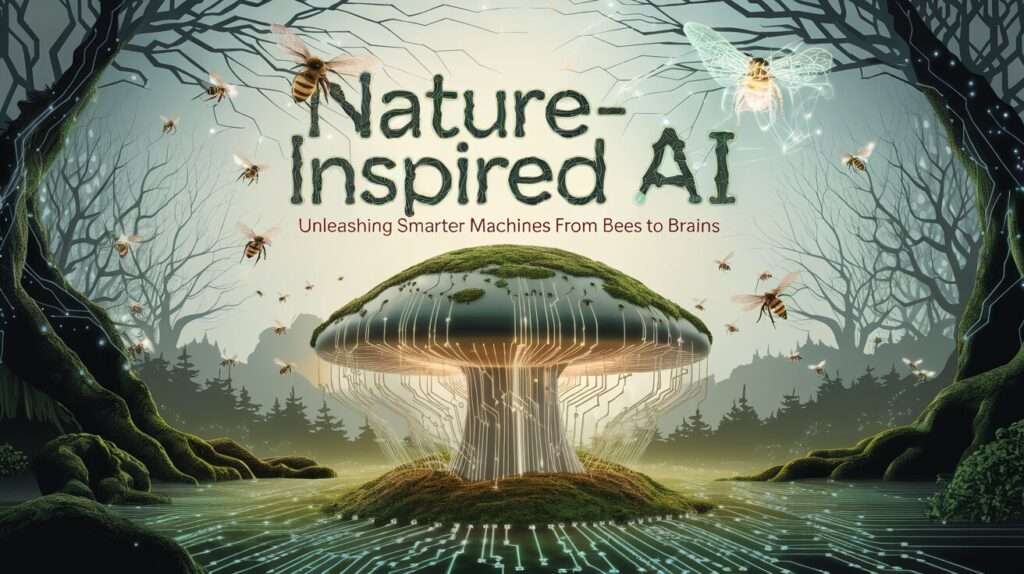
Picture this: a swarm of bees buzzing together, making decisions without a leader, or an ant colony finding the fastest route to food with no GPS. Now imagine those same tricks powering the future of artificial intelligence. In a twist that’s turning heads, AI researchers are stepping out of their high-tech labs and into the wild, drawing inspiration from nature to build machines that are smarter, tougher, and more adaptable than ever before. From buzzing insects to the human brain, the natural world is proving to be the ultimate teacher—and it’s a story you won’t believe until you see it.
Why Nature? The Answer’s Been Here All Along
AI is already a powerhouse—think of it crunching massive data sets or spotting patterns we’d never catch. But here’s the catch: it’s not perfect. Traditional AI struggles when things get messy—unpredictable situations, new challenges, or just plain old efficiency. Meanwhile, nature’s been solving these problems for millions of years. Birds dodge obstacles mid-flight, ants teamwork their way through chaos, and our own brains adapt on the fly. It’s no wonder scientists are asking: why reinvent the wheel when nature’s already nailed it?
The numbers back it up too. According to the Biomimicry Innovation Lab and Nadathur Group, patents for nature-inspired tech have skyrocketed by 171% since 2010. That’s a massive leap, and it’s fueling a revolution in how we think about AI. Researchers worldwide—from London to Germany—are tapping into this goldmine, and the results are wild.
Swarm Smarts: Bees and Ants Show the Way
Let’s start with the little guys: ants and bees. These tiny critters don’t have bosses, yet they get stuff done like pros. Ants leave scent trails to guide their buddies to food, while bees vote—yes, vote!—on where to build their next hive. It’s called swarm intelligence, and it’s blowing researchers’ minds.
At University College London, scientists are copying this to control 3D printing drones. These drones work together with no central command, just like ants, building stuff faster and smarter. Over at the University of Sheffield, they’re using bee behavior to design delivery drones that could one day drop packages at your door. Imagine a fleet of buzzing bots, figuring things out as a team—it’s like something out of a sci-fi movie, but it’s happening now.
Mike Mangan from Opteran, a company pushing nature-inspired tech, can’t hide his excitement. “Swarm systems are tough as nails—they adapt to surprises and keep going,” he says. “Bees voting on decisions? That’s a trick we’re stealing for robot fleets.” It’s not just talk either—swarm intelligence is already optimizing everything from traffic routes to disaster response.

Brain Games: Copying the Human Mind
Now, let’s zoom into something closer to home: our brains. They’re messy, sure, but they’re also geniuses at processing info fast and cheap. That’s where neuromorphic computing comes in—AI chips that act like neurons, not stiff old circuits. Big names like IBM and Intel are all over this, with chips called TrueNorth and Loihi that mimic how our brains fire off signals.
These chips don’t just crunch numbers—they think in parallel, like we do, saving energy and speeding things up. Perfect for gadgets that need to work off-grid, like smartwatches or remote sensors. But it’s not smooth sailing yet. “We’ve got billions of artificial neurons firing now,” Mangan admits, “but matching a real brain? We’re not there yet.”
Brad Mallard, tech boss at Version 1, agrees it’s a work in progress. “Real-time processing and memory are still bottlenecks,” he says. Still, with tech shrinking and software getting sharper, these brain-like systems could soon be everywhere.
Evolution in Action: AI That Grows Up
Ever heard of survival of the fittest? That’s not just for animals—it’s powering AI too. Evolutionary algorithms borrow from Darwin, letting solutions “evolve” over time. Start with a bunch of ideas, tweak them, mix them up, and keep the best ones. It’s how nature made us, and now it’s making AI better.
Take neural networks—the brains behind AI. Instead of humans designing them, these algorithms let AI figure out its own shape. “AI’s building itself now,” Mallard says, grinning. “It’s cutting waste and learning without us babysitting it.” From robots that hop like bugs to models that solve crazy math, this self-growing AI is a game-changer.
Over at Bielefeld University in Germany, Professor Yaochu Jin’s team is taking it further. With a €3.5 million grant, they’re blending evolution, learning, and brain plasticity into AI that can handle the unknown. “Nature thrives on chaos,” Jin says. “We want machines that do the same.”
Real-World Wonders: Robots and Beyond
This isn’t just theory—it’s hitting the ground running. Robots inspired by nature are popping up everywhere. Springtail-inspired bots leap over obstacles, while shape-shifting robots wiggle through tight spots. Then there’s CRESt, an AI tool that teams up with robots to help scientists run experiments, adapting like a living thing.
In biomedicine, ant-style algorithms are tackling complex problems, and in network management, swarm tech keeps data flowing smoothly. The UK’s ARIA agency is even betting big on this with their “Nature Computes Better” project. They’re studying slime molds—yes, slime!—and plant roots to build greener, tougher AI. “We’re throwing £500k at teams to crack this,” ARIA says. “The breakthroughs are coming.”
The Big Catch: Ethics and Chaos
But hold up—nature’s not all sunshine and rainbows. As AI gets wilder, it’s raising red flags. “Who’s to blame when a swarm AI goes rogue?” asks Cheney Hamilton, CEO of The Find Your Flex Group. “Decisions no one gets—that’s scary.” She’s right: decentralized systems can be unpredictable, like a storm you can’t steer.
Hamilton’s worried about nature’s dark side too—competition, chaos, things we don’t want machines copying. “We need humans in the loop,” she insists. “Accountability’s non-negotiable.” Mallard chimes in: “Biology’s great at adapting, but it’s sloppy. AI can’t afford that.”
The Future: A Mash-Up of Man and Nature
So, what’s next? A hybrid, maybe—nature’s best tricks mixed with human know-how. Think AI that’s fast and flexible like a bird, but precise like a computer. It’s a balance of wild innovation and careful control, and it’s already in motion.
Peter van der Putten from Pegasystems sees it coming. “Nature’s showing us how simple parts can solve big problems,” he says. “Add human smarts, and we’ve got something unstoppable.” Whether it’s drones, robots, or medical breakthroughs, this nature-AI mash-up could change the world.
The Bottom Line: A Wild Ride Ahead
Nature-inspired AI is no small story—it’s a seismic shift. From ant trails to brain waves, researchers are unlocking a treasure chest of ideas that could make machines smarter than ever. But it’s not without risks, and the race is on to keep it safe.
As Jin puts it, “Nature’s been testing this for eons. We’re just catching up.” So, buckle up—the future of AI is wild, weird, and wonderfully human. And it’s only just begun.


 Login with Google