
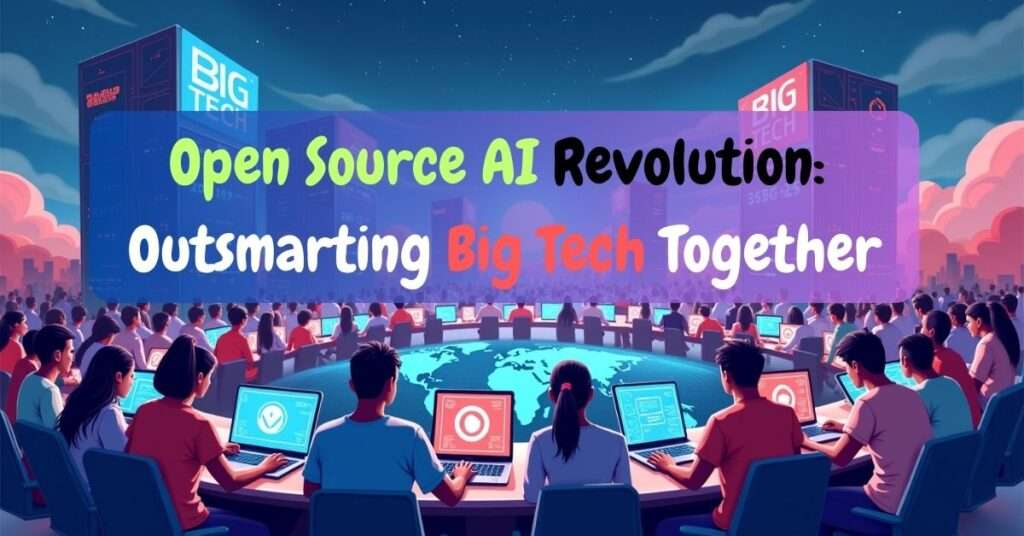
Picture this: a young coder in a tiny village, tapping away on an old laptop, builds an AI tool that outsmarts the shiny systems of Silicon Valley giants. Sounds like a movie, right? But it’s not—it’s happening now, and it’s all thanks to open source AI. In a world where artificial intelligence used to be locked behind the doors of big corporations, a thrilling shift is shaking things up. Open source projects are storming the scene, challenging the old guard, and proving that when people work together, they can outpace even the deepest pockets.
From language models that talk smarter than ever to video tools that bring dreams to life, these community-driven creations are rewriting the rules. They’re not just competing—they’re winning. And the best part? They’re making AI something anyone can touch, not just the tech elite. Let’s dive into this wild revolution, meet the projects changing the game, and see why this might just be the future we’ve all been waiting for.
The Big Shift: Open Source Takes on the Titans
For years, the AI world was ruled by closed-source systems—think massive companies with endless cash, secret data, and supercomputers humming in hidden labs. They had the edge, no question. But something’s changed. Open source AI, powered by people all over the globe teaming up, is catching up fast. It’s like David taking on Goliath, except this David’s got a whole army of coders behind him.
These open source projects are doing more than just keeping pace—they’re setting new records. Take Quen 3, a language model that’s got everyone talking. Word on the street is it’s beating Meta’s Llama 4 in tests, and it’s doing it with style. It speaks multiple languages, thinks sharp, and doesn’t cost an arm and a leg. Then there’s DeepSeek R2—rumors say it’s packing 1.2 trillion parameters (yeah, that’s a big number!) and slashing costs by 97% compared to GPT-4.0. If that’s true, we’re looking at a game-changer.
Why’s this happening? Collaboration, that’s why. When you’ve got thousands of brains tweaking code, sharing ideas, and fixing bugs, magic happens. Open source isn’t just about free stuff—it’s about building something better, together. And it’s tearing down walls, letting anyone with a computer join the AI party.
Meet the Stars of the Show
So, who are the heroes in this story? Let’s shine a spotlight on some of these open source wonders.
Quen 3: The Chatty Challenger
Quen 3 isn’t just another language model—it’s a wake-up call. Outperforming Meta’s Llama 4 in benchmarks, this open source gem handles multiple languages like a pro and tackles tough questions with ease. Developers love it because it’s cheap to run, and it’s licensed under Apache 2.0, meaning it’s free for anyone to use. Imagine a small business owner in India using Quen 3 to build a chatbot that speaks Hindi and English flawlessly—suddenly, she’s competing with the big dogs.
DeepSeek R2: The Cost-Cutting Giant
Whispers about DeepSeek R2 are buzzing through the tech world. With 1.2 trillion parameters, it’s a beast, but here’s the kicker—it’s supposedly 97% cheaper than GPT-4.0. That’s like buying a sports car for the price of a bicycle. If these rumors hold up, DeepSeek R2 could put high-powered AI in the hands of schools, startups, even hobbyists. Picture a kid in Brazil coding an app that rivals ChatGPT, all from his bedroom.
DIA: The Voice of Emotion
Ever heard a robot voice that actually feels? DIA, an open source text-to-speech model, is making it happen. It’s got emotional depth and tone control, and you can run it right on your own computer—no fancy cloud needed. Think of a teacher in Kenya using DIA to create audio lessons that sound warm and human, reaching kids who can’t read yet. It’s practical, it’s powerful, and it’s changing lives.
Frame Pack and Realist Dance: Video Magic on a Budget
Video’s getting a makeover too. Frame Pack lets you whip up long videos even if your computer’s got low memory—perfect for indie filmmakers or YouTubers on a shoestring. Meanwhile, Realist Dance makes human motion in videos look so real you’d swear it’s not AI. Built on the WAN 2.1 framework, it’s turning heads in entertainment and education. Imagine a dance teacher using it to create tutorials that look lifelike, all without a Hollywood budget.
RT Model: The Email Wizard
Need help sorting through a mountain of emails? RT Model’s got your back. This open source research agent beats proprietary systems at finding what you need, fast and accurate. Small businesses are eating it up—think of a harried shop owner who can finally keep up with customer inquiries, thanks to this little marvel.
Instant Character Model: Your Face, AI Style
Here’s a cool one: Instant Character Model turns your photo into a consistent digital character. It’s still in the research phase, but the possibilities? Endless. Game designers, animators, even kids messing around could use it to create avatars that stick around across projects. Picture a teen in Japan designing a whole cartoon world starring her friends, all from a few selfies.
Why It Matters: AI for Everyone
These projects aren’t just tech toys—they’re leveling the playing field. Big Tech used to hold all the cards, charging big bucks for AI power. Now, open source is handing that power to the little guy. A startup in Nigeria can build a translation app with Quen 3. A filmmaker in Mexico can churn out slick videos with Frame Pack. It’s not just about saving money—it’s about opening doors.

And it’s not stopping there. By sharing code and ideas freely, these projects spark more innovation. One coder’s tweak in Germany could inspire a breakthrough in Australia. It’s a snowball effect, and it’s rolling fast. The result? AI that’s smarter, cheaper, and more human than ever before.
The Bumps in the Road
Of course, it’s not all smooth sailing. Open source AI’s got some hurdles to jump. Scaling up—making sure these models work for millions of users—is a big one. It’s tricky to keep things running smooth when the crowd gets huge. Then there’s inclusivity—how do you make sure everyone, not just tech whizzes, can join in? And don’t forget ethics. Powerful AI can do amazing things, but it can also stir up trouble if it’s misused.
Take DIA’s lifelike voices—great for teaching, but what if someone fakes a politician’s speech? Or think about DeepSeek R2’s might—awesome for good, scary if it falls into the wrong hands. The community’s wrestling with these questions, and they’re not easy. But they’re not giving up, either. Coders are teaming up to tackle these challenges, bit by bit.
A Real-Life Win: The Startup That Could
Let’s zoom in on a story that brings this home. Meet Aisha, a 28-year-old entrepreneur from Ghana. She’s got a small healthcare startup, helping rural clinics track patient data. Big Tech AI? Too pricey. But then she finds Quen 3. With a bit of tinkering, she builds a system that reads handwritten notes and turns them into digital records—cheap, fast, and spot-on. Suddenly, her clinics are saving hours a day, and patients are getting better care.
Aisha’s not alone. Across the world, people like her are grabbing open source tools and running with them. It’s messy, it’s human, and it’s working. Sure, she mistyped a line of code once and crashed her laptop—oops!—but she laughed it off and fixed it. That’s the spirit of this revolution: real people, real grit, real results.
What’s Next? The Sky’s the Limit
So where’s this all headed? The open source crowd’s not slowing down. They’re dreaming bigger—better scalability, wilder applications, maybe even AI that learns to use tools like we do. Imagine an AI that doesn’t just talk but grabs a virtual wrench to fix a problem. Crazy? Maybe not.
The heart of it all is this: open source AI isn’t just about beating Big Tech. It’s about sharing the future. “When we build together, we build better,” says Maria Lopez, a coder on the Frame Pack team. She’s right. Every tweak, every idea, every late-night debug session is pushing AI into new territory.
Tim O’Reilly, a tech guru, once said, “The future is already here—it’s just not evenly distributed.” Open source AI’s on a mission to fix that. It’s handing out keys to anyone brave enough to unlock tomorrow. And honestly? Big Tech should be watching its back.
Next time you hear about an AI breakthrough, don’t bet on it coming from a gleaming corporate tower. It might just be from a scrappy team of dreamers, coding away in basements and bedrooms worldwide. This is their moment—and ours too.

 Login with Google