
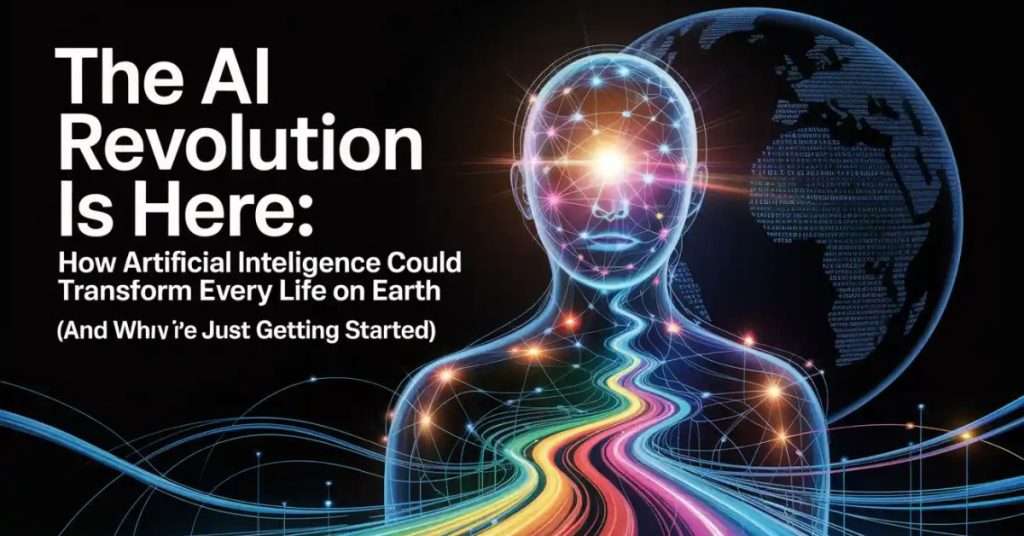
SILICON VALLEY – While most of us are still figuring out how to use ChatGPT properly, something much bigger is happening behind the scenes. The artificial intelligence revolution isn’t coming anymore – it’s already here, and it’s about to reshape every aspect of human life in ways that would have seemed like pure science fiction just five years ago.
I’ve been covering technology for over a decade, but I’ve never seen anything quite like what’s happening right now in the AI world. The numbers alone are staggering. Recent studies show that students using AI tutors learn twice as fast as those with human instructors. Ninety percent of ChatGPT users say the tool helps them understand complex ideas more easily. Small business owners are launching companies 70% faster when they use AI tools compared to traditional methods.
But here’s what really caught my attention: a nine-year-old girl recently built a fully functional business website in a single weekend using AI tools. No coding knowledge. No adult help. Just pure imagination and artificial intelligence working together to turn a birthday party planning idea into a real business.
This isn’t just another tech trend that’ll fade away in a few years. We’re witnessing the birth of the most democratizing technology in human history – or at least, that’s what it could become if we play our cards right.
The Great Equalizer or the Ultimate Divider?
The story starts with a simple but profound observation: every major technology shift in history has done one of two things. It either spreads power and opportunity to more people, or it concentrates wealth and influence in the hands of those who already have it.
Think about the internet. It promised to democratize information and level the playing field for small businesses. In many ways, it delivered on that promise. Today, a teenager with a smartphone can access more information than the greatest libraries in history. Small companies can reach global markets without massive advertising budgets.
But the internet also created tech billionaires and gave unprecedented power to a handful of massive corporations. The same technology that empowered millions also concentrated enormous wealth and influence in Silicon Valley.
Now we’re at another crossroads. AI could be the greatest equalizer humanity has ever created – or it could make existing inequalities even worse. The difference will come down to the choices we make right now, in these crucial early years of the AI revolution.
Knowledge: When Everyone Has a Personal Einstein
Let’s start with something most people can relate to: learning. Remember struggling through calculus in high school? Or trying to understand your medical test results? Or feeling completely lost when your car mechanic started explaining what was wrong with your engine?
For most of human history, accessing expert-level knowledge required incredible privilege. You needed money for good schools, connections to find the right teachers, or lucky geography to live near centers of learning. Even today, getting quality education or expert advice often depends more on your zip code and bank account than your curiosity or potential.
AI is already changing that equation dramatically. Imagine having a patient, infinitely knowledgeable tutor available 24/7, one who never gets frustrated, never judges you for asking “stupid” questions, and can explain the most complex topics in whatever language and style works best for your brain.
This isn’t theoretical anymore. Students around the world are already using AI tutors to master subjects that previously seemed impossible. The AI doesn’t just give answers – it teaches you how to think about problems, helps you develop confidence in areas that once felt intimidating, and adjusts its teaching style to match exactly how you learn best.
But the implications go far beyond traditional education. What happens when every person on Earth has instant access to expert-level knowledge in medicine, law, finance, science, and technology? When language barriers disappear because AI can translate not just words, but concepts and cultural context? When rural farmers in developing countries can get the same agricultural advice as corporate farming operations?
Healthcare: From Passive Patient to Empowered Partner
This one gets personal fast. Nearly nine out of ten American adults struggle to understand basic health information. That’s not because people are stupid – it’s because our healthcare system is incredibly complex and often deliberately opaque.
I know someone who spent years battling a chronic illness, visiting specialist after specialist, trying to piece together conflicting advice and incomprehensible test results. Despite having access to some of the world’s best doctors, they found themselves playing detective with their own health, trying to connect dots that medical professionals couldn’t or wouldn’t connect.
This experience is heartbreakingly common. Patients feel powerless in their own care, dependent on others to explain what’s happening in their bodies, often facing life-changing decisions without truly understanding their options.
AI is already beginning to change this dynamic in remarkable ways. Imagine an AI that can explain your lab results in plain English, translate medical jargon into language you actually understand, offer second opinions on treatment recommendations, and help you research your condition using the latest medical research.
But the real revolution goes beyond the doctor’s office. The biggest factors in preventing disease and staying healthy – sleep quality, nutrition, exercise, stress management, social connection – all depend on daily habits and lifestyle choices. AI can serve as an always-on health companion, providing personalized guidance based on your specific health profile, gently nudging you toward better choices, and helping you build sustainable healthy habits one small step at a time.
This isn’t about replacing doctors – it’s about giving patients the knowledge and confidence to be true partners in their own care.
Creativity: When Everyone Becomes an Artist
Here’s something that might surprise you: we’re all born creators. The human drive to imagine something and make it real is fundamental to who we are as a species. But for most people, there’s a massive gap between imagination and execution.
You might have incredible story ideas but struggle with grammar and sentence structure. You might visualize stunning artwork but lack the technical skills to draw or paint. You might hear melodies in your head but not know how to play any instruments or read music.
AI is collapsing that gap between imagination and creation in unprecedented ways. With AI image generation, someone can describe a complex visual scene and see it rendered in photorealistic detail within seconds. AI writing tools can help transform rough ideas into polished prose. AI music generators can turn hummed melodies into full orchestral arrangements.

Nearly one in three Gen Z users already say AI tools have helped them express themselves in ways they never could before. This isn’t replacing human creativity – it’s amplifying it, making the tools of creation accessible to everyone regardless of traditional artistic training.
Imagine a world where every person can bring their creative visions to life, where artistic expression isn’t limited by technical skill or expensive equipment, where the marketplace of ideas truly reflects human diversity rather than just the perspectives of those privileged enough to master traditional creative tools.
Economic Freedom: From Gatekeepers to Generators
Starting a business has always been one of the most reliable paths to economic independence, but it’s traditionally required significant barriers to entry. The average cost to launch a small business in the United States is around $30,000 – an impossible threshold for most aspiring entrepreneurs. Building digital products or services typically required coding skills that took years to develop.
These barriers meant that millions of people with brilliant ideas never got the chance to turn them into income. Economic opportunity remained concentrated among those with existing resources, technical education, or powerful connections.
AI is dismantling these barriers at breathtaking speed. Today, a single person with no coding experience can brainstorm product ideas with AI, create professional marketing materials, build functional websites and apps, handle customer service, and manage finances – all using tools they can access from their smartphone.
The nine-year-old party planner I mentioned earlier? She’s not an anomaly. She’s a preview of what’s possible when the tools of creation and commerce become accessible to everyone. Her weekend project would have required a team of professionals and thousands of dollars just a few years ago.
This shift will undoubtedly disrupt existing job markets. Some roles will disappear as AI handles tasks that once required human workers. But history suggests that technological revolutions create more opportunities than they destroy, especially when the technology democratizes access to tools and markets rather than concentrating them.
Even for people not interested in starting businesses, AI can provide crucial economic empowerment through financial education and guidance. Only one-third of American adults can correctly answer basic financial literacy questions, leading to poor decisions that trap people in cycles of debt and economic insecurity. AI financial advisors can provide personalized guidance on budgeting, saving, investing, and debt management – services that were previously available only to wealthy individuals who could afford human financial advisors.
Time: The Ultimate Currency
If you want to understand inequality in modern society, look at how people spend their time. Wealthy individuals hire personal assistants, housecleaners, meal delivery services, tutors, and various other professionals to handle life’s routine tasks. This frees up their time for high-value activities: building relationships, developing skills, creating wealth, and pursuing personal fulfillment.
Meanwhile, the average household spends nearly 20 hours per week on domestic work, logistics, and errands. For low-income families juggling multiple jobs and caretaking responsibilities, almost every waking hour is consumed by immediate necessities, leaving little time for activities that could improve long-term outcomes.
AI agents – sophisticated AI systems that can handle complex, multi-step tasks – promise to democratize access to personal assistance. Imagine AI that can research and book your family vacation, compare insurance options and handle the paperwork, schedule medical appointments and coordinate with your work calendar, or help your children with homework when you’re stuck at your second job.
This isn’t about making people lazy – it’s about giving everyone access to the same time-saving infrastructure that wealthy people have always used to maximize their potential.
The Road Ahead: Choices That Will Define Our Future
The transformation I’ve described isn’t guaranteed. Technology alone doesn’t determine outcomes – human choices do. The same AI capabilities that could democratize opportunity could also concentrate power among those who control the technology, the data, and the infrastructure.
Consider some of the challenges we’re already seeing: AI systems can perpetuate and amplify existing biases if they’re trained on biased data. The most advanced AI tools might remain expensive and exclusive. AI-generated misinformation could undermine trust in institutions and expertise. Economic disruption could happen faster than societies can adapt.
But here’s what gives me hope: awareness of these challenges is growing rapidly, and solutions are already emerging. Researchers are developing techniques to make AI systems more fair and transparent. Competition is driving down costs and increasing access to AI tools. Educators and policymakers are working to help people adapt to AI-powered changes in the job market.
Most importantly, the people building these systems seem genuinely committed to positive outcomes. When tech leaders talk about AI, they’re not just focused on profits or market dominance – they’re explicitly discussing how to ensure the benefits reach everyone.
What This Means for You
If you’re reading this article, you’re living through one of the most significant transformations in human history. The decisions made in boardrooms and research labs over the next few years will shape opportunities for generations to come.
But you’re not just a passive observer. The AI revolution will be shaped by how ordinary people choose to use these tools, what kinds of applications gain popularity, and what standards we demand from the companies building AI systems.
Start experimenting with AI tools now, even in small ways. Use AI to help with work tasks, learn new subjects, explore creative projects, or simply satisfy your curiosity about how these systems work. The more familiar you become with AI capabilities, the better positioned you’ll be to take advantage of new opportunities as they emerge.
Support policies and politicians who prioritize broad access to AI benefits rather than concentrated control. Demand transparency from AI companies about how their systems work and who benefits from them. Use your voice as a consumer and citizen to push for AI development that serves everyone, not just those who already have power and resources.
Most importantly, maintain perspective about what we’re witnessing. Yes, AI will disrupt many existing systems and assumptions. Yes, the transition will be challenging for many people. But if we make good choices – collectively and individually – we’re looking at the potential for the most empowering technology in human history.
Imagine a world where every person has access to expert-level knowledge, personalized education, creative tools, economic opportunities, and time-saving assistance. Where your potential is limited by your curiosity and effort rather than your circumstances and connections.
That world is no longer science fiction. It’s a realistic possibility that depends on the choices we make right now. The AI revolution is here – the question is whether we’ll use it to lift everyone up, or let it leave most people behind.
The future is being written today, and for the first time in history, everyone gets to help write it.

 Login with Google