
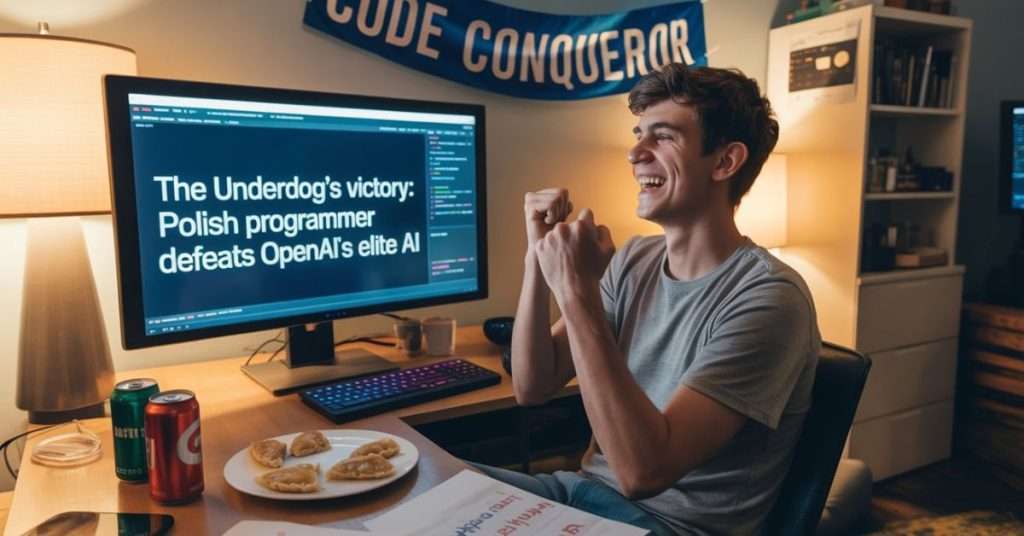
TOKYO – The tech world held its breath as Przemysław “Psyho” Dębiak, a 42-year-old programmer from the coastal city of Gdynia, Poland, stepped into what many believed would be his defeat. Armed with nothing but Visual Studio Code and three days’ worth of caffeine coursing through his veins, he was about to face off against one of OpenAI’s most sophisticated AI models in a grueling 10-hour coding marathon.
What happened next will likely be remembered as one of the most dramatic human victories over artificial intelligence in recent history.
The Unlikely Champion Who Helped Build His Own Opponent
Here’s where the story gets really interesting – Dębiak isn’t just any programmer. He’s a former OpenAI engineer who actually helped develop the company’s AI systems, including the famous OpenAI Five that dominated professional Dota 2 players. Talk about irony! The man who helped create the technology was now going head-to-head against his own digital offspring.
“I was close to the model’s score, and that pushed me to give everything,” Dębiak later admitted, his exhaustion evident even through his social media posts. But who exactly is this programmer who just pulled off what many thought impossible?
Dębiak’s resume reads like something out of a tech thriller novel. A Mensa member, four-time TopCoder Open Marathon champion, and veteran algorithmic competitor who’s never held a traditional full-time job. He’s the kind of person who once casually considered becoming a DJ or professional poker player before settling into the world of competitive programming. His unconventional path has made him one of the planet’s most formidable heuristic programmers – specialists in finding “good enough” solutions to impossible problems.
The Battle Arena: Where Legends Are Made
The stage couldn’t have been more perfect for this historic showdown. The AtCoder World Tour Finals 2025 in Tokyo is considered the Olympics of competitive programming, inviting only the world’s top 12 human coders to compete. But this year was different – for the first time ever, an AI model would join the human competitors in what organizers dubbed the “Humans vs AI” contest.
The challenge was brutal in its simplicity yet mind-bending in its complexity. Competitors had to plot a robot’s path across a 30×30 grid using the fewest possible moves – an NP-hard optimization problem with more potential solutions than there are atoms in the observable universe. No external libraries, no documentation, no safety nets. Just pure human intuition versus artificial intelligence processing power.
Contest administrator Yoichi Iwata later described it perfectly: while the AI excelled at raw optimization, it “fell short of human creativity.” That gap between computational power and creative thinking would prove to be the deciding factor in this epic battle.
Ten Hours of Mental Warfare
What unfolded over the next 10 hours was nothing short of extraordinary. Dębiak, running on fumes after getting only 10 hours of sleep over three days, found himself locked in an intellectual death match with OpenAI’s custom-built model, branded as OpenAIAHC.
This wasn’t your typical coding contest where there’s one correct answer. Heuristic optimization problems are different beasts entirely – they’re about finding the best possible approach under extreme pressure when perfect solutions don’t exist. It’s the kind of challenge where human intuition, the ability to make educated guesses, and creative problem-solving can actually trump raw computational power.
The tension was palpable. Here was a human programmer, exhausted beyond belief, going toe-to-toe with a system specifically designed to excel at exactly this type of task. Every line of code mattered. Every algorithm choice could make or break the competition.
As the hours ticked by, something remarkable began to happen. While the AI system processed possibilities at lightning speed, Dębiak was making those uniquely human leaps of logic – recognizing patterns, applying creative shortcuts, and using problem-solving approaches that might not be immediately obvious to a computational system.
The Stunning Victory That Shocked Silicon Valley
When the final results were tallied, the tech world was stunned. Dębiak had edged out the AI by approximately 9.5%, claiming first place while OpenAI’s sophisticated model had to settle for second. But here’s what makes this even more impressive – the AI still managed to beat all the other elite human programmers who had qualified for this prestigious competition.

“Humanity has prevailed (for now)!” Dębiak wrote on X, his relief and exhaustion evident in every word. “I’m completely exhausted. I figured, I had 10 hours of sleep in the last 3 days and I’m barely alive.”
Even OpenAI’s CEO Sam Altman took notice, responding with a simple but telling “Good job, Psyho.” Coming from one of AI’s most prominent figures, that acknowledgment carries significant weight – it’s a recognition that human ingenuity still has its place in our increasingly AI-dominated world.
The Deeper Meaning: What This Victory Really Represents
This wasn’t just a programming contest – it was a symbolic moment that cuts to the heart of humanity’s relationship with artificial intelligence. In an era where AI systems are dominating chess grandmasters, crushing Go champions, solving protein folding mysteries, and even creating art that sells for millions, Dębiak’s victory represents something precious: proof that human creativity and intuition still matter.
But let’s be honest about what we’re up against. Stanford’s 2025 AI Index revealed some sobering statistics – coding benchmarks showed AI success rates jumping from just 4.4% in 2023 to a staggering 71.7% in 2024. That’s not gradual improvement; that’s exponential advancement that should make every programmer pause and think.
Today, over 90% of developers already use AI assistants like GitHub Copilot for daily coding tasks. The integration of AI into programming workflows isn’t coming – it’s already here. Which makes Dębiak’s victory all the more remarkable and potentially significant.
The Human Edge: What AI Still Can’t Replicate
So what exactly allowed a sleep-deprived human to defeat a cutting-edge AI system? The answer lies in those uniquely human qualities that we sometimes take for granted. Dębiak’s approach relied on heuristic-driven problem-solving – using shortcuts, making educated guesses, and applying creative solutions that emerge from experience and intuition rather than brute-force calculation.
While the OpenAI model could process vast amounts of data at incredible speeds and optimize solutions systematically, it couldn’t make those inspired leaps of logic that humans excel at. It couldn’t recognize patterns in the same intuitive way, couldn’t apply creative shortcuts that might not be immediately obvious, and couldn’t adapt its strategy with the kind of fluid thinking that comes naturally to experienced problem-solvers.
The physical and mental endurance aspect also played a role. While the AI maintained consistent performance throughout the 10-hour marathon, Dębiak had to overcome fatigue, stress, and the psychological pressure of competing against a system specifically designed to excel at this exact task. Yet somehow, pushing himself to the absolute limit brought out the best in his performance.
The Price of Victory
The win came with a tangible reward – 500,000 yen (approximately $3,400) – but the real prize was the global recognition and the symbolic victory for human capabilities. However, the personal cost was significant. Dębiak’s exhausted state after the competition, having survived on minimal sleep and maximum determination, demonstrated the incredible lengths humans sometimes have to go to compete with AI systems.
“Honestly, the hype feels kind of bizarre,” Dębiak later reflected. “Never expected so many people would be interested in programming contests. Guess this means I should drop in here more often.”
A Glimpse Into the Future: Is This the Last Stand?
While we celebrate this human triumph, we must acknowledge the elephant in the room. Some experts are calling this victory “possibly the last human winner” in such competitions, and there’s a sobering truth to that prediction. The rapid pace of AI development suggests that future iterations may close the creativity and intuition gap that allowed Dębiak to succeed.
The AI model that came in second place wasn’t some experimental prototype – it was OpenAI’s custom-built system, specifically designed for this type of competition. The fact that it easily outperformed 11 other world-class human programmers while nearly beating the winner demonstrates just how capable modern AI has become.
As Dębiak himself acknowledged with characteristic honesty: “It’s easy to imagine a different problem where AI would win and humans would be far behind.”
The Ripple Effects: Why This Matters Beyond Programming
This victory resonates far beyond the world of competitive programming. It represents a moment when human creativity, adaptability, and intuitive problem-solving proved their continued relevance in an age of artificial intelligence. It’s a reminder that while AI systems are incredibly powerful tools, they haven’t yet replicated the full spectrum of human cognitive abilities.
The tech community’s overwhelmingly positive response suggests that people are hungry for these kinds of victories – moments that prove human intelligence still has something unique to offer. In boardrooms across Silicon Valley, executives are probably having conversations about the implications of this result for AI development strategies.
The Broader Context: Living and Working With AI
The reality is that the future isn’t about humans versus AI – it’s about humans working with AI. Dębiak’s victory doesn’t change the fact that AI is already deeply integrated into programming workflows and will only become more prevalent. But it does suggest that the relationship between human and artificial intelligence is more nuanced than simple replacement.
The qualities that allowed Dębiak to win – creativity, intuition, the ability to make inspired leaps of logic under pressure – are likely to remain valuable even as AI systems become more sophisticated. The key is learning how to leverage these uniquely human strengths in conjunction with AI capabilities.
Looking Ahead: What Comes Next?
As we process the implications of this historic victory, several questions emerge. Will future AI systems learn to replicate the kind of creative, heuristic thinking that gave Dębiak his edge? How long will humans maintain competitive advantages in specific types of problem-solving? And perhaps most importantly, what can we learn from this victory about the future of human-AI collaboration?
The answers to these questions will likely shape how we approach AI development and human education in the coming years. If certain types of creative problem-solving remain human strengths, we need to understand how to cultivate and preserve these abilities.
The Legend Continues
For now, Przemysław “Psyho” Dębiak has secured his place in tech history. The exhausted programmer from Poland who helped build AI systems at OpenAI has proven that the human mind, even when pushed to its absolute limits, still possesses something that the most sophisticated artificial intelligence cannot fully replicate.
His victory serves as both celebration and wake-up call. It’s a celebration of human creativity, determination, and the remarkable capacity of the human mind to rise to extraordinary challenges. But it’s also a reminder that the gap between human and artificial intelligence is narrowing rapidly.
Whether this will be remembered as one of the last great human victories over AI, or as a turning point that led to better human-AI collaboration, remains to be seen. What’s certain is that for 10 hours in Tokyo, one determined programmer proved that humanity still has what it takes to compete with the machines we’ve created.
In a world increasingly shaped by artificial intelligence, sometimes it takes a sleep-deprived coder armed with nothing but creativity and determination to remind us what makes us uniquely human. And for that reminder, the entire tech world owes Przemysław Dębiak a debt of gratitude.
As the dust settles on this epic showdown, one thing is clear: the conversation between human and artificial intelligence is far from over. If anything, it’s just getting started.




 Login with Google