
Artificial intelligence has gone from science fiction fantasy to daily necessity. From writing emails and helping with homework to building software and creating images, AI tools are no longer just for techies in Silicon Valley. They’re for students, small businesses, journalists, doctors, and even everyday folks who just want to save time.
But here’s the catch: while premium AI subscriptions are loaded with shiny extras, most people don’t want to—or can’t—pay $20, $30, or even $50 a month. That’s where free AI plans come in. And 2025 is proving to be a turning point.
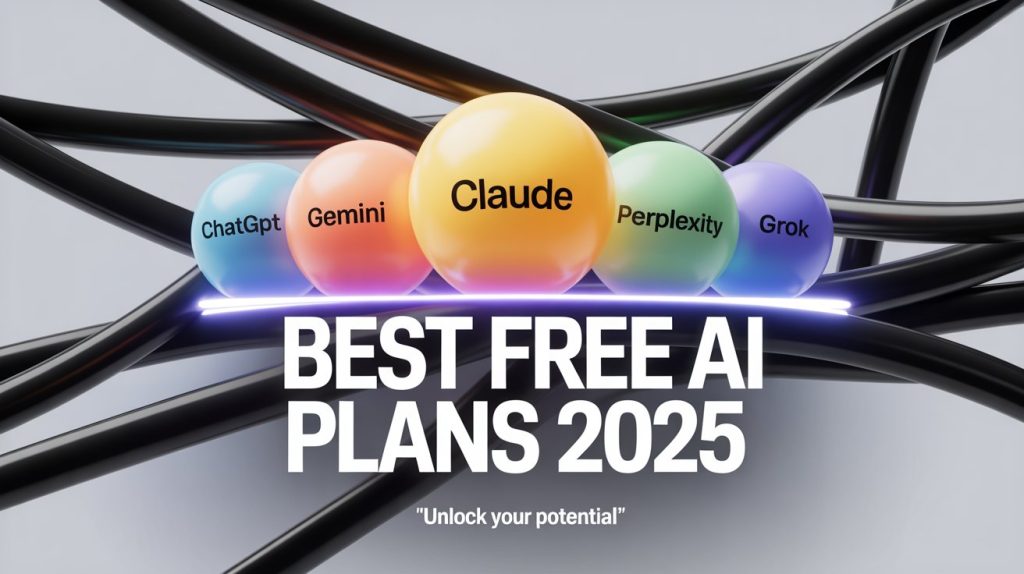
The world’s biggest players—OpenAI’s ChatGPT, Google’s Gemini, Anthropic’s Claude, Elon Musk’s Grok, and Perplexity AI—are locked in a battle for your attention. Each of them is offering surprisingly powerful free versions to lure in millions of users. But which one should you actually use? And which one secretly gives you the most bang for zero bucks?
Let’s dive in, reporter-style, and look at what each free plan offers—and what’s really at stake in the AI wars of 2025.
The Big Five: Free AI Plans Compared
ChatGPT – The Old Giant Refuses to Slow Down
If AI had a household name, it would be ChatGPT. OpenAI practically started the chatbot revolution back in late 2022. Fast-forward to 2025, and their free plan is still one of the most talked-about in the world.
The free version now runs on GPT-5, OpenAI’s latest reasoning model. Unlike earlier free plans that felt watered-down, GPT-5 is no joke. It can search the internet in real time, making it feel less like a parrot and more like a well-informed assistant.
But it’s not perfect. Free users face restrictions:
- File and image uploads? Limited.
- Image generation? Only a handful of tries.
- Voice conversations? Available, but basic.
- Code editing? Works best on Mac through their desktop app.

Still, when you consider you’re getting access to the same brain that powers OpenAI’s premium tools—without paying a cent—it’s hard not to see ChatGPT as a bargain. For students and casual users, this might already be enough.
Claude – The “Friendly” AI with Serious Brains
Anthropic markets Claude as a safer, more ethical alternative to OpenAI. And in 2025, its free plan is making waves among professionals.
Claude works almost everywhere: web, iOS, Android, desktop. No platform lock-in. And it shines in areas that many users care about most:
- Coding help that actually explains why something works.
- Professional data visualization for business analysts and researchers.
- Content writing and editing that feels natural and avoids robotic clichés.
Perhaps Claude’s most underrated feature is its desktop extension. This turns it into a behind-the-scenes co-pilot for whatever you’re working on, from drafting contracts to analyzing spreadsheets.
In short, Claude is not just a chatbot—it’s like a colleague who doesn’t complain about overtime.
Gemini – Google’s All-in-One Powerhouse
If you thought Google would stay quiet while others took over the AI spotlight, think again. Gemini, previously known as Bard, has become one of the most ambitious platforms on the market.
The free plan already includes:
- Gemini 2.5 Flash, a speedy reasoning model.
- Limited access to Gemini 2.5 Pro, their premium brain.
- Imagen 4, Google’s image generation tool.
- Deep Research mode, which digs through the web for longer, structured answers.
- Gemini Live, for real-time conversations.
- Canvas, for organizing projects.
- Gems, for coding tasks.
- And yes—NotebookLM, their research and writing assistant.

Oh, and they also throw in 15 GB of storage across Google Photos, Drive, and Gmail. In other words, Google is bundling AI with its ecosystem, making it hard to escape their web of services.
For students, researchers, and creators, Gemini feels like an entire Swiss Army knife in your pocket. But some users worry that too much integration with Google also means giving away too much data.
Perplexity – The Search Engine That Became a Genius
Perplexity started out as “Google but with AI,” and it has doubled down on that reputation. If you ask a question, Perplexity doesn’t just give you an answer—it shows you sources, citations, and even recommends follow-up queries.
The free plan is surprisingly generous:
- Unlimited basic searches.
- Access to search history, so you don’t lose past queries.
- Three Pro searches per day, which use stronger models for complex tasks.
- Three Research searches per day, designed for deeper reasoning.
- Basic file uploads, with up to three attachments per day and five uploads per space.
What makes Perplexity different is its focus on truth and reliability. Unlike other chatbots that “hallucinate” fake answers, Perplexity sticks to citations and verified data.
For journalists, researchers, and knowledge workers, this is a goldmine. It may not write poetry as well as ChatGPT, but it will give you facts with receipts.
Grok – Elon Musk’s Wild Card
And then there’s Grok, Elon Musk’s answer to ChatGPT. Part of his xAI initiative, Grok is built directly into X (formerly Twitter), and it has a personality that stands out.
Grok’s free plan includes:
- Limited access to Grok 3, its latest reasoning model.
- Context memory, though capped in the free version.
- Aurora Image, its image generation engine.
- Projects and tasks, for basic productivity.
- Voice features, letting you talk instead of type.
What makes Grok different is its “attitude.” Musk has openly said Grok will be “a chatbot with a sense of humor” and more unfiltered than its rivals. Some love it. Others find it distracting.
Still, with Musk’s reach on social media, Grok has become a cultural experiment in how AI might blend with online communities.
Head-to-Head: Who Offers What for Free?
Here’s a quick look at how the five stack up:
| Feature | ChatGPT | Claude | Gemini | Perplexity | Grok |
|---|---|---|---|---|---|
| Core Model | GPT-5 | Claude 3 | Gemini 2.5 Flash (limited Pro) | Model auto-selected | Grok 3 (limited) |
| Real-time Web | ✓ | ✓ | ✓ | ✓ | Limited |
| File Uploads | Limited | Yes | Yes | Limited | Limited |
| Image Generation | Limited | No (basic edits only) | Imagen 4 | No | Aurora Image |
| Voice Mode | Yes | No | Yes (Gemini Live) | No | Yes |
| Storage | None | None | 15 GB (Photos/Drive/Gmail) | None | None |
| Best For | General use | Professionals | Students/Researchers | Journalists/Fact-checkers | Social media fans |
Why This Battle Matters
This isn’t just about free perks. It’s about shaping how billions of people will experience AI for the first time. The free plans are the gateway drug of the AI economy.
If you fall in love with ChatGPT’s answers, you might eventually pay for ChatGPT Plus. If you’re impressed by Gemini’s NotebookLM, you might sign up for Google One AI Premium. If Claude becomes your trusted colleague, you might convince your company to buy enterprise access.
That’s why the companies are so generous. They’re betting on loyalty.
So, Which One Should You Use?
- If you want general help with everything: ChatGPT is still the safest bet.
- If you’re a professional who needs clarity and reliability: Claude shines.
- If you’re a student or researcher living in Google’s ecosystem: Gemini is unbeatable.
- If you’re a journalist, analyst, or fact-checker: Perplexity is your truth machine.
- If you live on social media and want fun with AI: Grok might surprise you.
The Bottom Line
In 2025, the AI wars are heating up—but for ordinary users, it’s actually a win. Free AI plans are no longer toys. They’re becoming serious tools.
Yes, the companies want you to upgrade. Yes, advanced features are still locked behind paywalls. But whether you’re writing an essay, coding a script, fact-checking an article, or just chatting for fun, you don’t need to spend money to access world-class AI anymore.
And that, in itself, is groundbreaking.
The real story here isn’t which AI is “the best.” It’s that the future of AI—once reserved for the wealthy—is now landing in everyone’s hands, free of charge.

 Login with Google