
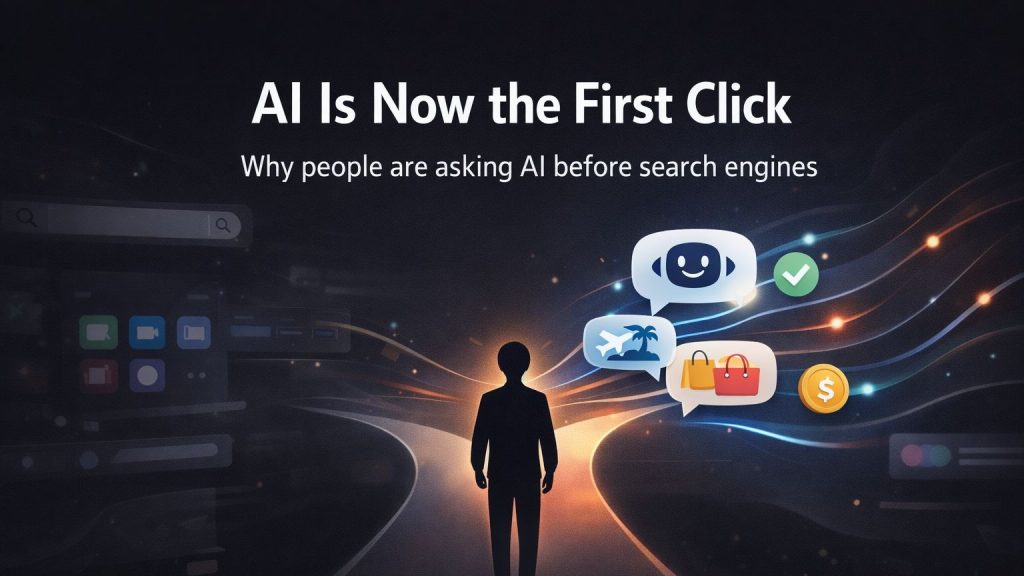
It is happening quietly, but it is happening fast.
For years, the internet began with a search bar. You opened a browser, typed a few words, clicked links, jumped between apps, and slowly figured things out. That habit shaped everything — from how companies advertised to how people made decisions.
Now, that habit is changing.
According to new research highlighted by the Digital Watch Observatory on January 18, 2026, more than 60% of adults in the United States used a standalone AI platform last year to begin everyday online tasks. Not to finish them. To start them.
Travel plans. Product comparisons. Money decisions. Shopping advice. Budget help. Life questions.
Instead of searching, people are talking — to AI.
And once you see it, you can’t unsee it.
From “Google It” to “Ask the AI”
A few years ago, if someone wanted to plan a trip, they opened a search engine, clicked five or six websites, compared prices, read reviews, maybe got confused, and then repeated the process again.
Today, many people simply open an AI app and type:
“Plan a 5-day trip to New York within $1,200.”
And the conversation begins.
No tabs. No endless scrolling. No jumping between apps. Just a dialogue.
The research shows that dedicated AI platforms are becoming the place where intent is first expressed. That moment — the very beginning of a decision — is shifting away from search engines and individual apps toward conversational AI tools.
This is not a small technical change. It is a behavior change. And behavior changes are the hardest to reverse.
Younger Users Are Leading, But Everyone Is Following
The shift is strongest among younger generations, but it is not limited to them.
Younger users are especially comfortable talking to AI like it is a helper, an advisor, sometimes even a quiet companion. They ask follow-up questions. They adjust plans mid-conversation. They trust AI to remember context.
But older users are catching on too — especially when they realize AI saves time.
The research, drawing on PYMNTS Intelligence data, shows AI use is now mainstream, not experimental. This is no longer about tech lovers testing new tools. This is about everyday people trying to get things done faster and with less mental effort.
Once someone experiences how easy it is to start a task with AI, it is hard to go back.
AI Is Becoming the “Decision Layer” of the Internet
Experts are starting to describe AI as the new decision layer.
In the old internet, discovery happened through search results and ads. You saw options, clicked links, and made choices on your own.
In the new internet, discovery happens through conversation.
You don’t just see options. You ask questions. The AI narrows things down. It explains trade-offs. It remembers what you like. It helps you decide.
That changes everything.
Predictions for 2026 suggest this shift will only grow stronger. AI is moving from being a tool you use after you decide, to a guide you consult before you decide anything at all.
Health, money, shopping, travel, work — AI is quietly stepping into all of it.
Businesses Feel the Pressure — And the Confusion
For businesses, this change brings both opportunity and fear.
Marketing was built around clicks, keywords, and search rankings. Entire industries grew around search engine optimization and app installs.
Now the question is different:
What happens when customers never click anything at all?
If a person asks AI, “What’s the best phone under $500?” and the AI gives three suggestions, the brands not mentioned might as well not exist.
Companies are being pushed to rethink how they show up in a world where decisions start with dialogue, not discovery pages.
Customer journeys are becoming conversations. Marketing is becoming advice. Commerce is becoming recommendations.
And many companies are not ready.

Payments and Actions Are Coming Next
Right now, many AI conversations end with advice. But that is changing fast.
The research points toward integrated payments and digital wallets becoming part of AI platforms. That means AI won’t just suggest what to buy — it could help you buy it.
This trend is already visible globally.
In early January 2026, Alibaba expanded its Qwen AI into task-performing agents that can handle real-world services like workflows and payments. This is not just chat anymore. This is action.
Imagine asking AI to plan a trip — and it books the hotel, reserves tickets, and manages the budget automatically.
That future is not far away. It is already being tested.
Fewer Apps, Fewer Clicks, More Trust
One reason people are moving toward AI is simple: fatigue.
Too many apps. Too many logins. Too many choices. Too much noise.
AI simplifies things.
Instead of remembering where to go, what to search, and which app does what, users just talk. The AI figures out the rest.
This convenience builds trust. And once trust is built, habits change.
Forrester predicts that 25% of brands will see improved self-service through reliable AI by the end of 2026. That means fewer support calls, fewer emails, and more problems solved before they even become problems.
Some consumers are even starting to build their own simple AI agents to handle tasks like reminders, budgeting, and basic planning.
This is personalization taken to a new level.
A Quiet Shift With Loud Consequences
What makes this change so powerful is how quiet it is.
There was no big announcement. No global switch. No single moment.
People just slowly started asking AI first.
And now, the numbers show it clearly.
More than half of US adults have already done it. Younger users do it daily. Businesses are scrambling to catch up.
Search engines are still here. Apps are still here. But they are no longer the front door.
AI is becoming that door.
The Internet Is Still There — But the Way In Has Changed
This does not mean search engines will disappear tomorrow. Or that apps will vanish.
But it does mean the starting point has shifted.
The internet used to ask users to work harder — to search, compare, decide.
Now, users expect the internet to work harder for them.
AI fits that expectation perfectly.
It listens. It responds. It adapts.
And once people experience that, going back feels slow.
Final Thought: This Is Just the Beginning
What we are seeing now is only the early stage.
Today, AI helps start tasks.
Tomorrow, it will complete them.
Soon, it may anticipate them.
The line between thinking and doing online is getting thinner.
For consumers, that means less effort.
For businesses, it means big changes.
For the internet itself, it means a new shape is forming.
One thing is already clear:
The era of “search first” is fading.
The era of “ask AI first” has begun.
And this time, the shift feels permanent.



 Login with Google