
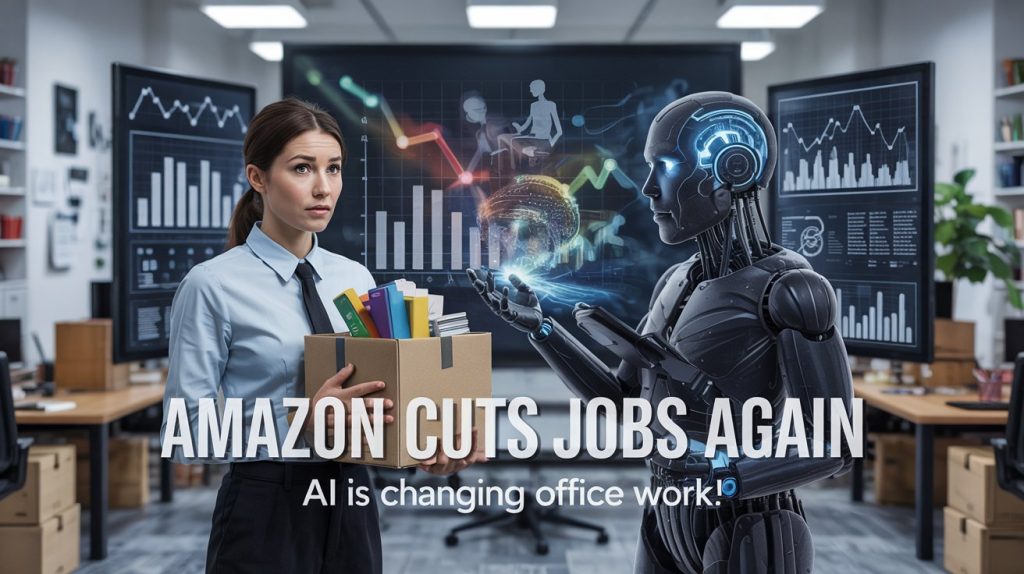
When the emails started landing in inboxes again, many Amazon workers felt the same cold drop in the stomach they had felt just weeks earlier. Some had only just finished helping friends clean out desks. Others thought the worst was over. It wasn’t.
Amazon has carried out another round of job cuts, adding to the roughly 16,000 corporate roles it already said it would remove earlier this year. The company has not shared the exact number this time. But reports from Reuters and The Wall Street Journal say more teams were hit, across different business units. It does not look like one big, clean break. It looks more like a slow drip. A rolling layoff.
For the people inside the company, that makes it harder. One day your team is safe. The next day, someone is gone. Then another meeting appears on the calendar, and nobody is sure what it means.
This new round of cuts comes as Amazon continues a big post-pandemic reset. During COVID, online shopping exploded. Cloud services grew fast. Hiring followed. The company added people, managers, and more managers. Now, leaders say they want to become “leaner.” Fewer layers. Faster decisions. More work done by machines and software, especially AI.
On paper, the story sounds neat and clean. In real life, it is not.
Profits Are Up. Jobs Are Down.
What makes this moment feel strange is the timing. Amazon recently reported a sharp rise in quarterly profits. Advertising is growing. Cloud margins are improving. Costs are under control. Wall Street is happy.
And yet, jobs keep disappearing.
Analysts told Bloomberg that this shows something important: in big tech companies, profit and job growth are no longer tied together like they used to be. A company can make more money and still hire fewer people. Or even cut more.
That is a big change from the past. For years, growth meant more offices, more teams, more hiring. Now, growth seems to mean better software, better automation, and fewer people in between.
Inside Amazon, executives have been more open than most about why this is happening. In internal messages shared with staff earlier, leaders said generative AI tools will reduce the need for some corporate roles over time. Not all jobs. But many of the routine ones. The kind that involve reports, planning, analysis, and support work.
Reuters reported that Amazon expects AI to take on more of these tasks, the kind often done by mid-level professionals. Spreadsheets. Forecasts. Slides. Summaries. Scheduling. The quiet, invisible work that keeps big companies running.
For some workers, that feels like the ground is moving under their feet.
Not the First Cuts, and Maybe Not the Last
This is not Amazon’s first round of layoffs in this cycle. In October 2025, the company cut about 14,000 roles. Then came the January 2026 announcement of around 16,000 more corporate jobs going away. That brings the total close to 30,000 in just a few months.
The cuts have touched many parts of the business: AWS, retail, Prime Video, and HR. The goal, according to the company, is to reduce bureaucracy and layers of management. In simple words, fewer people between ideas and decisions.
An internal email leaked before the official blog post from senior vice president Beth Galetti. In that message, workers in the US were told they would get 90 days to try to find another role inside the company, plus severance and benefits if they could not. The impact has not been limited to the US. Reports say employees in the UK, India, and other regions were also affected, with hundreds hit in India alone.
For many, the process has felt both fast and slow at the same time. Fast, because decisions come suddenly. Slow, because the company keeps making cuts in waves, not all at once. That creates a feeling of waiting. Of watching. Of checking messages twice before opening them.
As of early February, there are no confirmed reports of another big, named wave beyond this January round. But analysts warn that smaller, incremental layoffs could continue through 2026 as companies keep adjusting their workforces around AI.
In other words, this may not be over.
AI Is No Longer Just a Buzzword
A few years ago, AI in big companies was mostly a side project. A lab. A test. A promise for the future. That has changed.

The Financial Times recently wrote that big tech firms no longer treat AI as an experiment. They now see it as a core tool to redesign how work is done. That means flatter teams, fewer managers, and lower fixed costs. And yes, fewer jobs in some areas.
Across the tech industry, more than 123,000 jobs were cut in 2025 alone. Not all because of AI. But many companies, including Amazon, have clearly linked their cuts to “efficiency gains” from new tools.
CEO Andy Jassy has said more than once that AI will shrink parts of the corporate workforce, even as it creates new roles in engineering, data, and oversight. That is the trade-off being offered. Fewer people doing routine work. More people building and watching the systems that do that work.
The problem is timing. Jobs disappear faster than new ones appear. And not everyone who loses a role in planning or operations can quickly become an AI engineer or data specialist.
That gap is where the fear lives.
What It Feels Like on the Inside
Public statements talk about “restructuring” and “efficiency.” Inside, it feels more personal.
One former Amazon employee, who asked not to be named, said the hardest part was the silence before the news. “You hear rumors. You see meetings pop up. You watch managers act strange. And you wait,” they said. “It’s like waiting for a storm. You don’t know if it will hit your house or the one next door.”
Another worker said their team had just finished a big project when the cuts were announced. “We thought, okay, we delivered, we’re safe. But it didn’t work like that. The decision wasn’t about our project. It was about the shape of the company.”
That is the new reality for many white-collar workers, not just at Amazon. The work you do, the results you get, they still matter. But sometimes the bigger story is about structure, not performance.
A Bigger Shift in Corporate America
Amazon is not alone. Google, Meta, Microsoft, and others have all cut jobs while talking up AI at the same time. The pattern is starting to look clear.
Companies are using technology not just to grow, but to change how they are built. Fewer layers. More automation. Tighter teams.
For investors, this often sounds like good news. Lower costs. Higher margins. Faster decisions.
For workers, it sounds like a question mark.
Economists say the long-term impact will depend on whether people who lose jobs can move into the new roles that AI creates. History shows that technology does create new kinds of work. But history also shows that the transition can be painful and uneven.
Right now, we are in that messy middle.
The Human Cost Behind the Numbers
It is easy to talk about 16,000 jobs. Or 30,000. Big numbers become abstract. But each one is a person with rent, plans, and maybe kids in school. Each one has to explain at home what happened. Each one has to update a resume and start looking again.
In India, where hundreds were reportedly affected, the tech job market is already more crowded than it was a few years ago. In the US and UK, hiring has slowed compared to the boom days. That makes every cut feel heavier.
Some workers will land on their feet quickly. Amazon names on a resume still open doors. Others will take longer. And some will decide to leave big tech altogether.
What Comes Next
Amazon has not said which functions were hit in this latest round, and it has not said clearly whether more cuts are planned. The company keeps its statements careful and short.
But the direction is clear. More AI. Leaner teams. Fewer layers.
For now, Amazon’s latest cuts add to the growing signs that the next phase of efficiency in corporate America will not be driven by another shopping boom or cloud rush. It will be driven by software that can do more work with fewer people watching.
That might be good for balance sheets. It might even be good for customers in the long run.
But for the workers opening their email and seeing that meeting invite, it still feels the same. Quiet. Sudden. And very, very human.




 Login with Google