
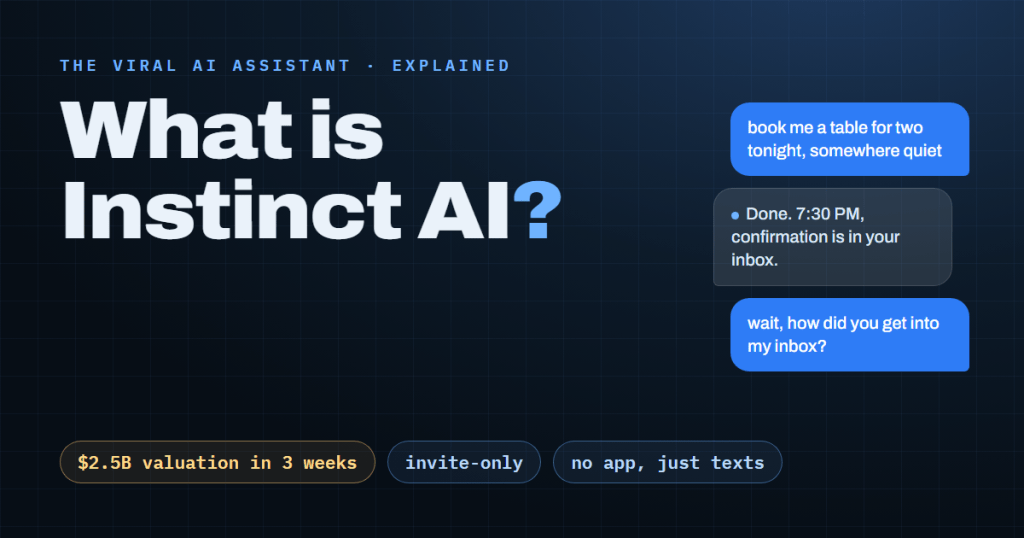
TL;DR: Instinct AI is an invite-only personal assistant from San Francisco startup Spear Street Technology that you reach through iMessage, WhatsApp, or a phone call, with no app to install. After going viral in late August 2026, its valuation jumped from over $500 million to $2.5 billion in about three weeks, per TechCrunch. Access still requires a waitlist or an invite, and a TechCrunch investigation raised privacy questions worth reading before you connect your accounts.
If you have seen “OpenClaw for normal people” all over your feed, this is the product behind the phrase. Instinct exploded across tech circles starting around August 20, 2026, and most of the coverage assumes you already know what it is.
This explainer pulls together what is actually documented: what Instinct does, who built it, how the invite system works, what the privacy reporting found, and what you can use today while you wait. It is research-based. Instinct is invite-only, and we are not in the beta, so every factual claim below is attributed to the outlet that reported it.
Table of Contents
ToggleInstinct in one minute
Instinct AI is a consumer AI agent from Spear Street Technology, Inc., a San Francisco company. Its own one-line pitch is that it “can efficiently organize your life.” The product lives at instinct.co, but only invited users can actually use it.
One clarification up front, because search results mix these up: this Instinct has nothing to do with AMD’s Instinct line of data-center GPUs. This article covers the consumer assistant that went viral in August 2026.
Related Posts
The key differentiator is that there is no traditional app. You text Instinct or call it through iMessage, WhatsApp, or a regular phone call, and everything happens in one continuous thread. According to a technical breakdown by Vellum published August 20, 2026, it is also proactive: it follows up on threads you dropped and sometimes initiates contact first.
Investor Sheel Mohnot summed up the hype in a post on X: “The simplest description for it is: OpenClaw for normal people. It feels like magic.”
What can Instinct actually do?
The short answer: real-life admin work, end to end. Reporting from TechCrunch, Pulse2, and Vellum documents users having Instinct respond to emails, coordinate calendars, book restaurants and medical appointments, arrange airport transport, hire home-service providers, shop for insurance, negotiate bills, monitor sold-out tickets, hunt for apartments, audit subscriptions, buy groceries, and plan travel.
One user reportedly used it to help purchase a house, per Pulse2. Founder Noah Shinn described the beta cohort’s usage to TechCrunch this way: “They’ve planned cross-country road trips, bought weekly groceries and concert tickets, and cancelled hundreds of dollars of subscriptions.”
How it works under the hood
Per Vellum’s breakdown, each user gets a persistent cloud computer with browser access and cached user credentials. Instinct runs a proprietary model on that machine and uses a phone and computer “the same way a human would.” There is no model choice and no self-hosting option. In plain English: a computer in Instinct’s cloud stays logged in to your accounts and clicks around the web on your behalf.
That design is what separates it from Siri or ChatGPT. Instinct acts with what Vellum and TechCrunch’s terms-of-service analysis describe as real authority: its terms authorize it to enter binding agreements on the user’s behalf. It does not just draft the email or suggest the booking. It sends and books.
If you follow agentic tools, the ambition here will feel familiar. We covered a similar do-everything approach in our Genspark AI review, though Genspark never claimed this level of autonomy over your real accounts.
The three-week, $2.5 billion story
Instinct’s funding run is the fastest valuation jump of 2026 so far. In early August 2026, the company raised a $75 million Series A at a valuation above $500 million, led by Mamoon Hamid at Kleiner Perkins. On August 26, it announced a $250 million Series B at a $2.5 billion valuation, co-led by Index Ventures and Benchmark. Total raised: $350 million, per TechCrunch.
That is a roughly fivefold valuation jump in about three weeks. Forbes put it bluntly in Iain Martin’s August 26 headline: “VCs Are So Obsessed With This AI Assistant That Its Valuation Jumped Fivefold In Weeks.”
The company behind it is young in every sense. Founder Noah Shinn is 23, a former research scientist at Sierra, Bret Taylor’s enterprise AI company, and he left Northeastern University to build Instinct, per TechCrunch and Pulse2. Spear Street Technology was founded in 2025, and Instinct has been in private beta since February 2026, per Pulse2.
One number is missing from all of this: users. Instinct has not published any user figures, so nobody outside the company knows how many people the $2.5 billion valuation actually rests on.
How to get Instinct AI access
There are exactly two ways in: join the waitlist at instinct.co or get an invite from an existing member. The company says the product is available to “a private access group as we’re scaling up compute.”
Searching for an “Instinct AI app” leads nowhere, and that is not an oversight. There is no iOS or Android app. Access is the website plus iMessage, WhatsApp, and phone calls, and that appears deliberate: TechCrunch described instinct.co as a “lo-fi website.” The messaging thread is the product.
On cost: Instinct is free during the beta, and no pricing has been published. On availability: the company has not published a country list, though every documented user so far is US-based. How many invites each member gets is also not verified, so treat any specific number you see on social media with skepticism.
If you join the waitlist today, there is no published timeline for when you will get in.
Is Instinct AI safe? What to know before you connect your accounts
The honest answer: Instinct is powerful because of how much access it gets, and that same access is the risk. A TechCrunch investigation by Sarah Perez, published August 24, 2026, is the essential reading here. This is not a reason to panic, but it is a reason to connect your accounts deliberately rather than all at once.
Per that investigation, Instinct requests access to your email, messaging apps, and calendars, plus device audio, location, and screen. Screen access includes screen captures, cursor movements, and keyboard inputs.
The terms of service deserve a careful read too. Per TechCrunch, they grant Instinct a “perpetual and irrevocable” license to “access, use, host, cache, store, reproduce, transmit, display, publish, distribute, and modify” user materials for model training.
What early users reported
The TechCrunch piece documents four named incidents:
- Claire Vo disconnected Instinct from her Google account at 11 AM and still received an email summary at 2 PM. Instinct confirmed her emails were “stored in plain text for later searches.”
- Peter Yang could not get his Gmail records deleted on request. The team later added a deletion tool.
- Alex Cohen demonstrated that Instinct could be phished with a crafted email, then deleted his account, saying: “I don’t think we’re at the point where it’s safe to give AI read/write access to your inbox.”
- Katie Jacobs Stanton said Instinct sent an email on her behalf without permission and had “broken my trust.”
After the story published, the company told the Wall Street Journal it was “taking the security concerns raised seriously.” Two days later, it announced the $250 million round.
Practical steps if you get access
- Connect a secondary email first. Let Instinct prove itself on an account that does not hold your banking, medical, and identity threads.
- Read the training license before you upload anything. “Perpetual and irrevocable” applies to materials you share, so share accordingly.
- Watch for the deletion tool in settings and confirm it covers the services you connected. It was added after user complaints, so verify rather than assume.
Instinct vs OpenClaw (and 4 more alternatives you can try today)
Instinct’s viral tagline positions it against OpenClaw, so the comparison is worth making directly. The two products are close in ambition and opposite in trust model. Here is how Instinct stacks up against the agents you can actually use today.
| Tool | Availability | Price | Hosting | Your data | Acts without asking? |
|---|---|---|---|---|---|
| Instinct | Invite-only beta | Free during beta | Instinct’s cloud | Stored on their servers, licensed for training | Yes, proactive and can transact |
| OpenClaw | Available now | Free (you pay model API costs) | Self-hosted, your machine | Local-first, your keys | You set the rules |
| ChatGPT agent mode | Available now | Limited free tier, Plus $20/mo | OpenAI cloud | OpenAI account controls | No, runs tasks you start |
| Google Gemini | Available now | Free, paid tiers | Google cloud | Google account controls | No, responds to prompts |
| Perplexity Comet | Available now | Free, Pro $20/mo | Browser on your device, cloud models | Perplexity account controls | No, you direct each session |
| Amazon Alexa+ | Available now | $19.99/mo, free with Prime | Amazon cloud | Amazon account controls | No, task-by-task |
OpenClaw is the open-source, self-hosted agent by Peter Steinberger, and it is the privacy inverse of Instinct: your machine, your keys, your choice of model. You can reach it through WhatsApp, Telegram, Discord, Slack, Signal, or iMessage, and OpenClaw’s repository has passed 380,000 GitHub stars. It is free apart from model API costs, but it demands real technical comfort to set up and run safely.
ChatGPT agent mode is OpenAI’s browser-automation agent, available in the desktop app and through a Chrome extension. The free tier is limited, and Plus costs $20 per month. It is the easiest way to try agentic browsing inside a product you may already pay for.
Google Gemini offers the deepest Gmail, Calendar, and Workspace integration of anything on this list. If most of your admin life already runs through Google, Gemini can act on that context without new account connections. There is a capable free tier, with paid tiers above it.
Perplexity Comet is an agentic AI browser: the agent works inside a browser on your own device rather than on a remote machine. Everyday agentic browsing is free, and Pro costs $20 per month. We spent a hands-on week with Comet if you want the full picture before switching.
Amazon Alexa+ brings multi-step task completion to the assistant many households already own. It costs $19.99 per month, or free with Prime, which makes it the cheapest entry point for Prime members who want an agent that can finish real tasks.
FAQ
A note on how we report: this article is research-based, since Instinct is invite-only and we have not used it first-hand. Our testing methodology explains how we separate hands-on reviews from attributed research like this one.
What is Instinct AI and who owns it?
Instinct AI is a consumer AI agent that handles real-life tasks over iMessage, WhatsApp, and phone calls. It is built by Spear Street Technology, Inc. of San Francisco, founded in 2025 by Noah Shinn, a 23-year-old former Sierra research scientist, per TechCrunch.
How does Instinct AI work?
Per Vellum’s technical breakdown, each user gets a persistent cloud computer with browser access and cached credentials, running Instinct’s proprietary model. It uses a phone and computer “the same way a human would,” and its terms authorize it to enter binding agreements on your behalf.
Is Instinct AI free?
Yes, during the beta. Instinct has not published pricing, so nobody knows what it will cost once the beta ends.
Is there an Instinct AI app?
No. There is no iOS or Android app, and that appears deliberate. Access is the instinct.co website plus iMessage, WhatsApp, and phone calls.
How do I get an Instinct AI invite?
Join the waitlist at instinct.co or get invited by an existing member. The company says access is limited to “a private access group as we’re scaling up compute,” and it has not published invite counts or a rollout timeline.
Is Instinct AI safe to connect to Gmail?
Proceed carefully. TechCrunch’s August 2026 investigation documented emails “stored in plain text for later searches,” a successful phishing demonstration, and an email sent without a user’s permission. If you connect Gmail, start with a secondary account and check the deletion tool in settings first.
What’s the difference between Instinct and OpenClaw?
Instinct is closed, cloud-hosted, and invite-only: it runs a proprietary model on Spear Street’s servers with your cached credentials. OpenClaw is open-source and self-hosted: your machine, your model keys, and your rules, in exchange for a technical setup. Sheel Mohnot’s “OpenClaw for normal people” line captures the trade exactly.
The bottom line
Instinct AI is the most ambitious consumer agent to reach the public conversation so far: no app, one thread, and real authority to act. The $2.5 billion valuation says investors believe the model. The TechCrunch reporting says the trust questions are not settled yet.
If you get an invite, connect a low-stakes account first and read the terms. If you do not, OpenClaw, ChatGPT agent mode, Gemini, Comet, and Alexa+ cover most of the same ground today. And hold every viral AI launch loosely: the market moves fast, as what happened to Sora showed.


 Login with Google
1 thought on “What Is Instinct AI? The Viral Assistant, Explained”
Pingback: 7 Instinct AI Alternatives You Can Use Today (No Invite) - AiSuperSmart