
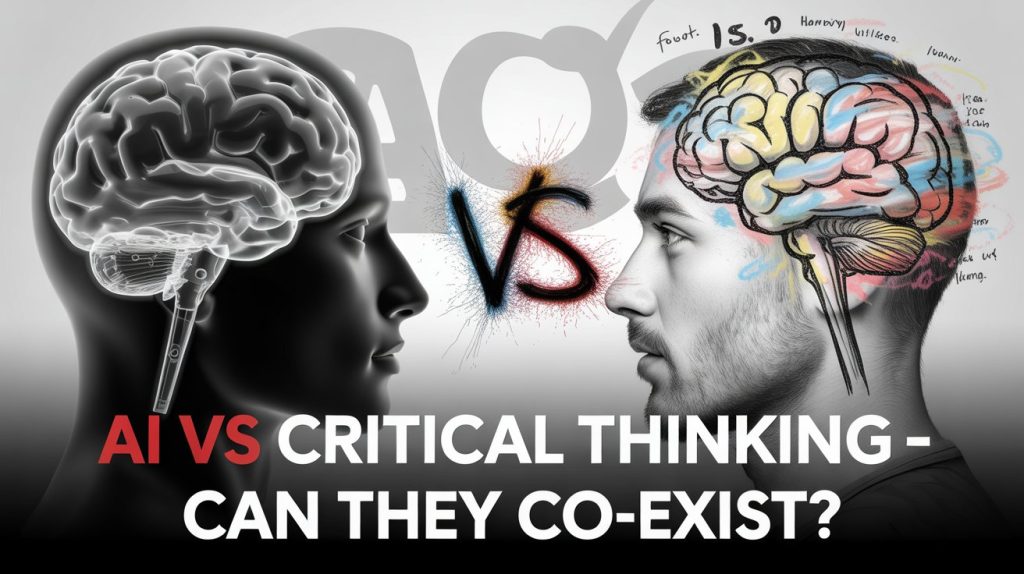
In a world where artificial intelligence is rewriting the rules of work, education, creativity — even how we cook in our own kitchens — a big, uncomfortable question is suddenly echoing across classrooms, offices, labs, and government halls:
Can AI and critical thinking truly co-exist, or are we sleepwalking into a future where machines think for us?
It’s a question that has stirred up global debate, sparked new education policies, and even led to warnings from some of the world’s top researchers. And as AI systems quietly (or not-so-quietly) take over everything from writing essays to diagnosing diseases, many are wondering: Are we sharpening our minds with AI… or outsourcing them?
This report digs into the tensions, the opportunities, and the human fears behind one of the most defining debates of our time.
A New Era — and a New Fear
Artificial Intelligence has become the powerhouse technology of the 21st century, shaping how we live, learn, cook, shop, vote, and think. From self-driving cars to ChatGPT, from Midjourney art generators to AI-powered medical imaging, the technology has crawled into nearly every corner of human life.
Even the concept of an “AI kitchen” — where a smart assistant plans your meals, tracks nutrients, and suggests recipes — is becoming mainstream.
But with AI now performing tasks once believed to be uniquely human, a simple yet troubling concern has arisen:
Are humans forgetting how to think?
Critical thinking, the ability to question, analyse, compare, judge, and understand, has long been considered the beating heart of human intelligence. It’s what helps us solve complex problems, detect bias, separate truth from noise, and make ethical decisions.
Yet AI can now:
- write essays
- summarise books
- solve equations
- generate art
- simulate conversation
- and even produce scientific hypotheses
— all in seconds.
For many educators and psychologists, this isn’t just impressive. It’s alarming.
The Core Concern: Is AI Making Us Mentally Lazy?
Researchers across the world are warning that if humans rely too heavily on AI, the long-term consequences could be serious.
A recent MIT-linked study from mid-2025 found that students who frequently used AI writing tools showed reduced cognitive engagement and weaker memory recall. In simple terms: too much AI = less thinking.
This isn’t because AI is harmful.
It’s because we’re using it passively instead of critically.
Philosophers call it cognitive outsourcing — the quiet habit of letting machines do the thinking for us.
Educators worry that if students can click a button and get a full essay, why struggle through the difficult, brain-stretching process of forming arguments, examining evidence, or building creativity?
And then there’s the flood of AI-generated content online. While fast and convenient, it can also be:
- biased
- inaccurate
- superficial
- repetitive
- or flat-out wrong
Yet millions accept it at face value.
This is why one education expert recently warned:
“AI isn’t replacing critical thinking. It’s replacing the need to use critical thinking — unless we actively fight against that.”
AI and Critical Thinking: A Clash… or a Partnership?
Despite concerns, many technologists argue the relationship doesn’t have to be adversarial.
In fact, Dr. Mukul Chandra Bora and many others propose the opposite:

AI can enhance critical thinking — if used consciously.
Here’s how:
1. AI as a Thought Partner
AI can reveal patterns and ideas humans miss.
Scientists now use AI to identify relationships in data that spark new hypotheses.
2. AI as a Debate Starter
Students can take an AI-generated essay and critique it — analysing its assumptions, errors, and biases.
This strengthens critical thinking rather than weakening it.
3. AI and Metacognition
Explainable AI (XAI) tools show how they reach conclusions.
Users can compare machine reasoning with their own, becoming better at analysing mistakes.
4. Realistic Simulations
AI training tools can simulate medical cases, ethical dilemmas, or crisis scenarios that require deep judgement.
These aren’t shortcuts — they’re accelerators.
5. Democratizing Education
AI platforms provide personalised learning and feedback, helping millions develop higher-order reasoning skills.
So while AI can make us passive — it can also make us sharper.
The deciding factor?
How we choose to use it.
Education: The Real Battleground for Human Thought
Around the world, education systems are quietly rewriting curriculums to tackle the AI revolution head-on.
A striking example comes from India:
Assam has introduced AI and critical thinking as a combined subject in higher secondary schools.
The goal?
To ensure students don’t simply use AI, but understand, question, and challenge it.
Teachers are now redesigning assignments so that:
- students must critique AI outputs
- justify revisions
- defend their reasoning
- detect biases
- evaluate sources
This marks a dramatic shift from the old “memorise and write” model.
And the global trend is clear:
AI literacy + critical thinking = the new essential skillset.
The Ethical Storm: Who Holds the Power?
AI isn’t just a technical tool.
It has social, political, and moral consequences.
Critical thinking is essential for spotting:
- algorithmic bias
- misinformation
- manipulative advertising
- unfair decision-making
- privacy violations
Take predictive policing — criticised for reinforcing racial and social bias.
Or medical AI tools that diagnose but cannot provide compassion or ethical judgement.
Without human oversight, empathy, and questioning, AI risks amplifying injustice.
As one ethicist put it:
“Automation without critical thinking is not efficiency — it’s danger.”
The Workplace: Humans Still Needed — But Smarter
AI is automating routine tasks at lightning speed.
Data entry? Automated.
Schedule drafting? Automated.
Basic analysis? Automated.
But this doesn’t kill human jobs — it transforms them.
The World Economic Forum now ranks critical thinking, creativity, and ethical decision-making as the top skills for the AI age.
Analysts must interpret AI insights.
Journalists must detect truth behind AI summaries.
Doctors must blend AI data with empathy.
Leaders must question what algorithms overlook.
Companies that combine AI efficiency with human reasoning are already pulling ahead.
So… Can AI and Critical Thinking Co-exist?
After examining research, expert opinions, global policy changes, and emerging trends, one thing becomes clear:
AI and critical thinking not only can co-exist — they must.
The danger isn’t AI itself.
It’s passive use.
It’s blind trust.
It’s forgetting to question.
But when humans partner with AI — questioning, analysing, interpreting, and challenging — the result is a powerful synergy:
- faster ideas
- sharper reasoning
- deeper insights
- more ethical decisions
The future isn’t AI replacing human intelligence.
The future is AI sharpening human intelligence.
The Road Ahead: What Humanity Must Do Now
To ensure AI becomes a catalyst, not a crutch, experts recommend:
- Teach AI literacy early
- Design explainable AI systems
- Encourage human–AI collaboration
- Strengthen ethics and policy
- Promote lifelong learning
Education will be the testing ground.
Workplaces will be the proving ground.
Society will be the long-term judge.
One thing is certain:
The digital age will belong to those who can blend human reasoning with machine precision.
And in that future, critical thinking is not optional —
it’s the last, strongest, and most essential human skill.



 Login with Google