
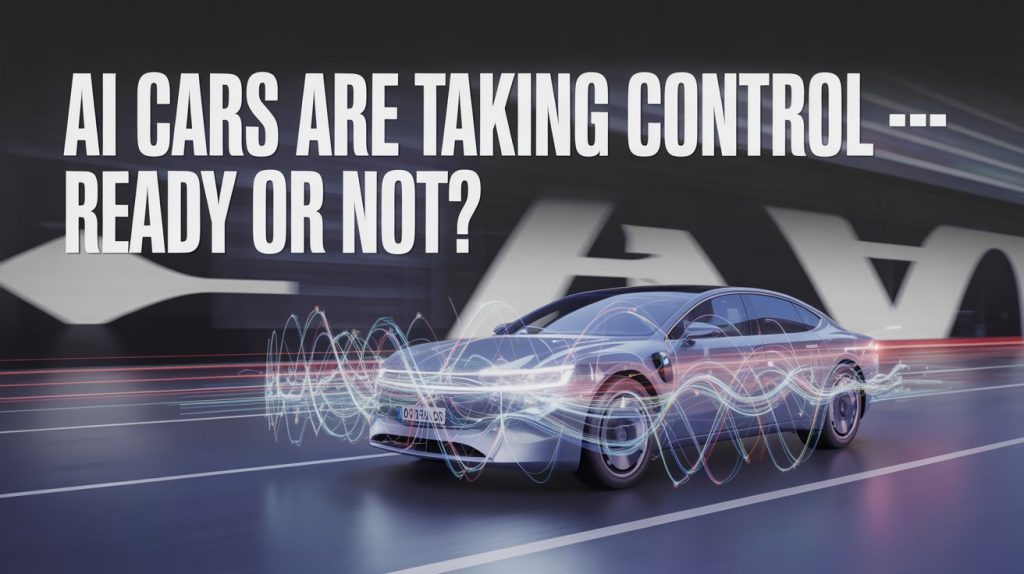
Las Vegas has seen many big promises over the years — flying taxis, smart homes that talk back, phones that fold twice. But at CES 2026, something felt different. This time, the future wasn’t buzzing or flashing. It was gliding quietly, confidently, without a human hand on the steering wheel.
Self-driving cars are no longer just a Silicon Valley dream or a PowerPoint idea shown on a dark stage. They are here, moving through real traffic, stopping for ambulances, and making decisions that once only human drivers could make. And artificial intelligence is the brain behind it all.
Even if Elon Musk’s long-promised robotaxis for everyone still feel far away, CES showed one clear message: AI-driven cars are no longer asking if they will arrive — they are deciding how fast.
A Quiet Revolution on the Vegas Floor
The Consumer Electronics Show floor was packed with sleek electric vehicles glowing under bright lights. But the real action wasn’t in their design. It was inside their computers.
Waymo’s robotaxis are already operating in parts of the United States. In China, Baidu’s Apollo Go has been expanding at speed, picking up real passengers without human drivers. These aren’t demos anymore. These are daily services, moving thousands of people every week.
For the first time, fully autonomous driving — where the machine takes full responsibility — feels proven. This is known as Level 4 autonomy, and it means the driver can truly let go.
Yet despite all the hype, only one company showed up at CES 2026 with a personal Level 4 car meant for individual owners.
That company is Tensor.
Meet Tensor’s $200,000 Robot Car
Tensor, a quiet Silicon Valley startup, arrived in Las Vegas with confidence — and a very expensive promise.
The company calls its vehicle “the first personal robot car on Earth.” It is a luxury SUV priced around $200,000, packed with technology that feels closer to science fiction than daily commuting.
The numbers alone tell a story:
- 34 cameras
- 5 lidar lasers
- Over 100 sensors
- NVIDIA Blackwell AI chips
- A foldable steering wheel
This car can drive itself in many situations, though not everywhere. Tensor’s autonomy is still limited, and the company is careful not to overpromise. Tests are currently approved in California, and new laws in Texas, Nevada, and Arizona may soon open more doors. Tensor is also working closely with partners in the United Arab Emirates, where regulations are often more open to new technology.
A first model is expected to hit real roads in the coming months.
Still, this is not a mass-market car. Not yet.
Why Level 4 Is Still Rare
If the technology exists, why don’t we all own self-driving cars already?
The answer is simple, and frustrating: laws and trust.

“From a technology standpoint, it is there,” said Pier Paolo Porta, marketing director at Ambarella, a company that builds autonomous driving systems.
“But from a legal and from a liability standpoint, it is still a gray area.”
Who is responsible when a self-driving car crashes? The owner? The manufacturer? The software developer?
These questions don’t have clear answers yet. And until governments solve them, fully autonomous cars will stay limited to testing zones, robotaxi fleets, and carefully controlled environments.
That’s why the industry has shifted focus.
Level 2: The Real Battleground
While Level 4 grabs headlines, Level 2 assisted driving is where most of the real progress is happening.
Level 2 means the car can steer, brake, and accelerate on its own — but the human driver must stay alert and ready to take control. Legally, the responsibility still belongs to the driver.
This is where Tesla’s Full Self-Driving operates in the U.S., and where Chinese brands like Xiaomi and BYD are moving fast. It’s also where AI is making the biggest difference.
Modern AI systems can now do more with fewer sensors. Instead of relying heavily on expensive lidar maps, cars are learning to understand the road visually, much like humans do.
And that’s where Nvidia stepped into the spotlight.
Nvidia’s “ChatGPT Moment” for Cars
On Monday at CES, Nvidia CEO Jensen Huang took the stage and delivered one of the most talked-about moments of the show.
He unveiled Alpamayo, an AI platform built specifically for autonomous driving. Starting this year, it will power electric Mercedes CLA models in the United States.
“Alpamayo brings reasoning to autonomous vehicles,” Huang said.
“It allows them to think through rare scenarios, drive safely in complex situations, and explain their driving decisions.”
Huang went further, calling it a “ChatGPT moment for physical AI.”
In simple terms, cars are no longer just following rules. They are reasoning.
During a December demonstration, a self-driving Mercedes powered by Alpamayo moved through heavy San Francisco traffic. A human safety driver sat ready, but only had to step in once — to navigate around an ambulance stopped unexpectedly in the road.
Unlike older systems, Alpamayo does not rely only on pre-mapped streets. It can handle roads it has never seen before. That’s a huge step forward.
Robotaxis Are Expanding — Carefully
While personal robot cars face legal hurdles, robotaxi fleets are growing quietly but steadily.
Waymo recently updated its safety software after a December 2025 outage in San Francisco. The company says the changes will support major expansion through 2026.
Uber used CES to debut a Lucid-based robotaxi, planned for San Francisco later this year. These vehicles will initially include human operators, but the long-term goal is full autonomy. Nvidia’s technology is again at the center.
In China, Apollo Go continues to grow, and in January 2026, it secured Dubai’s first fully driverless testing permit. The company plans to roll out a fleet of over 1,000 vehicles, with commercial operations expected in the first quarter.
The message is clear: robotaxis are becoming normal — city by city.
Everyone Wants a Piece of the Road
Nvidia is not alone.
Qualcomm showed off its Snapdragon Ride platform at CES, combining on-board AI with HERE maps to deliver Level 2+ driving with better foresight and decision-making.
Nissan announced it will soon integrate AI software from British startup Wayve across much of its vehicle lineup. Wayve’s system learns from real-world driving data instead of fixed rules, making it more adaptable.
Tesla, meanwhile, is pushing for full approval of its Full Self-Driving system in China by early 2026 — a move that could reshape the global EV race overnight.
Each company is chasing the same goal: give drivers the feeling of autonomy, while keeping legal responsibility with humans.
The Emotional Side of Letting Go
For many drivers, the hardest part isn’t technology or laws. It’s trust.
Letting a machine take control feels unnatural. Driving is personal. It’s about freedom, fear, confidence, and habit. A sudden brake, a sharp turn, a wrong decision — these moments stay with people.
Yet younger drivers, raised on automation, seem more open. They see self-driving not as a risk, but as relief. Less stress. More time. Fewer accidents.
And the numbers quietly support that hope.
The Road Ahead
CES 2026 didn’t promise a world where everyone sleeps while their car drives them to work. But it showed something more realistic — and perhaps more powerful.
AI is no longer learning about driving. It is learning how to drive.
Slowly. Carefully. With mistakes. With updates.
The steering wheel isn’t gone yet. But it’s starting to fold away.
And once that happens, there may be no turning back.


 Login with Google