
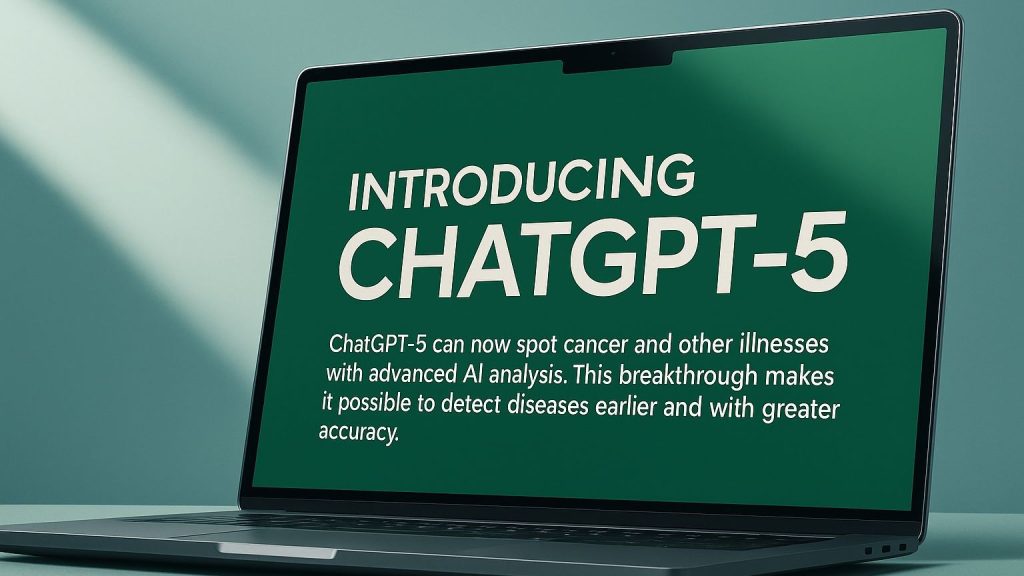
(San Francisco, August 10, 2025) – Hold onto your stethoscopes, folks. The world of artificial intelligence just took a quantum leap straight into your doctor’s office. OpenAI, the company that brought you the chatbot sensation ChatGPT, has unleashed its newest brainchild, GPT-5. And its boldest claim? This AI can now help spot cancer and other serious illnesses.
Yeah, you read that right. The same tech that helps you write emails or plan your vacation is now stepping into the high-stakes arena of medicine. It’s a development that’s sending shockwaves through the healthcare industry and sparking fierce debate – hope colliding head-on with healthy skepticism. Is this the dawn of a medical revolution, or just another overhyped tech promise?
More Than Just a Smarter Chatbot: GPT-5’s Medical Muscle
Unveiled just hours ago in a glitzy live event that felt more like a Hollywood premiere than a tech launch, GPT-5 isn’t just an incremental upgrade. OpenAI CEO Sam Altman positioned it as a fundamental leap forward. We’re talking faster responses, way fewer of those notorious AI hallucinations (you know, when it just makes stuff up), and significantly sharper accuracy across the board – writing, coding, you name it.
But the real showstopper? Its newfound prowess in health. Forget just explaining a rash; OpenAI claims GPT-5 can digest complex, terrifying medical jargon – like dense biopsy reports or intricate lab results – and translate them into plain, understandable English within seconds. And crucially, it can flag potential concerns, like signs of cancer, based on that information.
The Proof is (Allegedly) in the HealthBench Pudding
Okay, but how do they know? Enter “HealthBench.” Sounds like a gym machine, right? Actually, it’s OpenAI’s secret sauce for testing GPT-5’s medical chops. Developed alongside more than 250 real, live physicians, HealthBench throws complex, real-world medical scenarios at the AI. Think diagnosing tricky cases, interpreting ambiguous test results, explaining treatment pathways.
According to OpenAI, GPT-5 didn’t just pass HealthBench; it aced it. They say it dramatically outperformed all previous models, showing exceptional skill at cutting through medical complexity and offering clear, actionable guidance. It’s not just about spitting out facts; it’s about understanding the human weight behind them.
Carolina’s Story: When the AI Became a Lifeline
They didn’t just rely on dry benchmarks. To hammer home the potential human impact, OpenAI shared a gut-punch of a story during the launch. Meet Carolina (no last name given, privacy and all). Carolina, facing the terrifying whirlwind of a fresh cancer diagnosis, found herself staring at a biopsy report packed with impenetrable medical terms. Overwhelmed and scared, she turned, perhaps desperately, to ChatGPT powered by the new GPT-5.
What happened next? Within moments, GPT-5 took that dense, frightening document and transformed it. It broke down the diagnosis, the implications, the next steps – not in cold clinical terms, but in language Carolina could actually grasp. The result? Clarity. A sliver of understanding. A massive dose of emotional relief in the midst of chaos. That’s the kind of impact, OpenAI argues, that makes this more than just tech – it becomes a potential lifeline.
“It’s an Assistant, NOT Your Doctor!” – OpenAI’s Loud Caveat
Hold your horses, though. Before anyone starts firing their oncologist, OpenAI is screaming the disclaimer from the rooftops. GPT-5 is NOT a doctor. Repeat: NOT. A. DOCTOR.
Sam Altman himself took pains to frame it strictly as a “physician assistant” in digital form. Think of it as the world’s most knowledgeable, lightning-fast medical librarian and translator. Its job? To empower patients like Carolina, to help you understand what your doctor is saying (or what that confusing report actually means), to suggest questions for you to ask during your next appointment, and maybe, just maybe, to flag something concerning that needs urgent professional attention.

The emphasis is crystal clear: Literacy and Support, NOT Diagnosis and Treatment. GPT-5 helps you understand the puzzle pieces; the licensed human doctor is still the only one who can legally and safely put the picture together and decide what to do.
Why This Could Be a Game-Changer, Especially Where Doctors Are Scarce
So, where does this tool shine brightest? OpenAI is pointing directly at the massive, glaring gaps in global healthcare access.
Imagine remote villages miles from the nearest clinic. Imagine underserved urban areas with overstretched emergency rooms. Imagine someone at 2 AM with a worrying symptom, unable to reach their GP. That’s where GPT-5 steps in, OpenAI argues. It offers immediate, preliminary insights. It can help someone understand if that chest pain might be serious enough to rush to the ER, or if it’s likely something less urgent. It can translate complex discharge instructions after a hospital visit. It can provide basic health information where libraries or community health workers are scarce.
“Enabling healthcare support at scale,” Altman called it. The potential to empower billions with basic medical understanding? That’s the multibillion-dollar, world-changing enterprise he hinted at.
Beyond the Hype: Is it Revolutionary or Just… Better?
Not everyone is ready to crown GPT-5 as the medical messiah. Some early reactions from tech watchers and users online suggest a more measured view: “Evolutionary, not revolutionary.” They see GPT-5 as a highly refined, significantly more reliable version of what came before – a tool focused intensely on usability and trustworthiness in critical domains like health.
The skepticism is valid. AI in medicine has a checkered past. Remember when algorithms promised to read X-rays better than radiologists? The reality often proved messier. Bias in training data, unexpected errors, the sheer complexity of the human body – these are massive hurdles. GPT-5, despite its impressive HealthBench scores, hasn’t been battle-tested by millions of real users facing real, diverse medical crises. That test is happening right now.
What You Get: Speed, Smarts, and (Hopefully) Less Nonsense
Beyond the medical headlines, GPT-5 brings tangible upgrades for everyone:
- Blazing Speed: Responds significantly faster than GPT-4.
- Sharper Accuracy: Makes fewer factual errors.
- Reduced “Hallucinations”: Less likely to invent plausible-sounding nonsense.
- Multimodal Mastery: Better at understanding images, charts, and documents you upload alongside your questions.
- Wider Access: Rolling out now across both free and paid (ChatGPT Plus) tiers of service.
The Bottom Line: A Powerful Tool in Your Pocket, Handle with Care
So, what are we left with? OpenAI has thrown down a gauntlet. ChatGPT-5, available to millions right this second, claims an unprecedented ability to navigate complex health information and potentially flag serious conditions like cancer.
The story of Carolina is powerful. The potential for global health empowerment is genuinely exciting. The promise of faster, clearer medical understanding for everyone is undeniably attractive.
But. And it’s a huge but. This is not magic. It’s sophisticated software. Relying on it for diagnosis is dangerous. Ignoring your actual doctor because ChatGPT said something different is foolish. Seeing a concerning flag from GPT-5 should trigger one action: Call your doctor. Immediately.
GPT-5 represents a potentially transformative support tool – a medical flashlight in the dark, a translator for the bewildered, a question-generator for the intimidated. It could save lives by prompting earlier doctor visits. It could ease minds by explaining the unexplainable. It could democratize basic health knowledge.
But it walks a razor’s edge. Misuse could lead to missed diagnoses, unnecessary panic, or a dangerous erosion of trust in human medical professionals. The responsibility now lies not just with OpenAI to ensure the tool’s safety and accuracy, but with every single one of us to use it wisely.
The AI can spot potential cancer? Maybe. But the human judgment to act on that information, responsibly and urgently? That’s irreplaceable. GPT-5 is here. The experiment in AI-powered health literacy has begun. Handle with extreme care, and always, always keep your doctor on speed dial. The stakes just got a whole lot higher.



 Login with Google