
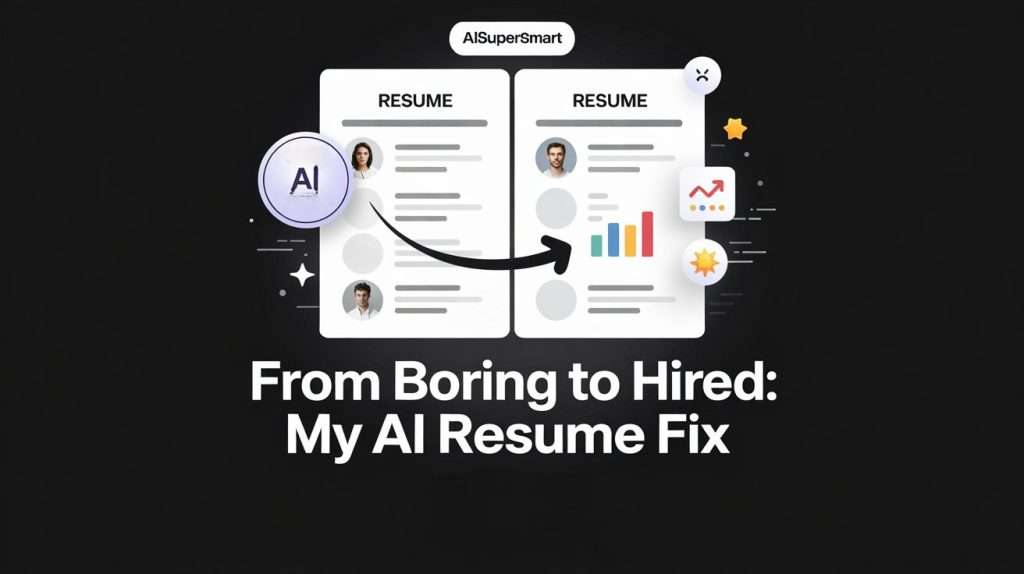
Let’s be honest, writing a resume feels like a chore from another decade. You spend hours trying to remember what you did in a job from three years ago, cramming in keywords, and fighting with formatting in Google Docs, only to send it into the black hole of an online application portal. I was there. I’d sent out nearly 50 applications and heard nothing but silence. My resume wasn’t terrible, but it was boring. It was a laundry list of my job duties, not a highlight reel of my accomplishments.
I knew AI was the buzz, so I decided to put it to the test. Could these “smart” tools actually turn my bland CV into something that gets a hiring manager’s attention? I spent a week and about $40 testing five of the most popular AI resume tools to see what they were really made of.
Here’s the no-fluff breakdown of what I found:
Key Takeaways
- Best for Fixing Bullet Points: Kickresume. Its AI writer was the most consistent at turning my boring duties into impressive, quantifiable achievements.
- Best for Beating the Robots (ATS): Teal. Its keyword-matching feature against a specific job description is the best I’ve ever used. It’s a must-have for serious job seekers.
- Best for Professional Design: Kickresume. It has modern, clean templates that the AI populates for you, making you look polished in minutes.
- My #1 Tip: Don’t just accept what the AI gives you. Use its suggestions as a starting point, then inject your own voice and, most importantly, add specific numbers and metrics to make the achievements uniquely yours.
The “Before”: My Sad, Boring Resume
First, let me show you what I was working with. It was a simple, one-page resume I’d made in Google Docs. The real problem was the content. It was passive and described what I was “responsible for” instead of what I actually accomplished. It was the definition of “meh.”
Take a look at this bullet point from my previous marketing role. This is the kind of stuff that gets your resume tossed in the ‘no’ pile.

This tells a recruiter absolutely nothing. Did I post once a month? Did I grow the accounts? Did my work lead to any sales? It’s a total mystery. This is exactly what I needed AI to help me fix.
The 5 AI Tools I Tested (and What They’re Best For)
I focused on tools that represented the different ways AI can help your resume. I chose:
- Kickresume: An all-in-one platform with an AI writer, designer, and cover letter generator.
- Teal: A powerful job search tracker with a fantastic resume-builder and ATS optimization tool.
- Rezi: An AI writer heavily focused on keyword targeting and ATS compliance.
- ChatGPT (GPT-4): The famous do-it-all chatbot. I wanted to see how it stacked up against specialized tools.
- Skillroads: A service that uses AI to score your resume and provide feedback.
My goal wasn’t just to build a resume from scratch but to see how these tools could handle specific, critical missions.
Mission 1: Fixing My Terrible Bullet Points
This was my biggest challenge. I needed to turn that weak “Responsible for…” bullet point into a powerful achievement. I fed my original, boring sentence into the AI writers of Kickresume, Rezi, and ChatGPT to see what they would spit out.
The Test: Transform “Responsible for managing the company’s social media accounts” into an impressive accomplishment.
The Results (Head-to-Head Comparison):
The difference was immediately clear. While all the tools gave me something better than my original, the quality varied quite a bit.

- ChatGPT: Gave me a solid, but slightly generic, option: “Managed and grew the company’s social media presence across multiple platforms, increasing follower engagement.” Grade: B
- Rezi: Was very keyword-focused: “Maximized social media account performance through strategic content creation and community management to drive brand growth.” Grade: B- (A bit too much jargon for my taste).
- Kickresume: Nailed it. It gave me a framework I could easily edit with my own stats: “Spearheaded social media strategy, growing audience by 25% and increasing post engagement by 40% over six months.” Grade: A+
The Winner for Bullet Points: Kickresume.
Kickresume’s AI consistently produced results that sounded like real, human achievements. It understood the assignment—to show impact. I still had to go in and add my real numbers (the 25% and 40%), but it gave me the perfect template to do so.
Mission 2: Beating the ATS Robots
Applicant Tracking Systems (ATS) are the gatekeepers of the hiring world. These programs scan your resume for keywords from the job description before a human ever sees it. If you’re not tailored, you’re out.
The Test: Take my improved resume and optimize it for a real “Marketing Manager” job description I found on LinkedIn.
For this mission, Teal was in a league of its own.
Here’s how I did it. I saved the job description to my Teal Job Tracker, and then opened its Resume Builder tool. It automatically placed the job description’s most important keywords and skills on a panel right next to my resume.
It was incredible. Teal showed me in real-time which keywords were missing from my resume. My resume had “content creation,” but the job description wanted “content strategy.” Close, but not close enough for a robot.

Was it Worth It? Absolutely. This feature alone is worth the price of a monthly subscription. Manually cross-referencing keywords is a nightmare. Teal turns it into a simple matching game that takes maybe 15 minutes. It gave me total confidence that my resume was perfectly tailored for the role.
Mission 3: A Professional Design That Doesn’t Look Generic
My Google Doc resume wasn’t just boring in its content; it looked bland, too. A clean, professional design can make a huge difference in how you’re perceived.
The Test: Create a visually appealing resume that looks like it was professionally designed.
I turned back to Kickresume for this one, as its template designs are known to be top-notch. I chose a modern, two-column template, and its AI automatically ported all of my newly-improved bullet points and information into the design. The process was seamless.

The difference is night and day. The “before” looks like I put in zero effort. The “after” looks like I’m a serious candidate who pays attention to detail.
My Final Verdict: What’s Worth Paying For?
So, after all this testing, what’s the bottom line? Can AI really make your CV stand out?
Yes, but you have to be the pilot, not the passenger.
My recommendation is a two-step approach. Start with the free version of Kickresume to get your basic story and bullet points in order. Its AI writer is fantastic for sparking ideas and phrasing your duties as achievements. Then, when you’re ready to start applying seriously for a specific role, buy one month of Teal Pro (it’s around $9/week). The keyword-matching feature is the single most effective tool I found for getting past the ATS and into the hands of a real person.
For me, that $36 investment in a month of Teal felt like a bargain for the time it saved me and the confidence it gave me.
Ultimately, these tools are amazing assistants. They clean up your language, organize your thoughts, and handle the tedious parts of resume writing, freeing you up to focus on what matters most: telling your unique professional story.
What tools have you tried? Share your results in the comments below! 🙂

 Login with Google