
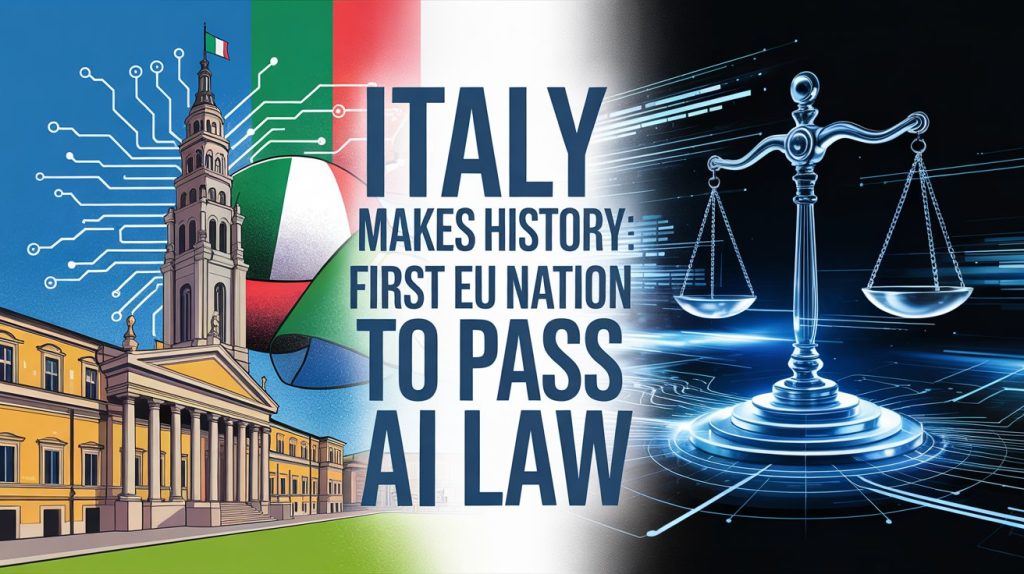
Rome, October 4, 2025 — In a bold move that’s set to make headlines across the world, Italy has become the first European Union country to pass a national law regulating artificial intelligence. The law, known as Law No. 132 of 2025, was approved by Parliament on September 17, published in the official gazette on September 25, and is slated to go into effect on October 10, 2025.
While Europe as a whole prepares for the EU-wide AI Act (to take full effect in 2027), Italy has opted to not wait but act first—asserting that innovation must be balanced with accountability, human rights, and safety.
What the New AI Law Does
Crackdown on Harmful AI and Deepfakes
One of the most dramatic aspects of Italy’s legislation is how it tackles misuse of AI for harm. The law criminalizes unlawful dissemination of AI-generated or manipulated content—especially deepfakes—if such content causes harm. Offenders could face prison sentences from one to five years.
Moreover, when AI is used to facilitate more traditional crimes—fraud, identity theft, and the like—the penalties escalate further, adding layers of consequence to those who weaponize technology.
Text & Data Mining: With Limits
The law also addresses the use of text and data mining (TDM) for AI training. Italy restricts such activities strictly to non-copyrighted works or sanctioned scientific research uses. This ensures respect for intellectual property while still permitting progress in AI research.
Italy even amended its copyright rules to reflect this framework. Only AI-assisted works that genuinely show human creativity or effort may receive protection.
Human Oversight, Traceability & Sector Limits
A core principle of the new law is human oversight. Across sectors such as healthcare, public administration, employment, justice, and education, important decisions must rest with humans—not AI acting alone. In health care, for example, doctors (not machines) remain responsible for major treatment decisions, and patients have a right to know when AI is involved in their care.
AI systems will also need traceability: logs, provenance, and ability to audit decisions are mandatory.
Protecting Minors: Parental Consent & Age Tiers
The law gives special care to minors. Children under the age of 14 cannot use AI systems unless their parents provide consent. Those aged 14 to 18 may consent themselves—but only after being properly informed.
This dual-tier consent model reflects Italy’s effort to strike a balance: protecting youth from possible harm while not casting them aside entirely.
Enforcement, Institutions & Funding
To enforce and monitor the law, two bodies have been designated:
- AgID (Agency for Digital Italy) will handle innovation promotion, conformity assessments, and notifications.
- ACN (National Cybersecurity Agency) takes charge of inspections, market surveillance, and sanctions.
Existing bodies—like the data protection authority (Garante) and financial regulators—retain their roles under the new framework.
Italy is also putting its money where its mouth is. The law authorizes a €1 billion state-backed venture capital fund dedicated to AI, cybersecurity, telecoms, and quantum technologies.

Still, critics argue that while this sum is bold in the European context, it remains modest compared to AI investments in the U.S. and China.
How It Relates to the EU AI Act
Italy is not trying to rewrite EU rules—it’s complementing them. The country’s legislation is tightly linked to the EU AI Act (Regulation 2024/1689), which requires member states to enforce rules by 2027.
Definitions like “AI system” and “high-risk AI” are adopted directly from the EU text, ensuring national measures dovetail rather than conflict with the bloc’s regulations.
Where Italy’s law adds value is by clarifying enforcement mechanisms, criminal penalties, and sectors of national sensitivity—areas where the EU Act leaves room for national variation.
Why It Matters — and What Could Go Wrong
Italy as a Testbed for Europe
Italy’s decision is historic. By moving first, it casts itself as a European laboratory for AI governance. The law will be watched closely—by governments, companies, and civil society alike. Italy hopes its model will signal how to enforce AI rules in a human-friendly, innovation-friendly way.
Implementation Will Be Tough
Passing a law is one thing: applying it is another. Many implementing decrees, guidelines, technical regulations, and sectoral rules still need to be fleshed out. Institutions like AgID, ACN, and Garante must be scaled up to do their jobs well.
Also, balancing innovation and regulation is a delicate art. Some AI firms warn that overly strict rules—especially in copyright and TDM—could stifle creativity or competitiveness.
Businesses & Workers Will Feel the Change
Companies in Italy will have to rethink how they build, deploy, monitor, and license AI systems. They’ll need internal policies, auditing procedures, logging infrastructures, and compliance offices. Some sectors (health, justice, HR) will face especially strict scrutiny.
Workers may gain new rights too—particularly if AI is used in monitoring, evaluation, or decision-making. The law calls for transparency and human review in such cases.
A New Chapter in AI Governance
Italy’s AI law is not just a national step—it is a global signal. It says that countries don’t need to wait years for international consensus before trying to govern AI. The Italian experiment may feed into global standards and inspire others to act rather than hesitate.
But it’s far from perfect. The coming months will test whether Italy can translate lofty goals into workable rules that protect people, support creators, and let technology thrive responsibly.
If Italy succeeds, we may soon see a cascade—other EU nations and beyond passing AI laws with teeth. If it stumbles, it will serve as a cautionary tale about the difficulty of regulating a fast-moving, complex technology without losing momentum or innovation.
Stay tuned: the AI story in Europe just turned a new page—and Italy grabbed the pen.


 Login with Google