
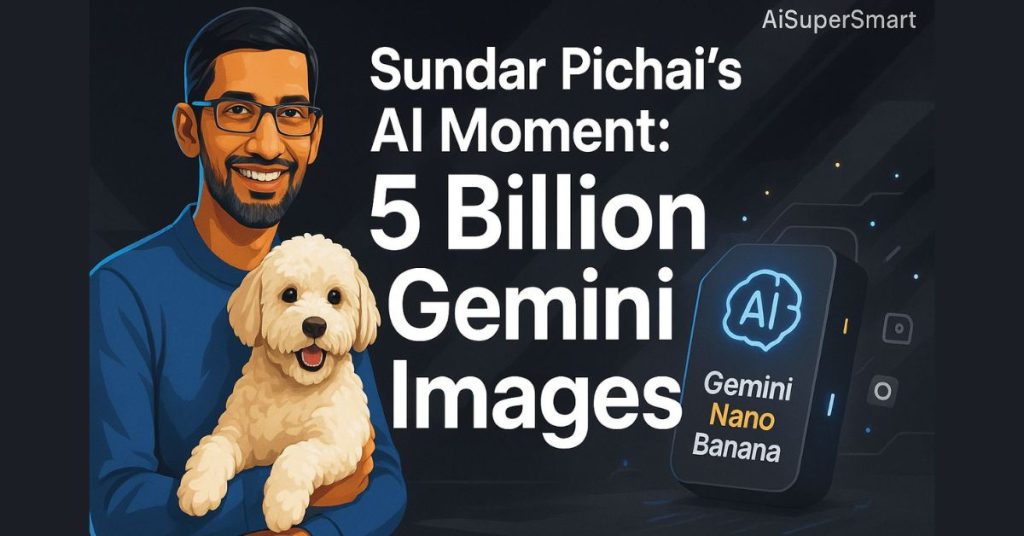
Silicon Valley woke up to an unexpected splash of color and curiosity this week. Google’s CEO Sundar Pichai didn’t announce a new Pixel phone or another secret AI model. Instead, he posted something far simpler — and perhaps more powerful. A single 3D image. But not just any image. This one was generated entirely by Google’s own Gemini AI and featured Pichai himself cradling his dog Jeffree.
In a world obsessed with AI right now, this playful post — and its massive numbers — have become the tech industry’s latest talking point.
The Post That Made Headlines
It all started with a milestone update from Google VP Josh Woodward. Earlier this week, Woodward proudly revealed that the Gemini app had crossed an eye-watering 5 billion images generated in under a month. That’s a figure no tech giant can ignore — even in the current AI gold rush.
Pichai, usually measured in his public appearances, responded in a way few expected. Posting on X (formerly Twitter), he quipped:
“Make that 5 billion and 1.”
Attached to the post was a stunning, slightly surreal 3D image of himself holding his golden retriever Jeffree. The duo sat at a desk that looked like it belonged in a futuristic art gallery — adorned with bright colors, floating gadgets, and creative flourishes. Within minutes, tech journalists, creators, and AI enthusiasts were sharing and dissecting the image.
What Made This Image Special
The picture wasn’t made in a photo studio. No expensive 3D modeling software. No team of graphic artists working overnight. Instead, it was born in seconds using Gemini’s Nano Banana tool, part of the company’s growing “Gemini Toolbox” suite.
Nano Banana may sound playful, but it’s quickly becoming one of Google’s most powerful creative AI tools. It allows anyone — from casual users to professional designers — to generate text-to-image creations, 3D visualizations, and advanced editing in just a few clicks.
For Google, this is exactly the point. As AI tools explode in popularity, the company wants to position Gemini not just as a competitor to other AI engines but as the creative powerhouse for the next generation of digital creators.
Why the 5 Billion Milestone Matters
The 5 billion figure isn’t just a vanity metric. It’s a sign of how quickly AI-generated visuals have gone mainstream. For context, it took some of the earliest image-generation platforms months — sometimes years — to hit their first billion. Google’s Gemini reached five billion in under a month.
That’s an unprecedented pace of adoption, even by Silicon Valley standards. And it signals something larger: AI creativity is no longer a niche experiment. It’s becoming an everyday tool, woven into the workflows of marketers, designers, teachers, small businesses, and even hobbyists.
Pichai’s lighthearted post reflected exactly that. By putting himself (and Jeffree) in the frame, he humanized the technology and showed how easy — even fun — it can be to use.
Inside Google’s AI Strategy: Accessibility Meets Power
Tech insiders say this post wasn’t just a CEO having fun online. It was also a subtle marketing move. By sharing his personal AI-generated image, Pichai demonstrated Gemini’s accessibility — not just for coders, but for anyone.
Gemini Nano Banana and its companion tools have been designed to bridge the gap between casual creativity and professional-grade output. Features like:
- 3D content generation from a single text prompt
- Instant background edits for photos and videos
- Advanced object manipulation in visuals
- Real-time collaborative editing for teams

This “everything in one place” approach is what Google hopes will make Gemini stand out in a crowded AI landscape.
A Playful Dog Named Jeffree: The Unexpected Star
Let’s be honest. Every big tech CEO has a public persona. Tim Cook has his quiet discipline. Elon Musk has his unpredictable tweets. And Sundar Pichai has his polished, thoughtful demeanor. But it was Jeffree, his dog, who stole the show in this post.
Social media reactions were immediate. Comments ranged from “The dog’s the real MVP here” to “Gemini’s gone from zero to Pixar in under a month.” Jeffree, who has appeared in Pichai’s posts before, now finds himself at the center of Google’s AI marketing moment.
That playful, almost awkward touch — a CEO holding his pet in a 3D AI image — made the post feel more authentic and relatable. And in the world of AI, where skepticism and fear often dominate the headlines, relatability might just be the secret ingredient.
The Bigger Picture: Tech Giants Battle for AI Dominance
Pichai’s post also comes at a time of intense competition in the AI space. Microsoft, OpenAI, Meta, and Anthropic are all racing to roll out next-generation AI tools. Google’s own Gemini model, unveiled as a rival to OpenAI’s GPT lineup, is now at the center of the company’s strategy.
By highlighting Gemini’s creative power — rather than just its chatbot abilities — Google is signaling that it’s playing on more than one front. It wants to own the entire AI experience: search, conversation, creativity, and beyond.
Industry experts note that image generation is only the beginning. With tools like Nano Banana, Google is building an ecosystem where text, audio, video, and 3D visuals all converge. That kind of multi-modal approach could reshape how people think about “using” the internet itself.
How AI-Generated Images Are Changing the Web
The rise of AI-generated images isn’t just about fun social media posts. It’s reshaping everything from advertising to education. Teachers can create custom lesson visuals in seconds. Small businesses can design marketing campaigns without hiring graphic designers. Gamers can imagine entire worlds and see them rendered instantly.
By crossing 5 billion images so quickly, Gemini shows how deeply AI has already embedded itself into everyday life. And by posting his own creation, Pichai sent a clear message: if the CEO can do it, so can you.
Human Touch in a High-Tech World
Ironically, one of the most human things about this story is how imperfect it is. The 3D image isn’t flawless — some users joked about minor glitches in Jeffree’s fur or the strange way Pichai’s glasses reflected light. But instead of undermining the technology, those small quirks made it feel more real.
In an era where AI is often painted as cold, robotic, or even threatening, Google’s CEO chose to share something playful, creative, and slightly imperfect. That’s a calculated risk — and a smart one.
What Comes Next for Google Gemini
If the numbers hold, Gemini could soon rival the biggest AI platforms on the planet. Insiders say Google is already working on integrations with its popular products — from Google Docs to YouTube — allowing users to generate visuals directly inside apps they already use daily.
Imagine:
- A YouTube thumbnail built in seconds with Gemini Nano Banana.
- A Google Docs illustration created from a single line of text.
- A Google Meet background rendered as a 3D fantasy landscape on the fly.
This is the future Google envisions. And Sundar Pichai’s playful post may be remembered as the moment Gemini went from an AI project to a household name.
The Final Word: A CEO, A Dog, and a Billion Users Waiting
At its core, this story isn’t about Sundar Pichai, or even Jeffree. It’s about how fast technology is changing — and how the people leading it are trying to make it approachable.
By sharing a single image, Google’s CEO turned a corporate milestone into a cultural moment. He showed that AI creativity isn’t just for engineers or tech insiders. It’s for anyone with an idea and a few seconds to spare.
Whether you’re inspired, amused, or skeptical, one thing is clear: Gemini has arrived, and it’s already reshaping how we create, share, and imagine the digital world.




 Login with Google