
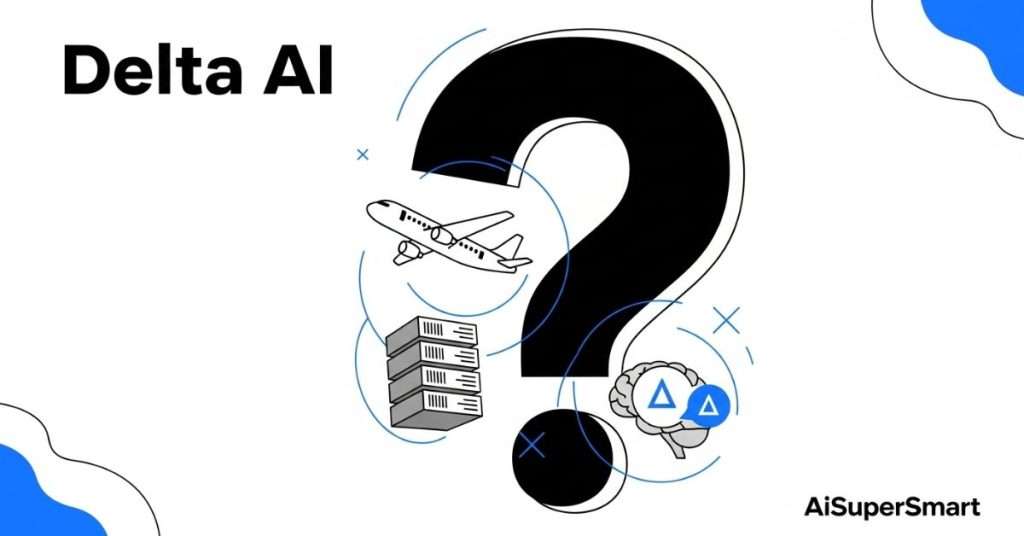
I Tried to Figure Out “Delta AI” and Found Three Different Things. Here’s What It Actually Means.
Heard the term “Delta AI” being thrown around and have no idea if people are talking about an airline, a data platform, or something else entirely? Yeah, I was in the same boat. The term is so vague it’s almost useless without context, and a quick search sends you down a dozen different rabbit holes.
After digging in, I realized the confusion is the whole point. “Delta AI” isn’t one thing. So I sorted it all out for you.
Key Takeaways :
- If you mean the airline: You’re thinking of Delta Air Lines’ AI, which powers their customer service chatbot and helps manage flight operations.
- If you’re in tech/data: You most likely mean Databricks Delta Lake, a technology for organizing massive, messy datasets so you can reliably train AI models on them.
- The Core Concept: In tech, “delta” simply means “change” or “increment.” The common thread here is technology that tracks and manages changes, either in data or in AI models themselves.
First, Let’s Acknowledge the Mess
When I first searched for “Delta AI,” my screen looked like a mess. I saw press releases from the airline, super technical documentation from a company called Databricks, and a handful of smaller startups. There was no single, clear answer.
This is the core problem: People use the same term to describe completely different things in different industries.

Let’s break down the three most common meanings, from the one you’ve probably interacted with to the one that’s shaping the future of AI development.
Possibility #1: You’re Talking About Delta Air Lines’ AI
This is the most public-facing “Delta AI.” If you’ve ever tried to change a flight using the chat function on Delta’s website or app, you’ve used it.
Delta has been investing heavily in AI to improve its customer experience. Their main tool is a sophisticated chatbot designed to handle common requests like flight changes, baggage questions, and seat selections without you having to wait on hold for a human agent.
I decided to test it out by asking a simple question about baggage allowances for a flight to London.

My take: It works pretty well for standard questions. The AI is clearly trained on their own knowledge base and can pull up your flight info if you’re logged in. It’s part of a larger trend where big companies are using AI to free up human agents for more complex problems. Behind the scenes, they also use AI for things like optimizing flight paths and predicting maintenance needs.
So, if you hear someone in a business context talking about improving customer service with AI, they might be referring to what Delta is doing.
Possibility #2: You Mean Databricks Delta Lake (The Techy Answer)
Okay, now for the one that gets the tech world excited. If your friend is a data scientist or engineer and mentions “Delta,” this is almost certainly what they’re talking about.
Databricks Delta Lake is not an AI model itself. It’s the foundation you build AI on.
To understand it, you need to know the problem it solves. Companies have a ton of data (a “data lake”), but it’s often messy, unreliable, and constantly changing. Trying to train a powerful AI model on a messy data lake is like trying to build a skyscraper on a swamp. It’s going to collapse.
Delta Lake fixes this by adding a reliability layer on top of the data lake.
My favorite analogy is to think of it like this:
- A regular data lake is like a Word document that anyone can edit, with no history. If someone deletes a paragraph, it’s just gone. Chaos.
- A Delta Lake is like a Google Doc. It tracks every single change, character by character. You can see the entire version history, restore previous versions, and see who changed what. It brings order to the chaos.
This reliability is everything for AI. It ensures that the data used for training is consistent and auditable. Databricks calls this the “Lakehouse” architecture, and you can see how they visualize the “delta” (change) records as a core part of the system.

This concept of managing incremental data changes is so fundamental that the open-source Delta Lake project is now managed by the Linux Foundation, making it a standard for the whole industry.
Possibility #3: The General Concept of “Delta” Tuning in AI
This one is a bit more advanced, but it connects to the same core idea. When you hear about giant AI models like GPT-4, you might wonder how they get updated. Retraining a massive model from scratch costs millions of dollars and takes weeks.
A more efficient method is called “delta tuning” or parameter-efficient fine-tuning (PEFT).

Instead of retraining the entire model, developers only train a small set of “delta” parameters. Think of it like adding a small sticky note with new information to a giant encyclopedia instead of reprinting the whole thing. You freeze the massive original model and just train a tiny, new “delta” layer on top of it.
This is a huge deal because it makes fine-tuning large models cheaper, faster, and more accessible. The “delta” here, once again, refers to a small, tracked change applied to a much larger system.
So, What’s the Bottom Line?
While “Delta AI” can mean a few things, the underlying theme is control and reliability.
- For Delta Air Lines, it’s about controlling the customer experience with a reliable AI chatbot.
- For Databricks, it’s about creating a reliable data foundation by tracking every single “delta” or change.
- For AI researchers, it’s about efficiently updating models by applying small, controlled “delta” changes.
Next time you hear someone say “Delta AI,” you can confidently ask, “Do you mean the airline, the data lake, or the tuning method?” You’ll not only sound like you know what you’re talking about—you actually will. 🙂
What other confusing AI terms have you run into? Drop them in the comments below, and maybe I’ll tackle them next.


 Login with Google